DTC Sites vs Marketplaces in Agentic Commerce
Agentic commerce gives marketplaces new distribution power, but DTC sites remain the place where brands control product facts, trust, customer data, and measurement.
Read more
DTC store changes need product context, preview, validation, approval, and read-back before execution.
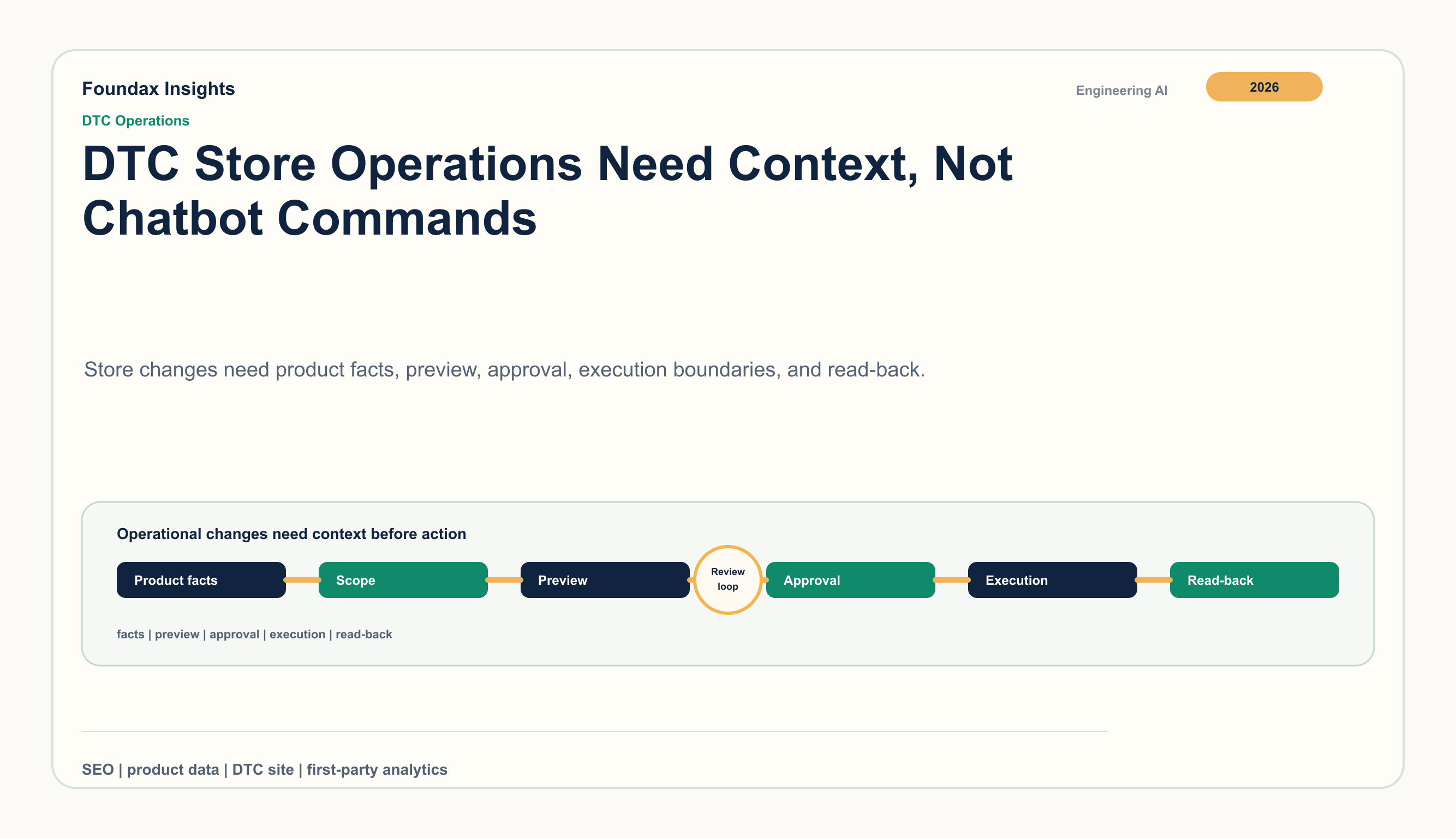
DTC teams do not need another chat box that can trigger isolated admin actions. They need a safer way to change the store while keeping product facts, SEO, content, Merchant Center data, localization, policies, and analytics aligned.
That distinction matters as commerce platforms add more assistant-like features. A model can draft a product description, summarize a report, or suggest a content update. But store operations are not just text generation. A small change to a PDP can touch variant availability, price, image order, SEO metadata, Product JSON-LD, feed eligibility, localized copy, shipping language, return promises, and measurement. If the system cannot see those relationships, it may move fast while leaving the team with more cleanup.
Most ecommerce work looks simple from the outside. Rename a product. Improve a landing page. Add a buying guide. Prepare a collection for Google Shopping. Localize a page for a new market. Review products that are underperforming.
Inside the business, each request crosses several records and several owners. A product title may also affect search snippets, feed titles, internal links, support answers, and campaign naming. A localization change may require policy facts, currency context, delivery expectations, and market-specific search intent. A feed fix may require the public PDP and the submitted Merchant Center data to say the same thing.
This is why a useful commerce assistant cannot behave like a loose command line. It has to understand current state before suggesting a change. It has to show what will change before applying it. It has to keep execution behind product, content, SEO, commerce, and analytics rules that the platform can validate.
Tool calling is useful for narrow, predictable actions. Read an order status. Create a draft. Pull a report. Submit a single approved field. Those tasks have clear inputs and clear outputs.
DTC operations are messier. A founder might ask why a hero product is getting impressions but weak conversion. The answer may involve metadata, page speed, product images, price positioning, return language, product attributes, structured data, content links, traffic source, device mix, and market context. A tool list can fetch pieces of that picture, but it does not automatically decide which facts matter, which surface owns the fix, or which risks should be reviewed before execution.
The danger is not that the model lacks confidence. The danger is that confidence arrives before enough context. Teams need the system to slow down at the right places: gather facts, narrow scope, show evidence, preview the update, confirm intent, execute through the right owner, and read back the live state.
For DTC teams, the better pattern starts with context rather than commands.
First, the system needs the right business objects: products, variants, images, pages, SEO articles, Merchant Center settings, content drafts, shipping rules, payment and refund policies, promotions, order summaries, SKU performance, and analytics events.
Second, those objects need scope. Which merchant, locale, page, product, collection, and channel are involved? Is the content still a draft, already published, or waiting for review? Are we touching a public page, a feed field, an internal note, or an analytics label?
Third, proposed changes need reviewable shape. A team should be able to see the old value, the new value, the reason for the change, the affected surfaces, and the expected read-back before anything goes live.
Fourth, execution should belong to the platform services that already own the business rules. The model can help investigate and draft. The system should decide which fields are writable, which checks are required, and which owner service can safely apply the change.
Foundax is designed around this operating view. The product direction is not a generic chatbot placed on top of an admin panel. It is a connected layer for DTC store operations: product records, site publishing, Content Studio, SEO, Product JSON-LD, Merchant Center preparation, Search Console, localization, first-party analytics, and GA4 diagnostics should work from the same facts.
Current public-facing capabilities already support that foundation: site SEO settings, sitemap and robots output, Search Console verification and sitemap submission, server-side Product JSON-LD on PDPs, strict Merchant Center preflight and sync, Content Studio with draft and published states, multilingual content operations, first-party analytics, and GA4 as supplemental diagnostics.
The important product principle is separation of responsibilities. Content can be drafted before it is public. Product data can be checked before it is sent to Google. SEO pages can be indexed from published state rather than from a private workbench. Analytics can help diagnose what to improve next without becoming the only source of truth.
A DTC team should feel the difference in ordinary operating loops.
When improving a PDP, the team should not only rewrite copy. It should review product attributes, media, price, availability, structured data, feed fields, internal links, and the questions buyers need answered before purchase.
When preparing for AI-assisted discovery or shopping surfaces, the team should not chase every new interface. It should make the product facts clean enough for search, shopping, comparison, and content systems to read.
When localizing a page, the team should not translate paragraphs alone. It should review market facts: delivery, returns, currency, sizing, materials, policy language, support promises, and local search intent.
When measuring performance, the team should not depend only on ad dashboards. It should connect Search Console, Merchant Center, page analytics, product behavior, locale, source, device, and conversion steps.
The common thread is not automation for its own sake. It is fewer disconnected places to maintain the same commercial truth.
Before adopting any AI-assisted commerce feature, ask these questions.
| Question | Why it matters |
|---|---|
| What current data can the system read? | Suggestions are only useful if they start from the real store state |
| What business object is being changed? | A product field, page block, SEO field, policy, feed value, and analytics label have different owners |
| Can the team preview the diff? | Review prevents silent drift across public pages and channel data |
| What checks run before execution? | Validation should catch missing fields, wrong scope, policy conflicts, and unsupported writes |
| Who confirms the action? | Commercial changes need accountable approval |
| What proves success afterward? | Read-back should inspect real state, not just produce a completion sentence |
This checklist is more important than whether a vendor calls the feature a copilot, assistant, automation layer, or commerce intelligence product. The name matters less than the operating contract.
Because store changes often affect product data, SEO, Merchant Center, content, localization, policies, and analytics at the same time. A command can be fast, but the business still needs scope, preview, validation, confirmation, and read-back.
Yes, when those tools reduce operational work without hiding risk. The strongest use cases are research, drafting, diagnostics, structured review, and assisted execution through approved platform services.
Check the affected product records, public page, metadata, canonical path, Product JSON-LD, Merchant Center fields, localized copy, policy language, internal links, and analytics labels.
Foundax focuses on the operating layer around the DTC brand site. It connects product data, SEO, content publishing, Google channel preparation, localization, and measurement so teams maintain fewer duplicated facts.
Start with reliable product facts: titles, variants, identifiers, images, prices, availability, attributes, policy language, structured data, feed data, and content that explains buyer questions.