SEO & GEO#AI shopping#DTC founders#product data#structured data#Merchant Center
AI Shopping FAQ for DTC Founders: What to Do Before the Channel Fully Matures
Straight answers for DTC founders on AI shopping, product data, structured pages, Merchant Center, content, localization, measurement, and practical next steps.
AI Shopping FAQ for DTC Founders: What to Do Before the Channel Fully Matures
DTC founders are hearing the same signals from several directions: AI shopping results, agentic commerce, product-data completeness, Merchant Center insights, assistant-like discovery, and new commerce protocols. The practical question is not whether every brand should rebuild its stack this quarter. The practical question is what a DTC team can improve now so the brand is easier for search, shopping surfaces, and buyers to understand.
This FAQ answers that question from an operating point of view. The near-term work is not chasing every new interface. It is cleaning up product facts, public pages, structured data, feeds, localization, content, policies, and measurement. Those foundations already matter for SEO and Google Shopping. AI-mediated discovery makes them more visible.
What does AI shopping mean for a DTC brand?
AI shopping describes buying journeys where a system helps the shopper search, compare, narrow options, understand attributes, or move toward purchase. Google, Shopify, OpenAI, and AWS have all published materials that point in this direction, though each platform uses its own vocabulary and rollout path.
For a founder, the important shift is that product discovery becomes more dependent on machine-readable facts. A buyer may ask for a product by use case, material, fit, compatibility, budget, delivery need, or policy concern. The brand's public site, product data, structured markup, feed fields, reviews, policies, and content all become part of the evidence external systems can use.
Is this mature enough to prioritize now?
It is mature enough to prepare for, but not mature enough to make panic-driven platform decisions. Google has announced tools for an agentic shopping era. Shopify has described product discovery and transaction workflows for AI-mediated commerce. Google Merchant Center has introduced AI-shopping performance insight concepts in selected markets. AWS has packaged assistant-like shopping technology for retailers.
Those signals matter, but the practical work is still foundational. A DTC team should not stop improving SEO, content, product pages, feed quality, or analytics because a new interface is emerging. Those are the same inputs AI shopping systems need.
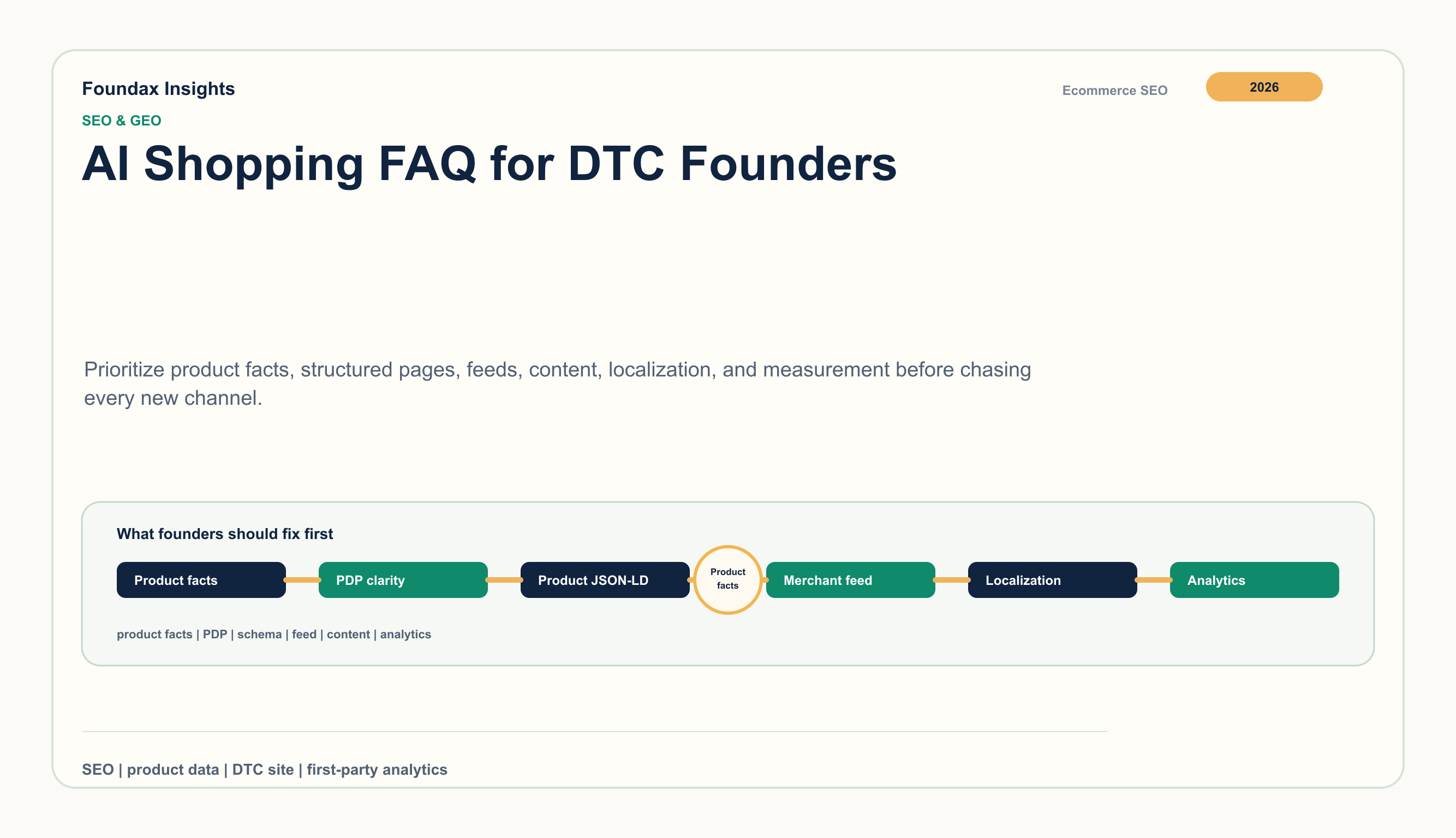
What should founders fix first?
Start with priority SKUs, not a broad technology roadmap. Pick the products that drive revenue, margin, or strategic positioning, then check whether each product has consistent facts across every surface.
This is not glamorous work, but it is the work that makes the brand understandable.
Do product feeds matter more than webpages?
They matter together. A feed can carry product attributes, but the landing page still needs to support the same claims. A PDP can explain the product beautifully, but a weak feed can make the product harder to classify or compare. Product structured data can help search engines understand page facts, but it should not contradict the buyer-visible page.
The strongest operating model treats product record, PDP, Product JSON-LD, Merchant Center fields, content links, and analytics labels as connected views of the same product. When they drift apart, every discovery surface gets weaker inputs.
What role does content play?
Content helps explain the questions product fields cannot fully answer. A shopper may ask which material is better for travel, which size fits a narrow space, which product works with an existing setup, or which return policy applies to a gift purchase. Product attributes are necessary, but buying decisions often need context.
For DTC brands, content should not be a detached blog. Buying guides, comparison pages, FAQ pages, policy explainers, and localized guides should connect back to live products and current policies. The goal is to help buyers and external discovery systems understand how product facts map to real use cases.
How should a founder think about localization?
Localization is not a translation queue. It is market-specific product truth. The same product may need different delivery wording, return context, currency expectations, size language, regulatory hints, support hours, and search phrasing across markets.
A localized page that only translates the English page can still be operationally wrong. For AI shopping and ordinary search alike, each locale should carry a coherent market promise.
What should be measured?
Founders should measure whether discovery work connects to buyer behavior. Useful signals include landing page, source, content interaction, product view, add-to-cart, checkout step, purchase, refund, return, locale, device, and product family. Google Merchant Center's AI-shopping insight concepts also point toward product terms, attributes, funnel performance, and attribute completeness as useful diagnostic areas.
The goal is not to collect every possible metric. The goal is to know which product facts, pages, and markets need improvement.
Where Foundax fits
Foundax helps DTC teams manage the operating layer behind AI shopping visibility: product records, published pages, site SEO settings, sitemap and robots output, server-side PDP Product JSON-LD, strict Merchant Center preflight and sync, Search Console verification and sitemap submission, Content Studio with draft/published separation, multilingual content operations, first-party analytics, and GA4 as supplemental diagnostics.
That means the work does not have to be split across a page builder, a feed tool, a content tool, a localization spreadsheet, and a reporting patchwork before the team can see whether product facts are aligned.
FAQ
Does every DTC brand need an AI shopping strategy now?
Every DTC brand should prepare the foundations: product facts, public pages, structured data, feeds, content, localization, policies, and measurement. The exact channel strategy depends on market, category, platform mix, and product maturity.
What is the first practical step?
Audit the top revenue or margin-driving SKUs. Check whether the PDP, Product JSON-LD, Merchant Center fields, content links, localized pages, and analytics labels describe the same product.
Is structured data enough?
No. Structured data helps search systems understand page facts, but it should match visible PDP content, feed data, policy context, and product records.
Should founders focus on Google, Shopify, OpenAI, or Amazon first?
Start with the channels that already influence your category and traffic. The shared foundation is product-data quality, page clarity, content depth, localization, and measurement.
How does Foundax help?
Foundax connects product records, SEO settings, sitemap/robots, PDP Product JSON-LD, Merchant Center preflight, Search Console, Content Studio, multilingual publishing, and first-party analytics in one operating path.