DTC Sites vs Marketplaces in Agentic Commerce
Agentic commerce gives marketplaces new distribution power, but DTC sites remain the place where brands control product facts, trust, customer data, and measurement.
Read more
A problem-led pillar guide for DTC teams using AI in ecommerce operations without losing control of product facts, content, localization, channel data, policies, and measurement.
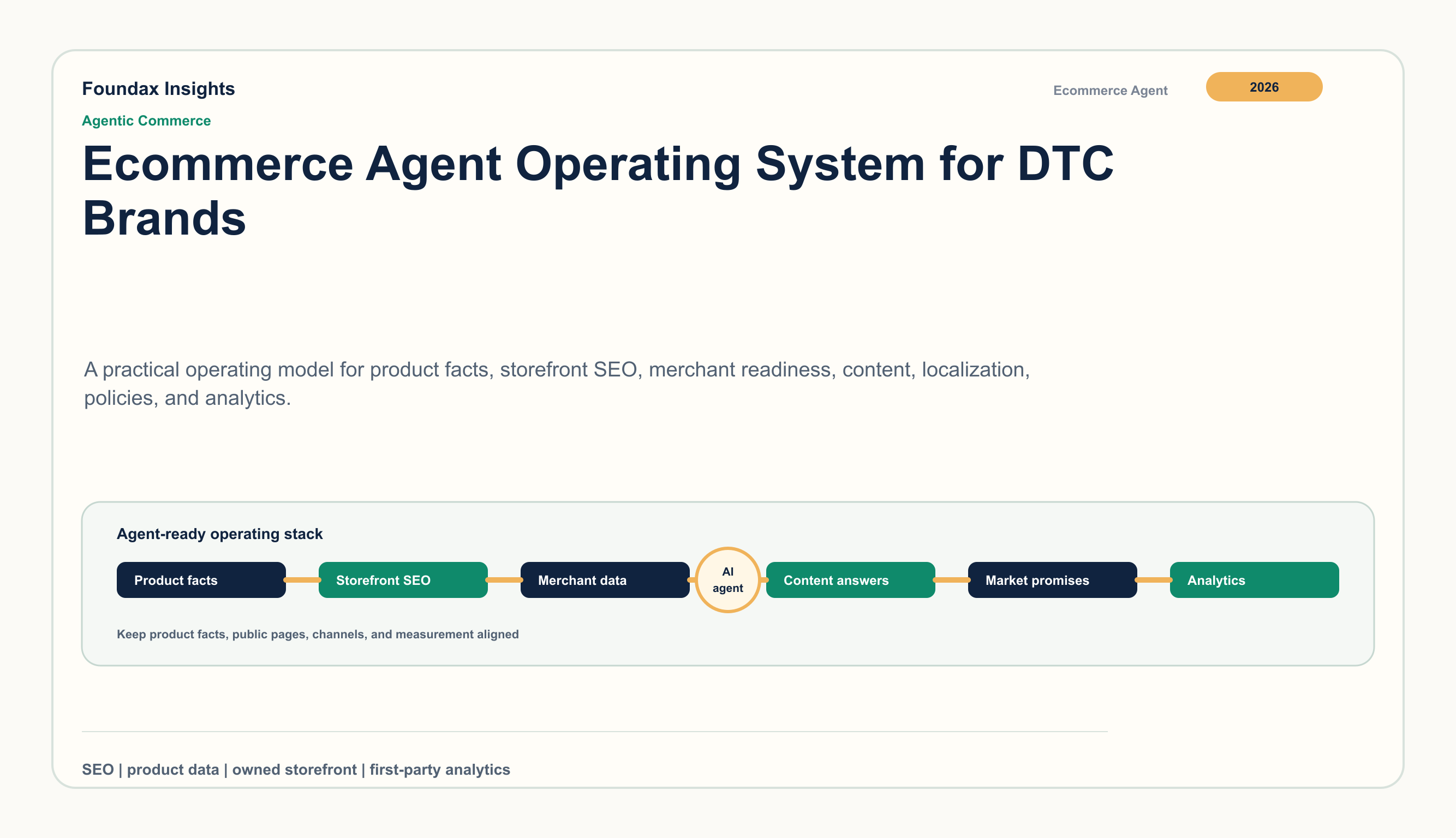
AI-mediated shopping changes the job of an ecommerce team. A product page still has to persuade a human buyer, but it also has to supply clean facts to search systems, merchant feeds, AI shopping surfaces, and analytics tools that decide what can be understood, compared, and measured.
For DTC brands, the practical response is an operating system: one disciplined way to maintain product facts, public pages, structured data, channel data alignment, localized content, policy promises, and measurement. The brands that treat agentic commerce as an operating rhythm will move faster than teams that chase each new protocol as a separate project.
The practical goal is to make the brand easier to understand wherever product discovery becomes more conversational, comparative, and data-driven. Teams can then adapt to new surfaces without rebuilding the same product facts from scratch.
Many merchants do not need another chatbot first. They need AI workflows that can safely use the business facts they already depend on:
This pillar treats AI as an operating layer, not a magic front end. The useful question is: which business objects are clean enough for AI to read, draft, translate, explain, or improve without creating drift?
In a traditional ecommerce journey, shoppers search, browse, compare pages, read reviews, and choose. In an AI-mediated journey, the shopper often starts with a richer request: a use case, a constraint, a budget, a destination country, or a comparison question. The AI layer then needs reliable product and merchant facts before it can produce a useful answer.
The 2026 platform signals point in the same direction. Google introduced agentic commerce tools and the Universal Commerce Protocol. Shopify describes Catalog and UCP as infrastructure for AI agents to discover and transact with merchants. Google Merchant Center is adding AI performance insights that focus on share of voice, funnel performance, product terms, and attribute gaps. OpenAI explains that shopping results can use merchant and product metadata from merchants and third-party providers.
The immediate implication for DTC teams is concrete: product data quality, page structure, Merchant Center checks, content clarity, and measurement discipline become part of the same growth system.
AI operations discipline is less about adding a chat widget and more about reducing inconsistency. Product names, variants, images, prices, availability, return terms, shipping promises, canonical URLs, schema markup, and localized copy all need to describe the same reality.
When those inputs disagree, every downstream surface becomes harder to trust. Merchant feeds may conflict with pages. Structured data may be thinner than the visible PDP. Localized pages may translate copy while keeping US-only shipping or sizing facts. Analytics may show traffic without explaining whether the right products and pages are gaining visibility.
| Layer | Operating question | Evidence to maintain |
|---|---|---|
| Product facts | Can a system identify the exact item, variant, attributes, and offer? | Title, SKU, GTIN/MPN, brand, price, availability, images, attributes, Product JSON-LD |
| Storefront SEO | Can the public page be crawled, indexed, canonicalized, and understood? | Titles, descriptions, canonical paths, sitemap, robots, hreflang, structured data |
| Merchant data alignment | Can feed data match the public page without avoidable conflicts? | Merchant Center product data, landing-page consistency, preflight checks, sync results |
| Content answers | Can a buyer or AI assistant answer practical comparison questions? | FAQ, use cases, buying guides, comparison content, policy explanations |
| Market promises | Are shipping, tax, return, warranty, and payment facts clear by market? | Policy pages, PDP promises, localized copy, support workflows |
| Measurement | Can the team see what changed after product or page fixes? | Search Console, Merchant Center insights where available, first-party analytics, GA4 diagnostics |
| Review rhythm | Does the team revisit facts before they become stale? | Monthly top-SKU audit, feed/page diff checks, content refresh log, localization review |
A useful audit starts with the products that already matter to the business. Pick the top 20 SKUs by revenue, margin, or strategic importance, then inspect the same facts across product records, PDPs, structured data, merchant data, content, policies, and analytics.
Many teams first react to agentic commerce by imagining a shopper-facing chatbot. That may become useful in some contexts, but it does not solve the harder operating problem. A chatbot can answer only from the facts it can access, and it becomes risky when product facts, policy facts, inventory facts, and market facts are scattered across disconnected tools.
The more durable system is a fact pipeline. Product data should move from the catalog into the PDP, structured data, Merchant Center checks, internal search, content links, and analytics with minimal reinterpretation. Policy data should move from shipping, tax, returns, warranty, and payment rules into the public pages where buyers make decisions. Content should answer buyer questions with enough specificity that an assistant can distinguish one product from another. Analytics should show whether the change improved product discovery, engagement, cart behavior, or order quality.
This is why AI operations discipline belongs near operations instead of only marketing. Marketing can shape the message, but operations owns whether the message remains true after a price update, market launch, variant change, policy revision, or content refresh. A product that is accurately represented in one channel and stale in another is not prepared for AI-mediated discovery. The assistant layer exposes the inconsistency faster.
An ecommerce agent operating system needs a governance rhythm because product truth decays. Prices change, inventory changes, policy pages change, promotion rules change, tax assumptions change, shipping destinations change, and content pages age. Without a review cadence, the store can remain visually polished while the underlying facts become less useful to search systems, merchant systems, AI shopping tools, and buyers.
A lightweight governance model is enough for most teams:
The value of this rhythm is not bureaucracy. It prevents the team from treating AI visibility as a one-time optimization. The same product facts have to stay aligned through repeated business changes.
Agentic commerce makes buyer-answer content more important because comparison often starts before the buyer lands on the product page. Product pages still matter, but category guides, sizing guides, compatibility notes, care instructions, policy explainers, and comparison pages provide the context that short product fields cannot carry.
The best content answers are specific. Instead of saying that a product is suitable for travel, explain cabin-bag dimensions, material weight, weather constraints, warranty terms, compatible accessories, care steps, and return conditions. Instead of saying a supplement supports wellness, explain ingredients, usage timing, certification context, storage requirements, contraindication language that has been legally reviewed, and the product role in the buyer decision in a routine. Specific answers create better buyer confidence and cleaner retrieval material.
For DTC teams, content should be managed as product infrastructure. Every important product category deserves a small content cluster: a buying guide, a practical FAQ, one or two comparison pages, and policy context. Internal links connect that cluster back to products, and analytics shows whether the cluster creates product exploration rather than isolated reading.
Foundax is strongest when DTC teams need the operating layer between product records, public pages, content, localization, Google merchant workflows, and measurement. The platform keeps the work close to the owner of each fact instead of scattering it across isolated tools.
| Foundax workflow | Operational value |
|---|---|
| Product records and PDP output | Maintain owned product information and publish pages that can include server-rendered Product JSON-LD. |
| Site SEO workspace | Manage page SEO fields, sitemap and robots output, Search Console verification, and sitemap submission from one workflow. |
| GMC preflight | Use structured preflight checks and sync paths so teams see blocking issues before sending product data to Merchant Center. |
| Content Studio | Publish buyer education, FAQ, comparison, and market preparation content as DTC website assets. |
| Localization | Operate multilingual content and product-facing copy with review status instead of treating translation as a one-time export. |
| Analytics | Use first-party analytics with GA4 as supplemental diagnosis to understand page, source, and conversion behavior. |
| Window | Work to complete |
|---|---|
| Week 1 | Audit top products and clean the facts that drive product understanding: identifiers, attributes, variants, images, price, availability, and policy facts. |
| Week 2 | Repair public-page signals: titles, descriptions, canonical paths, sitemap coverage, Product JSON-LD, and crawlable policy pages. |
| Week 3 | Add content answers around real buyer decisions: use cases, comparisons, sizing or compatibility questions, shipping expectations, and return concerns. |
| Week 4 | Run the measurement loop: Search Console checks, Merchant Center checks, first-party analytics review, and a written work queue for the next SKU/content batch. |
It is the repeatable workflow a DTC team uses to keep product facts, storefront SEO, merchant data, content, localization, policies, and analytics aligned as AI-mediated shopping grows.
Most teams should start by improving the facts and workflows they already control: product records, PDP structure, structured data, merchant data alignment, content answers, and measurement.
Start with the top products. Clean identifiers, attributes, variant mapping, images, price, availability, Product JSON-LD, shipping and return promises, then compare those facts with Merchant Center data.
SEO still matters, but AI operations discipline also requires machine-readable product facts, feed consistency, localized market promises, buyer-answer content, and a feedback loop for AI-influenced discovery.
Foundax gives teams a connected workflow for DTC website publishing, site SEO, Product JSON-LD, Google merchant workflows, Content Studio, localization, and first-party analytics.
Track concrete inputs first: attribute completeness, crawlable pages, sitemap coverage, merchant preflight status, content coverage, localized page quality, and source-level analytics changes.