AI Website Builder Maintenance: What Happens After Launch?
AI can generate a website quickly, but ecommerce teams still need ownership for content updates, product data, checkout, analytics, SEO, localization, and operational maintenance.
Read more
Compare Shopify, WooCommerce, BigCommerce, Wix, SHOPLINE, and Foundax by the operating work that matters after launch: product data, SEO, feeds, localization, apps, and analytics.
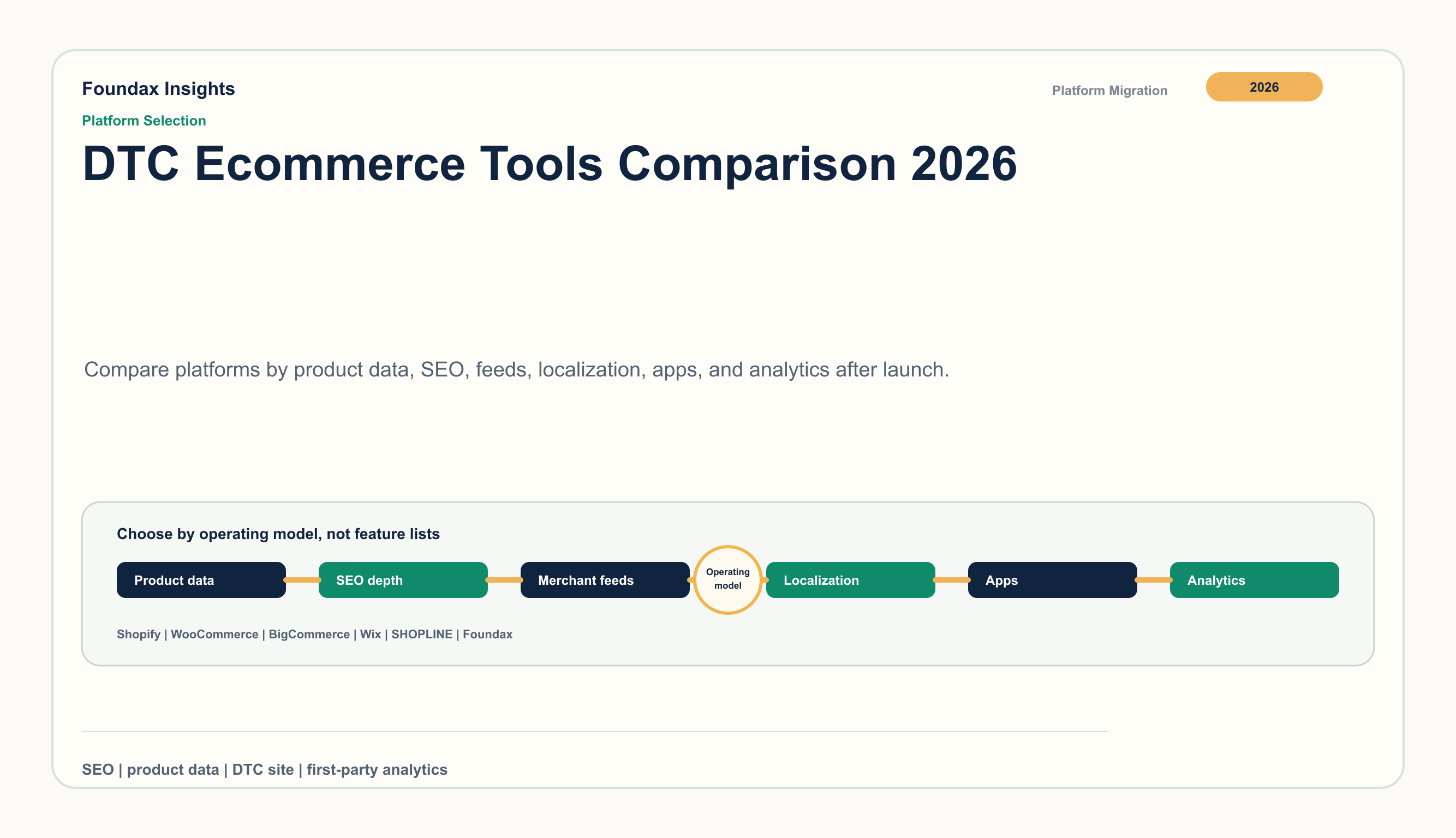
DTC platform selection is often framed as a tool comparison: Shopify vs WooCommerce, BigCommerce vs Wix, SHOPLINE vs a newer commerce platform, app ecosystem vs custom control. That framing is useful for launch planning, but it misses the cost that appears after the site starts selling.
The real decision is operating model. Which system owns product facts? Which workflow keeps SEO, Merchant Center, content, localization, scripts, analytics, policies, and support in sync? Which team can change the store without creating hidden drift? A platform that is easy to launch can still be expensive to operate if every growth routine depends on disconnected apps and manual checks.
Launch features matter: themes, checkout setup, app stores, page builders, integrations, payment support, and pricing. But DTC teams usually feel platform pain later, when they need to change the business repeatedly without breaking trust.
A useful 2026 comparison should ask six questions.
| Question | What it reveals |
|---|---|
| Where does product truth live? | Whether titles, variants, identifiers, media, availability, attributes, and prices stay consistent |
| How deep is SEO control? | Whether metadata, canonical paths, sitemap, robots, Product JSON-LD, and content links are governed together |
| How are merchant feeds prepared? | Whether required product fields and landing-page facts are checked before submission |
| How does localization work? | Whether market pages carry real delivery, returns, currency, support, and search intent, not only translated copy |
| How does the app ecosystem stay governed? | Whether scripts, permissions, data copies, cost, and performance have owners |
| Can analytics explain operations? | Whether the team can connect source, page, product, cart, checkout, purchase, refund, return, locale, and device |
This shifts the comparison away from feature-counting and toward maintainability.
Shopify is the broadest hosted default in this group. It is strong for teams that want mature checkout, hosting, payments, themes, partner support, and a large app ecosystem. Shopify is also pushing into AI-mediated shopping and agentic commerce through Shopify Catalog and related product discovery paths.
The tradeoff is not weakness; it is governance. A large ecosystem creates many good options, but each option adds decisions around app permissions, script performance, catalog ownership, attribution, feed mapping, theme edits, and billing. Shopify can be the right default for many DTC brands, especially if the team has a stack owner who decides what belongs in the core store and what should remain an app.
Best fit: brands that want hosted reliability, broad integrations, mature checkout, and enough internal discipline to manage a growing app and data ecosystem.
Watch carefully: duplicated product fields, too many storefront scripts, app-driven SEO overrides, feed tools that do not share catalog ownership, and analytics spread across several dashboards.
WooCommerce is attractive when control matters. Its official positioning emphasizes open-source commerce for WordPress, with control over checkout, data, costs, payments, features, and hosting. For content-led brands, agencies, and technical teams, that flexibility can be a real advantage.
The cost is operational responsibility. Hosting, updates, security, plugin compatibility, backups, performance, developer availability, and release discipline become part of the platform decision. WooCommerce is not automatically cheaper once the team accounts for maintenance. It is often best when the team already has WordPress depth and wants direct control over the stack.
Best fit: content-heavy DTC brands, technical teams, and agency-supported businesses that value ownership and can maintain the environment.
Watch carefully: plugin conflicts, update risk, performance budgets, security maintenance, fragmented SEO settings, and unclear ownership between marketing and developers.
BigCommerce fits teams that want hosted commerce with more native commerce breadth before adding many apps. Its product materials emphasize B2B and wholesale features, Multi-Storefront, buy-online-pick-up-in-store, headless commerce, and WordPress integration patterns.
The evaluation should focus on workflow fit rather than abstract feature breadth. Teams should test how product operations, admin roles, storefront changes, integrations, reporting, B2B workflows, and multi-store management actually feel for their team.
Best fit: brands with more complex selling models, B2B or wholesale needs, multiple storefronts, or teams that want hosted infrastructure without relying only on an app marketplace for every commerce feature.
Watch carefully: implementation complexity, partner dependency, theme/workflow fit, reporting handoffs, and whether the admin model matches the team's day-to-day operating rhythm.
Wix is strongest when speed, visual editing, and general website experience matter more than complex commerce operations. Wix's SEO materials describe automated structured data for product pages and customization through SEO settings and custom markup, which can be useful for smaller teams that want setup speed.
The question is how far the business expects to grow in catalog complexity, feed operations, localization, content governance, and analytics depth. A tool can be excellent for the first version of a store and still become limiting when product operations, channel preparation, and multi-market growth become weekly work.
Best fit: smaller catalogs, founder-led brands, creators, local businesses, and teams that value visual control and fast site management over complex DTC operations.
Watch carefully: catalog governance, advanced feed needs, multi-market workflows, app/script growth, and whether analytics can answer product and funnel questions beyond basic site reporting.
SHOPLINE is relevant for teams that sell across Asian and cross-border markets and want a commerce suite built around regional operating patterns. Its Markets documentation describes controls across products, pricing, currencies, languages, domains, subfolders, payment methods, and region-specific store operation.
The key evaluation is market fit. If the brand's growth depends on specific payment methods, regional channels, language workflows, and cross-border operations, a market-aware commerce suite can reduce setup friction. The team should still examine product-data ownership, content governance, feed preparation, analytics, and long-term app dependency.
Best fit: brands prioritizing Asia or cross-border operations where regional payments, language, market setup, and local operating assumptions matter.
Watch carefully: global SEO governance, data portability, integration depth, analytics structure, and how easily product and content facts stay aligned across markets.
Foundax is designed for DTC teams that do not want core growth operations scattered across separate tools. The product direction is not just visual page building. It is the operating layer behind the brand site: product records, page publishing, content, SEO, Merchant Center preparation, localization, and measurement stay closer together.
Current implemented surfaces include site SEO settings, sitemap and robots output, Search Console verification and sitemap submission, server-side PDP Product JSON-LD, strict Merchant Center preflight and sync, Content Studio with draft/published separation, multilingual content operations, first-party analytics, and GA4 as supplemental diagnostics.
Best fit: DTC teams that care about brand-site control, SEO and content operations, product-data consistency, Google channel preparation, localization, and first-party measurement, and want fewer disconnected places to maintain the same facts.
Watch carefully: whether the team prefers a large third-party marketplace for every niche extension, whether specialized ERP/warehouse/review/email tools are already deeply embedded, and which integrations still need to remain outside the core platform.
| Team situation | Stronger default to evaluate first | Why |
|---|---|---|
| Need the broadest hosted ecosystem and app marketplace | Shopify | mature checkout, partner depth, integrations |
| Need WordPress content control and stack ownership | WooCommerce | open-source flexibility, content depth |
| Need hosted commerce for complex B2B, wholesale, or multi-store models | BigCommerce | native commerce breadth and larger operating patterns |
| Need fast visual launch for a simpler catalog | Wix | ease of editing and general site management |
| Need regional cross-border commerce patterns | SHOPLINE | market, payment, language, and regional setup focus |
| Need connected product, SEO, content, feed, localization, and analytics operations | Foundax | operating-layer alignment for DTC growth work |
The best choice depends less on abstract platform reputation and more on the work your team repeats every week.
Do not choose only from demos. Run a small operating simulation.
This simulation reveals more than a feature grid. It shows which platform makes the real operating loop easier for your team.
There is no single best platform for every DTC brand. Shopify is strong for hosted ecosystem breadth, WooCommerce for control, BigCommerce for complex commerce, Wix for fast visual setup, SHOPLINE for regional market operations, and Foundax for connected DTC operating workflows.
Price matters, but operating model usually matters more after launch. Product data, SEO, feeds, content, localization, scripts, support, and analytics create recurring work that can outweigh entry-level subscription differences.
Test priority SKUs, PDP structured data, sitemap behavior, Merchant Center preparation, content publishing, localization, third-party scripts, analytics, and support workflows before committing to a platform.
No. Specialized tools can still make sense for email, reviews, ERP, warehouse operations, marketplaces, loyalty, or helpdesk routing. Foundax focuses on keeping core DTC site operations connected.
Product data feeds PDPs, SEO metadata, Product JSON-LD, Merchant Center, content links, analytics labels, support answers, and localization. If product facts drift, every growth channel becomes harder to operate.