DTC Tech Stack#DTC data stack#ecommerce data infrastructure#product data#Google Merchant Center#analytics
Best Ecommerce Data Stack for DTC Brands
A practical framework for DTC teams that need one reliable data stack for product facts, storefront SEO, Merchant Center alignment, content, localization, and first-party analytics.
The best ecommerce data stack is the one that keeps commercial facts consistent across the places where buyers, search engines, merchant feeds, operators, and AI shopping systems read them. For a DTC brand, the hard part is rarely buying one more tool. The hard part is making sure a product title, price, image, variant, availability status, shipping promise, landing page, content page, and analytics event all describe the same business reality.
That operating problem matters more in 2026 because product discovery is spreading across more surfaces. Google Merchant Center uses product data to match products to relevant queries. Google Search can read Product structured data on pages. OpenAI's shopping experience says it considers structured metadata such as price and product descriptions when surfacing products. A DTC stack that cannot keep those inputs aligned creates avoidable work for the team and avoidable ambiguity for discovery systems.
What the stack must keep aligned
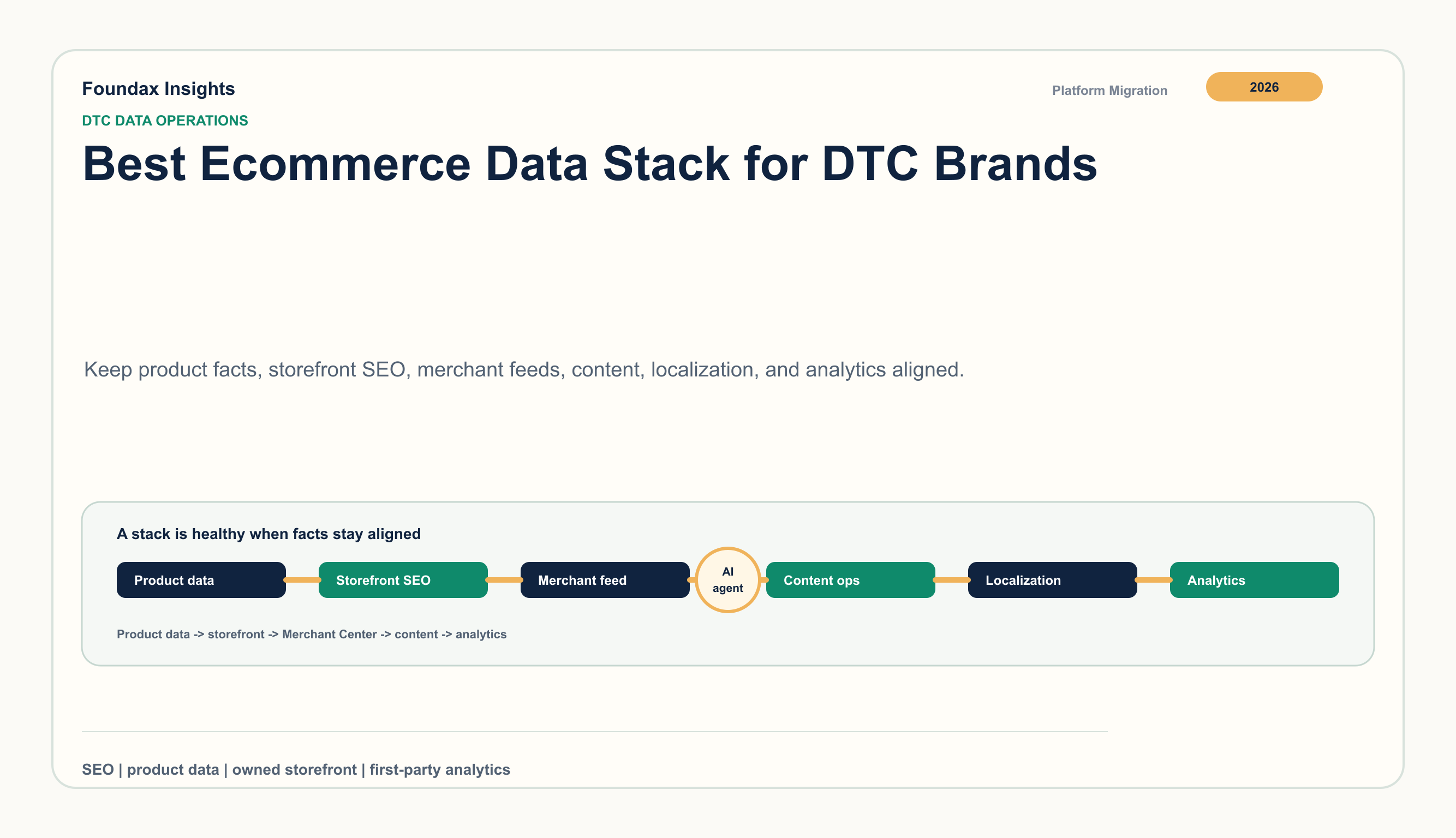
A useful DTC data stack should keep six fact groups synchronized: product facts, storefront pages, merchant feed fields, content assets, localization records, and measurement events. The brand may use several systems, but there still needs to be one operational source of truth for each fact.
The risk appears when each team edits a different copy of the same fact. Merchandising changes a variant name, marketing rewrites the PDP, an agency updates the feed, customer support edits a policy page, and analytics keeps reporting against an old product label. None of those actions is wrong in isolation. Together they create a stack where the public store, channel data, and reports slowly drift apart.
Seven layers to evaluate
The practical review starts by naming each layer and checking whether it has a clear owner, source of truth, and review cadence.
Teams often ask whether the stack should have three tools, five tools, or ten tools. A better question is how many handoffs are required before a product change is reflected everywhere that matters. A small stack with weak data ownership can still drift. A larger stack with clean contracts can work if every system knows which facts it owns and which facts it consumes.
The failure pattern is familiar. The product team updates a price in the store. A feed rule keeps sending the old price. A landing page contains a different shipping promise. Search Console and Merchant Center now see inconsistent public information. Analytics still groups the product under the old category. The brand does not have a visibility problem yet; it has a data governance problem.
Product data is the foundation
Google's product data specification emphasizes accurate and correctly formatted product information because missing or conflicting data can create disapprovals, limited eligibility, or incorrect product display. Product structured data works the same way on the page: Google can understand a purchasable product more clearly when the page carries the required product and offer information.
For a DTC team, this means product data should not be treated as back-office admin. Titles, descriptions, images, GTIN or MPN, brand, price, availability, variant attributes, shipping details, and returns context are growth inputs. If those fields are incomplete, the store may still look finished, but the discovery layer is underfed.
Merchant feeds and AI shopping need clean inputs
AI shopping visibility should be reviewed as an input-quality discipline, not as a magic channel. OpenAI's shopping documentation names structured metadata, price, and product descriptions among the signals considered by ChatGPT shopping. Google Merchant Center has been adding more reporting around AI-powered shopping experiences and product attribute gaps.
The implication is practical: keep product attributes complete, keep landing pages consistent with the feed, keep structured data aligned with visible page content, and review warnings before they become channel problems. A stack that only publishes pretty pages is incomplete. A stack that publishes pages and also maintains machine-readable product facts is much stronger.
Analytics should connect behavior to products
First-party analytics should answer operational questions, not only count traffic. Which source produced product views? Which product views led to add-to-cart? Which localized page brought engaged visitors? Which campaign drove orders but low margin? Which product category creates repeat visits but weak checkout completion?
Those answers require product identifiers, page paths, sessions, events, and order data to share a stable vocabulary. GA4 can be useful for supplemental diagnosis, but the brand still needs its own session and order truth for day-to-day decisions. Without that layer, the team sees dashboards without knowing which product facts caused the result.
A minimum viable DTC data architecture
Early-stage teams do not need a heavyweight enterprise stack. They need an architecture that prevents the most expensive forms of drift.
data changes become frequent enough to require process control
The stack can evolve, but the source-of-truth model should be designed early. Rebuilding product facts after several channels have already copied them is more expensive than assigning ownership at launch.
Where Foundax fits
Foundax approaches the ecommerce data stack as an operating workflow for DTC teams. The implemented surfaces map to the layers above: site SEO configuration, sitemap and robots routes, server-rendered Product JSON-LD on PDPs, strict Google Merchant Center preflight and sync, Content Studio publishing, multilingual content operations, first-party analytics, and GA4 as supplemental diagnostics.
That combination helps teams keep product facts, public pages, merchant feed alignment, content, localization, and measurement closer together. The value is operational clarity: a team can see what is published, what is ready for Google, what content is live, and how visitors interact with products without treating each layer as a separate island.
Evaluation checklist
Can one product attribute change flow to the PDP, structured data, feed payload, filters, and reports?
Can the team see which Merchant Center issues are blocking sync and which are optimization items?
Can every locale maintain its own product and content copy without leaking another language into the page?
Can analytics connect source, session, product engagement, cart activity, orders, and revenue definitions?
Can the team identify every third-party script on high-value pages and explain why it exists?
Can content pages support SEO, buyer education, and product discovery instead of living as isolated blog posts?
An ecommerce data stack is the operating structure that keeps product data, storefront pages, merchant feeds, content, localization, analytics, and channel integrations consistent. It can include several tools, but each important fact needs a clear source of truth.
What data matters most for DTC brands?
Product identifiers, titles, descriptions, variants, images, price, availability, shipping and returns context, page metadata, structured data, customer events, and order records matter most because they affect both buyer experience and discovery systems.
How is a data stack different from a tech stack?
A tech stack lists the tools a company uses. A data stack explains how facts move through those tools. The data stack is healthier when product facts, public pages, merchant feeds, and analytics share the same definitions.
Does AI shopping change ecommerce data requirements?
Yes. AI shopping makes structured, consistent product information more important because assistants and search experiences increasingly rely on metadata, merchant feeds, public page content, and reviews to understand products.
When should a DTC team upgrade its data stack?
Upgrade when manual reconciliation becomes routine: frequent feed fixes, inconsistent localized pages, unclear analytics definitions, duplicate product records, or product changes that require several people to update several systems.