DTC Sites vs Marketplaces in Agentic Commerce
Agentic commerce gives marketplaces new distribution power, but DTC sites remain the place where brands control product facts, trust, customer data, and measurement.
Read more
A practical operating audit for DTC teams preparing product facts, PDP SEO, Merchant Center checks, content answers, localization, policies, and measurement for AI shopping.
AI shopping visibility is no longer a side project for the SEO team. Product discovery is becoming more conversational, comparison-heavy, and dependent on machine-readable facts. Google has described commerce tools for an agentic shopping era, Shopify is organizing agentic commerce around catalog quality and product data, Merchant Center is adding AI-oriented product insights, and OpenAI shopping surfaces can use merchant and product metadata.
For DTC brands, the practical question is simple: can a buyer, a search system, a merchant feed, and an AI shopping surface all understand the same product promise without finding conflicting facts? The strongest starting point is an operating audit that connects product data, public pages, channel data alignment, content answers, local market promises, and measurement.
Agent readiness does not start with a bot. It starts with a cleaner commercial record. A DTC team needs one maintainable source for product names, identifiers, variants, prices, availability, images, attributes, policies, and market rules. Those facts then need to appear consistently in the places external systems can read: product pages, structured data, merchant feeds, localized pages, policy pages, content hubs, and analytics logs.
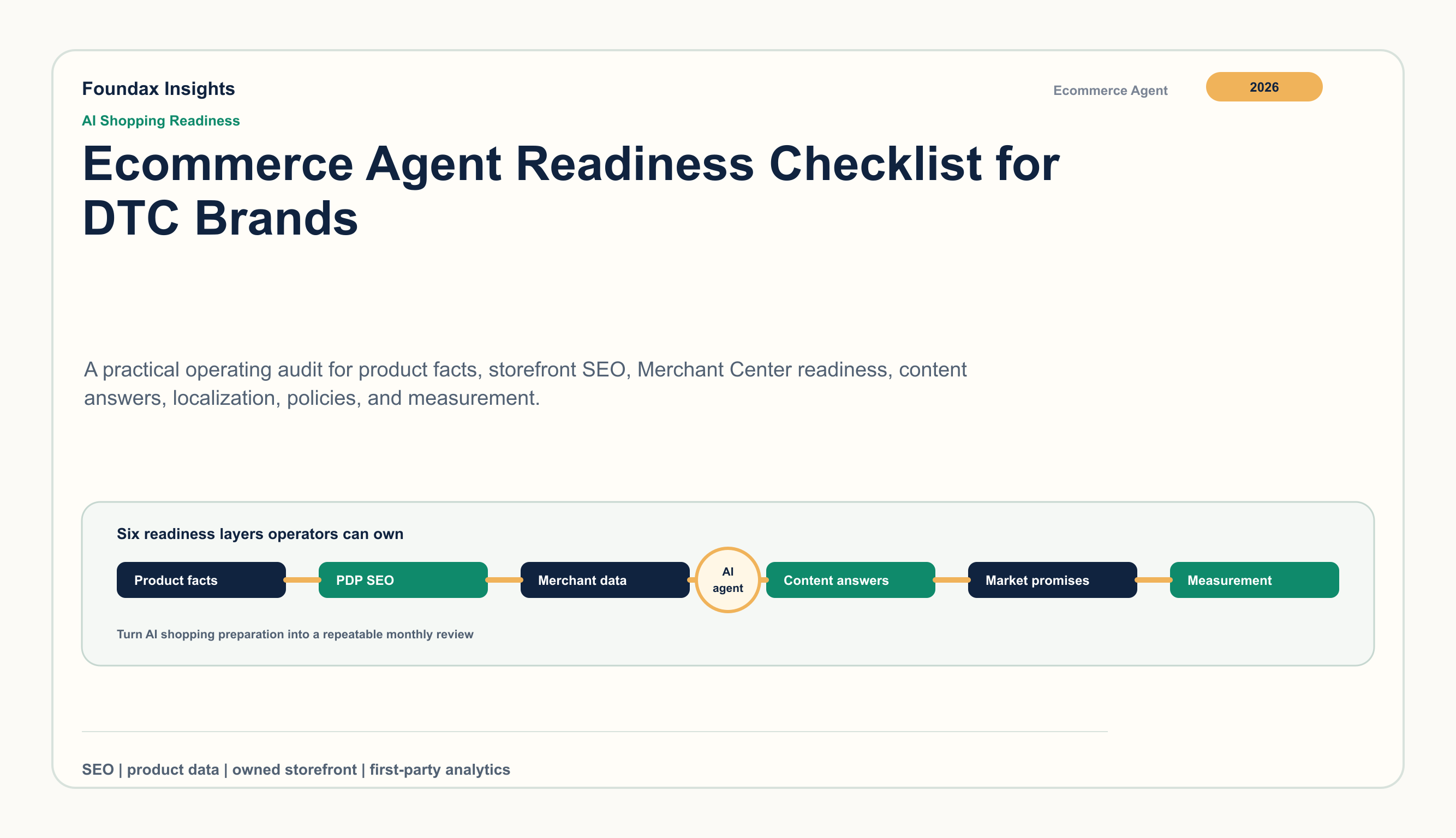
The audit below treats readiness as six operating layers. Each layer has a business owner, a public surface, and a signal that can be reviewed every month.
| Layer | What operators check | Why it matters for AI shopping |
|---|---|---|
| Product facts | Names, identifiers, variants, attributes, images, price, availability | External systems need stable facts before they can compare products accurately. |
| PDP SEO | Titles, descriptions, canonical URLs, Product JSON-LD, indexability | Search and shopping systems need a crawlable page that matches the product record. |
| Merchant data | Merchant Center attributes, feed-page consistency, landing-page requirements | Product feeds and public pages should describe the same offer. |
| Content answers | Use cases, sizing, compatibility, care, proof, FAQs | Conversational discovery needs direct answers, not only keyword blocks. |
| Market promises | Shipping, returns, tax/duty notes, language, units, support expectations | International shoppers compare local promises as much as product features. |
| Measurement | Search Console, Merchant Center insights, first-party analytics, query logs | Teams need directional evidence before they change data, pages, or content. |
Product facts are the raw material for every downstream channel. If the catalog record is vague, the product page, feed, structured data, and localized content will drift.
Use these checks first:
The business test is not whether the product record looks complete in an admin screen. The test is whether a merchandiser, content editor, feed operator, and support teammate would answer the same buyer question from the same facts.
A product detail page is both a sales page and a data surface. Google Search Central documents Product structured data for fields such as price, availability, reviews, shipping, and returns. The point is not to decorate a page with markup after the fact. The point is to make the visible page and structured data describe the same offer.
Review these checks:
This layer often exposes hidden process problems. A product team may update the admin record, a content team may update the page, and a feed team may update Merchant Center separately. Agent readiness improves when those updates move through one review path.
Merchant Center and similar shopping channels make product data quality visible. Google's product data specification emphasizes attributes such as identifiers, image links, availability, price, condition, shipping, and item group relationships. For DTC teams, the readiness question is whether feed data and landing pages tell the same story.
Operational checks:
Merchant data is where vague catalog work becomes expensive. A missing attribute may look minor inside a spreadsheet, but it can weaken product matching, filtering, comparison, or eligibility downstream.
AI-mediated shopping favors pages that answer concrete buyer questions. A PDP that only says "premium", "innovative", or "perfect for everyone" leaves comparison work to someone else. Strong content answers reduce ambiguity.
Audit each priority product for these answer types:
| Buyer question | Page asset that should answer it |
|---|---|
| Who is this product best for? | Use-case block, persona examples, product summary |
| Which variant should I choose? | Variant table, sizing guide, compatibility notes |
| What is included? | Box contents, bundle table, material/spec list |
| How does shipping work? | Delivery promise, shipping threshold, market-specific policy |
| What happens if it does not fit? | Return, warranty, exchange, support flow |
| Why should I trust it? | Reviews, certifications, test method, source-backed proof |
FAQ content belongs here when it answers real buying questions visible on the page. FAQPage markup can help structure those answers where appropriate, but the page still needs useful, accurate answers for people.
Translation alone does not make a storefront ready for international discovery. A localized page should keep the same product truth while adapting the facts a local buyer actually uses: units, sizing, shipping window, return address, tax/duty explanation, support language, and payment expectations.
Use these checks before a market launch:
The most common localization risk is false consistency. Pages look translated, but the promise is still written for the source market. Agent readiness requires local facts, not only local words.
Agent readiness cannot be proven by one prompt or one screenshot. Treat measurement as a directional review system.
Monthly review inputs should include:
The review should produce decisions, not a dashboard screenshot. Decide which product facts need cleanup, which PDPs need better answers, which feeds need QA, which market promises need correction, and which content assets deserve expansion.
Use a simple score to focus the team. Score each of the six layers from 0 to 5.
| Score | Readiness level | Operating priority |
|---|---|---|
| 0-10 | Fragmented | Repair product facts, canonical pages, sitemap coverage, and policy pages before expanding channels. |
| 11-18 | Search-ready but uneven | Improve variant data, Product JSON-LD, merchant feed consistency, and FAQ coverage. |
| 19-25 | Agent-readable foundation | Add localized market facts, tighter content answers, and monthly evidence review. |
| 26-30 | Operationally strong | Keep the cadence, monitor platform changes, and expand the framework to more products and markets. |
Start with a narrow SKU set. Ten products are enough to reveal the operating gaps.
| Week | Workstream | Output |
|---|---|---|
| Week 1 | Product truth | Priority SKU list, missing attribute log, variant/identifier cleanup plan |
| Week 2 | PDP and structured data | Title/description/H1 cleanup, Product JSON-LD review, sitemap and robots check |
| Week 3 | Merchant and content | Feed-page consistency review, buyer-question blocks, FAQ updates |
| Week 4 | Localization and measurement | Market-promise audit, analytics baseline, monthly review template |
The goal is not to finish the whole catalog in a month. The goal is to prove one repeatable path that can expand to the next SKU group.
Foundax is built around the operating path this audit requires. Product records, storefront SEO settings, published pages, core Product JSON-LD, sitemap and robots output, Search Console verification and sitemap submission, Merchant Center preflight and sync workflows, Content Studio publishing, multilingual content operations, and first-party analytics all sit in the same product environment.
That matters because readiness work fails when every team keeps a separate file. Foundax helps operators keep product facts, page metadata, channel checks, localized content, policy promises, and measurement signals closer together. The result is a monthly workflow: identify product gaps, update the source facts, publish page and content improvements, run Google workflows checks, review first-party signals, and carry unresolved issues into the next sprint.
Three patterns usually signal that the team is not ready:
Fixing those patterns creates more value than chasing every new agent protocol separately.
Run a focused review monthly for priority products, before major launches, and before entering a new market. A full-catalog review can happen quarterly once the operating path is stable.
Start with product facts and PDP SEO. Clean identifiers, variants, prices, availability, canonical URLs, titles, descriptions, and structured data create the foundation for merchant data, content, localization, and measurement.
Yes, when they answer real buyer questions. FAQ blocks are useful for sizing, compatibility, care, delivery, returns, warranty, and setup questions. They become weak when they repeat marketing claims or answer questions nobody would ask before buying.
Use them as review inputs when they are available in the account and market. Compare product-term and attribute-gap signals with feed data, PDP content, and analytics movement before changing the catalog.
Foundax keeps the operational inputs closer together: product records, SEO metadata, Product JSON-LD, sitemap and robots behavior, Search Console and Merchant Center checks, Content Studio, localization, and first-party analytics. That makes the checklist repeatable instead of becoming another spreadsheet.