Why Marketplace Sellers Need a DTC Site in 2026
Marketplace sellers need a DTC site to build brand search, product depth, first-party customer data, SEO content, and margin visibility while still using platforms for reach.
Read more
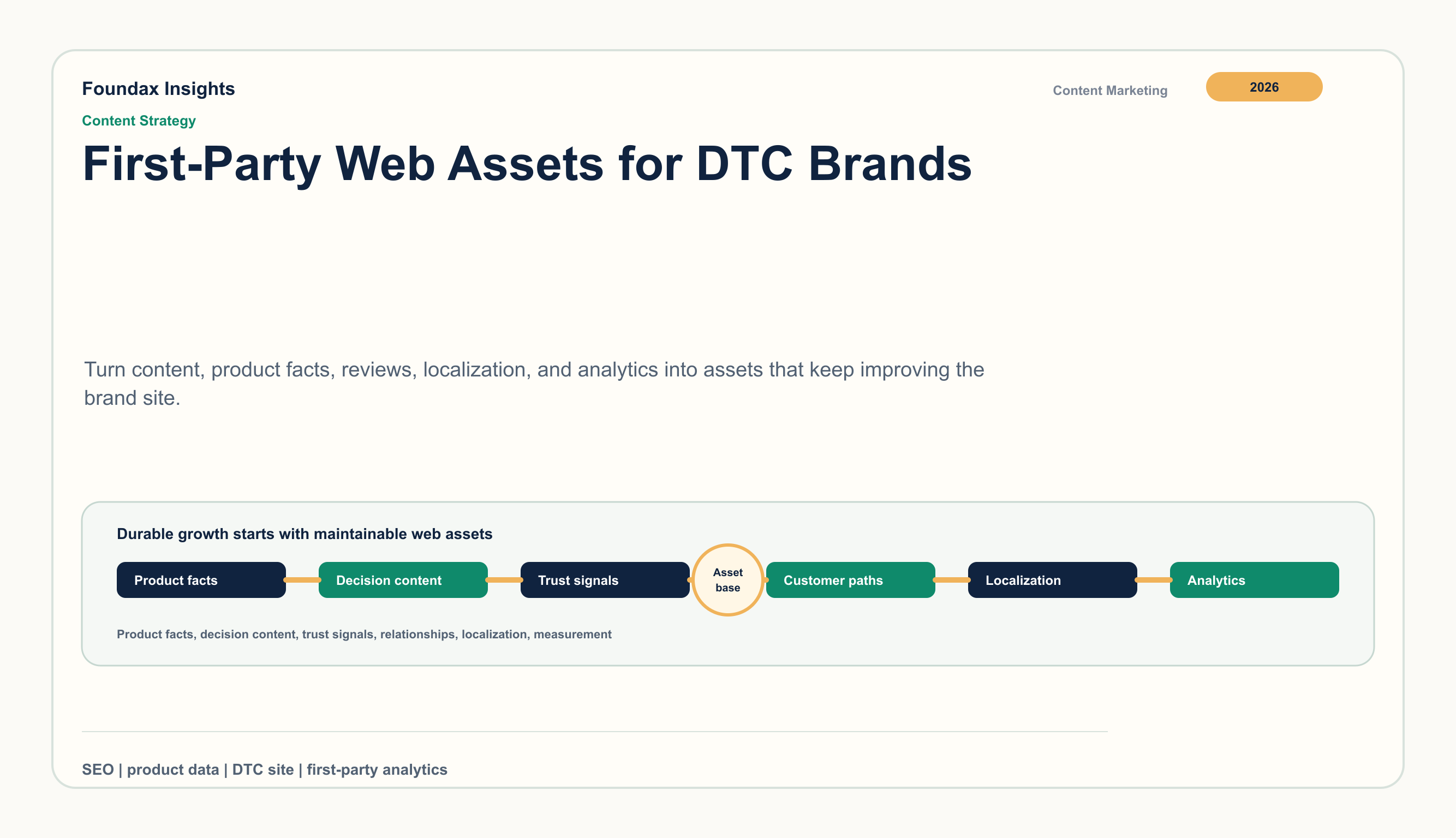
DTC growth does not compound from traffic alone. It compounds when content, product data, reviews, email capture, localization, and analytics become durable first-party assets on the brand site.
A DTC brand does not build durable growth just by buying more traffic.
Traffic can be useful. Marketplace demand, paid search, creator posts, affiliate links, and social ads can all create sales. But when the campaign ends, the platform ranking changes, the creator stops posting, or the ad budget pauses, much of that visibility disappears. What remains is the part of the business the brand has turned into a first-party asset: pages that search can understand, product facts that channels can reuse, reviews that explain real buyer language, content that answers decisions, email and SMS relationships, local market pages, and analytics that show what people did after they arrived.
That is the difference between a channel expense and a web asset.
A channel expense helps the brand get attention for a moment. A first-party web asset improves the brand's ability to be discovered, understood, trusted, measured, and remembered over time.
A page is a URL. An asset is a business capability that happens to live on the web.
A product page becomes an asset when it contains accurate product facts, useful buying context, structured data, review language, policy clarity, internal links, and measurement. A buying guide becomes an asset when it answers a recurring purchase question, links to relevant products, attracts search demand, and can be refreshed as the category changes. A review collection becomes an asset when it teaches the team what buyers care about, not just when it adds stars to a product card.
The difference is intent.
A weak page is published once and forgotten. A real asset has an owner, a role in the customer journey, a data source, a refresh rhythm, and a metric that tells the team whether it is still useful.
For DTC brands, the most valuable web assets usually sit in six categories:
The brand site is where these assets can connect. A marketplace listing may sell a product. A brand site can explain the product, collect the signal, update the data, and improve the next page.
Search engines and shopping systems do not only need slogans. They need clear, consistent facts.
Google's product structured data and merchant listing documentation describe how product pages can expose price, availability, shipping, return, review, and product details. Merchant Center's product data specification is even more explicit: product information needs to be accurate, complete, and formatted correctly so Google can understand what is being sold. Google's guidance on helpful content keeps returning to the same idea from a content angle: pages should be useful for people, not just built to attract clicks.
AI shopping raises the standard because comparison can happen before the shopper reaches the site. OpenAI's shopping documentation describes using product information, merchant data, structured metadata, and publicly available sources when presenting shopping options. Google has also published guidance on how AI features relate to websites and search visibility.
The practical implication is simple: the brand's public web presence has to describe the product clearly enough for both buyers and systems.
If a product page says one thing, Merchant Center says another, a marketplace listing says a third, and the buying guide has outdated policy language, the brand has not built an asset. It has scattered product claims across surfaces.
Most DTC content problems start as product-data problems.
A buying guide cannot recommend the right product if material, fit, dimensions, compatibility, variants, and care instructions are incomplete. A Merchant Center feed cannot stay clean if price, availability, image links, identifiers, and variant URLs drift from the public page. A local market page cannot feel local if it still uses the wrong units, size system, shipping expectations, or policy language.
A product-fact base is not just a catalog export. It is the operating record for what the brand sells.
For each important SKU, define:
Once this base exists, every content page can become more specific. Without it, the team keeps writing vague copy because the facts are not easy to trust.
A content calendar should not start with empty publishing dates. It should start with purchase decisions.
A mattress brand needs pages about firmness, sleeping position, room size, trial periods, returns, and delivery. A luggage brand needs pages about cabin size, rail travel, wheel durability, airline limits, materials, and repair. A skincare brand needs pages about ingredients, routines, skin concerns, sensitivity, seasonality, and claim language. These are not generic blog ideas. They are decision assets.
A good decision page does four jobs:
That is why thin SEO content does not work well for DTC brands. It may target a keyword, but it does not improve the buying decision. A first-party asset has to help the shopper decide what to buy, whether to buy now, and why the brand's product fits the use case.
Reviews are not only conversion widgets. They are customer research.
The words buyers use in reviews often reveal what product teams and marketers miss: fit problems, installation confusion, unexpected use cases, delivery anxiety, quality signals, gifting motivations, durability concerns, and comparison language. Review and Q&A content can improve PDP copy, buying guides, support pages, ad messaging, and product development.
But this only works if reviews are treated as a structured asset:
The goal is not to make every page louder with testimonials. The goal is to let real buyer language improve the brand's public web presence.
A DTC brand's web assets should not stop at acquisition.
The first purchase is often the most expensive conversion. After that, the brand needs post-purchase education, care reminders, replenishment logic, cross-sell paths, warranty or service instructions, and product-specific follow-up. Email and SMS capture are useful because they let the brand connect the purchase to a longer relationship.
The asset is not the email list by itself. The asset is the relationship map:
When this is handled carefully, content, product data, and customer communication reinforce each other. The guide that helped a buyer choose a product can become the post-purchase guide that helps them use it well.
Translation is not enough for international growth.
A local market page should carry local facts: currency, sizing, units, delivery expectations, return language, payment assumptions, seasonal context, policy details, and examples that match the market. Google's hreflang guidance helps search engines understand localized page relationships, but the local page still needs to be useful on its own.
For a DTC brand, local pages become assets when they answer market-specific purchase decisions. A winter apparel page for Germany, a skincare routine page for Hong Kong, and a travel-bag page for Japan should not read like the same English page with different words. They should make different examples, assumptions, and policy details visible.
This is especially important when product data and content need to agree. Local PDPs, local buying guides, structured data, Merchant Center fields, and policy pages should tell the same story.
An asset that cannot be measured is hard to improve.
DTC teams need to understand how people move from source to content, from content to product, from product to cart, and from order to repeat purchase. This does not require turning every page into a performance dashboard, but it does require a stable measurement model.
At minimum, track:
The point is to make the web asset easier to maintain. If a buying guide attracts search traffic but never sends qualified users to product pages, it needs a better role. If a product page converts but generates support tickets, it needs clearer facts. If a local page gets impressions but no engagement, it may be translated instead of localized.
DTC teams usually fail when they try to build every asset type at once. A better sequence is narrow and commercially grounded.
Days 1-15: choose one revenue category. Pick a category with search demand, product complexity, margin importance, or strategic value. Do not start with the entire catalog.
Days 16-30: clean the product-fact base. Fix the top products in that category: titles, attributes, size, fit, materials, images, price, availability, shipping, returns, and structured data inputs.
Days 31-45: create two decision pages. Write one buying guide and one comparison or use-case page. Link them to the relevant PDPs. Use actual product facts, not generic category advice.
Days 46-60: improve trust assets. Add review themes, Q&A, policy explanations, warranty language, delivery details, and support links where the buyer hesitates.
Days 61-75: connect relationship paths. Add email capture or post-purchase education that matches the product decision. Use the same content after purchase when it helps the buyer succeed with the product.
Days 76-90: review the measurement loop. Look at Search Console, first-party analytics, content-to-product paths, product engagement, refund/support signals, and data-quality issues. Decide what to refresh before adding the next category.
This sequence is deliberately small. A useful asset in one revenue category is better than twenty generic pages across the whole site.
Foundax is useful when a DTC team wants these assets to live close to the actual business objects: products, pages, content, SEO, localization, Google channel operations, and analytics.
The relevant Foundax capabilities are concrete:
The role of Foundax is not to replace channel strategy. It is to keep the assets that channel strategy depends on from being scattered across disconnected tools.
It is a page, dataset, content library, review collection, customer relationship path, localization layer, or measurement model that the brand can maintain directly and reuse across growth channels. A product page, buying guide, review corpus, size guide, local market page, or first-party analytics model can all become assets when they are structured and maintained.
No. A blog becomes an asset only when it answers real purchase decisions, links to relevant products, stays current, and produces useful measurement. A generic article library can create maintenance burden without improving the customer journey.
Start with one revenue category and the product facts behind it. Then build decision pages, trust content, email or post-purchase paths, and measurement around that category. Expand only after the first category has a repeatable pattern.
Yes. Marketplaces can still create demand, validation, and distribution. The point is to avoid making them the only place where product facts, reviews, buyer education, and customer learning accumulate.
AI shopping increases the value of clear, consistent, public product facts. Product pages, structured data, feeds, reviews, policies, and content should reinforce each other so shoppers and systems can understand the product before and after a click.