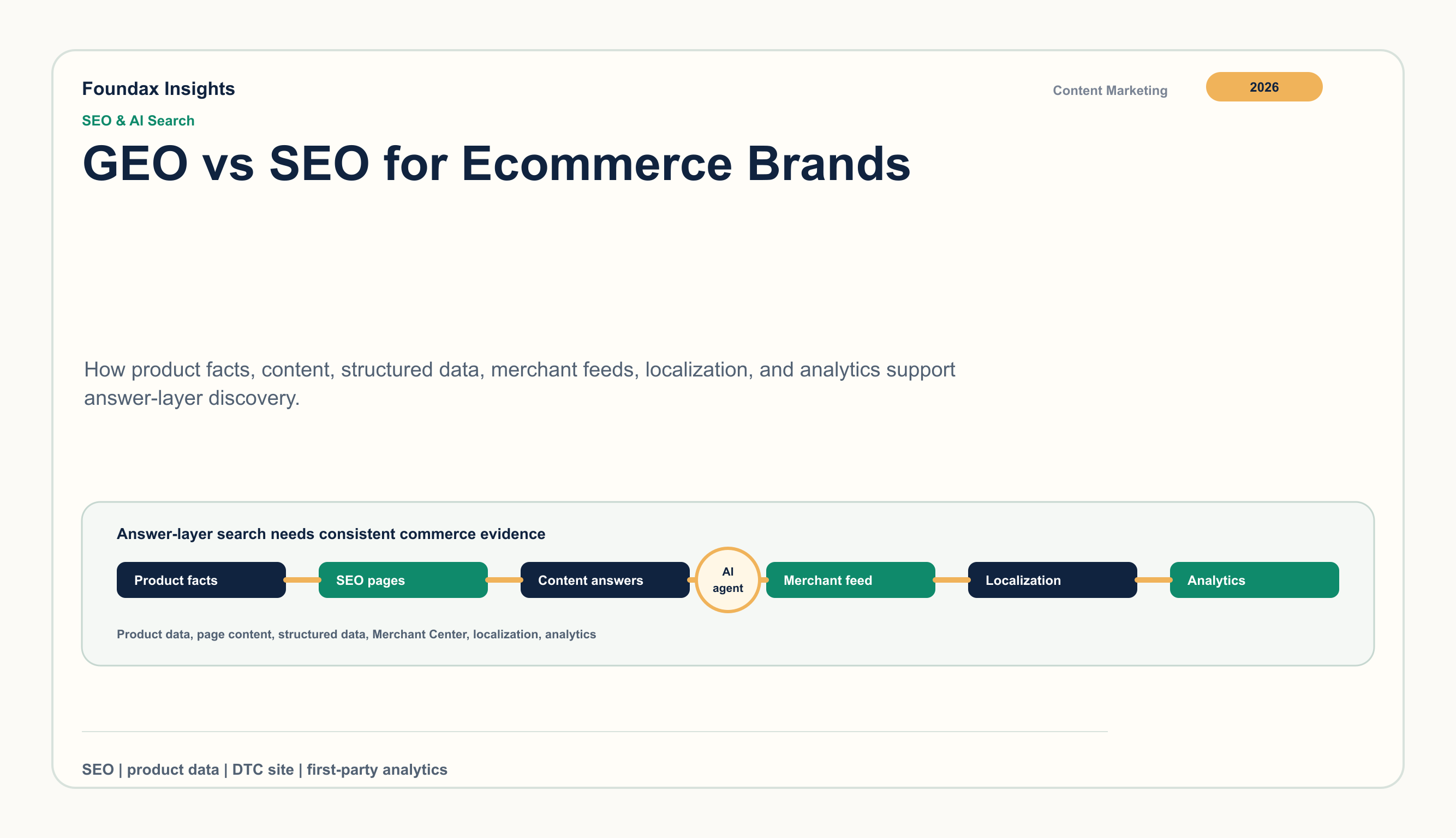
A shopper no longer has to search for one neat keyword like "carry-on luggage" and click through ten blue links. They can ask for "a lightweight carry-on for a two-week Japan trip, under $200, that fits overhead bins and will not look too corporate." The answer layer can break that sentence into constraints, compare products, summarize tradeoffs, and send the shopper to a smaller set of sources.
That is the real reason ecommerce teams are talking about GEO. It is not because SEO stopped mattering. It is because the page is no longer only a destination for a click. In AI-mediated search, the page, the product feed, the structured data, and the brand's explanatory content can all become evidence used before the click happens.
For a DTC brand, the useful question is not "Should we do SEO or GEO?" The useful question is: "When a search or shopping assistant tries to understand our products, what facts can it safely use, and where do those facts come from?"
The Short Version: GEO Is an Evidence Problem, Not a Prompt Hack
Traditional ecommerce SEO tries to earn visibility in search results. It still depends on crawlable pages, relevant content, technical hygiene, internal links, structured data, performance, authority, and a clear match between page intent and query intent.
GEO adds a second pressure: can a generative system extract a reliable answer from the same business reality?
That changes the work. A category page that says "premium everyday bags for modern life" may be acceptable brand copy, but it is weak evidence. A page that explains laptop fit, fabric weight, waterproofing limits, airline sizing, warranty, repair policy, and best-use scenarios gives both search engines and AI answer systems more to work with.
The mistake is treating GEO as a new wrapper around thin content: add an FAQ block, sprinkle "best for" headings, and wait for AI citations. That is not a strategy. It is formatting. Formatting only helps when the underlying facts are specific, current, and consistent.
What Actually Changes When Search Becomes an Answer Layer
1. Queries Become Constraints, Not Just Keywords
Classic SEO often starts with keyword groups: "best running shoes," "running shoes for flat feet," "women's trail running shoes." AI-mediated discovery turns those into constraint bundles: foot shape, terrain, injury history, budget, return policy, materials, sizing confidence, and social proof.
For ecommerce teams, this means product content has to explain fit, compatibility, use case, and tradeoff. A shopper asking an AI assistant for a recommendation is not only asking "what ranks?" They are asking "which option matches my situation?"
That is why product pages and buying guides need decision facts, not just adjectives. "Lightweight" is weak. "312g per shoe in men's US 9, built for daily road runs under 10 miles, with a wider midfoot platform" is usable.
2. The Page Becomes Both Landing Page and Source Material
SEO has always cared about landing pages because users click them. GEO cares about pages because answer systems may summarize them, cite them, compare them, or use them to verify a product claim.
This raises the standard for page writing. A useful ecommerce page should make a few things unambiguous:
- Who the product is for and who it is not for.
- Which attributes are factual: size, material, dimensions, compatibility, availability, warranty, care, shipping, returns.
- Which claims are comparative and how they should be interpreted.
- Whether the page content matches the product feed and structured data.
- Which local market assumptions are being used: units, delivery promise, return window, payment methods, taxes, and seasonal context.
If those facts are scattered across a product database, a PDP, a Merchant Center feed, a blog post, and a translated page that says something slightly different, the brand has an evidence problem.
3. Structured Data Moves From Technical SEO Detail to Commercial Infrastructure
Product structured data used to be treated as a rich-results checklist. In AI-mediated shopping, it becomes part of the commercial fact layer.
Google's own guidance for AI features continues to point site owners back to existing Search fundamentals: pages need to be crawlable, indexable, eligible for snippets, and useful to people. Google also connects AI feature appearances to Search Console and analytics measurement. Merchant Center guidance pushes the same operational discipline from the commerce side: product data should be accurate, complete, and consistent with the landing page.
For DTC teams, that means Product JSON-LD, merchant feeds, visible page content, and internal product records should not be treated as four separate writing surfaces. They should describe the same product.
4. Measurement Moves From "Rank and Click" to "Rank, Mention, Assist, Convert"
SEO measurement does not disappear. Rankings, impressions, CTR, organic sessions, assisted conversions, and revenue still matter.
GEO adds messier questions:
- Did our page appear as a source in an AI answer?
- Did our product show up in an AI shopping comparison?
- Did AI search reduce clicks but increase branded/direct demand later?
- Are AI referrals being classified correctly in analytics?
- Which product attributes are missing when platforms compare similar items?
Google's 2026 Search Console generative AI performance reporting and Merchant Center AI shopping insights are early signs of this measurement shift. The important point is not that every brand suddenly gets perfect reporting. It is that search platforms are separating some AI visibility signals from ordinary web performance, which means ecommerce teams need cleaner source, product, and content data before the reports become useful.
What Does Not Change: SEO Is Still the Distribution Base
GEO does not rescue a weak search foundation. If important pages are blocked, duplicated, slow, uncrawlable, thin, or disconnected from the rest of the site, an answer layer has less reliable material to use.
The durable SEO base still includes:
- Crawlable PDPs, category pages, buying guides, and support pages.
- Search titles and descriptions written for real query intent.
- Canonical and hreflang handling that does not split the same product across confusing URLs.
- Internal links that show category hierarchy and product relationships.
- Product structured data that matches visible page content.
- Merchant feed data that reflects the current product, price, availability, shipping, and return policy.
- Content that answers the commercial questions shoppers ask before buying.
The difference is that these foundations now serve two jobs. They help pages compete in search results, and they help answer systems decide whether the brand's information is usable.
The DTC Content Shift: From Keyword Pages to Decision Pages
Many ecommerce blogs are built around keyword variations. That can still work when the search intent is narrow, but AI-mediated discovery rewards content that explains how to decide.
A DTC brand should think in four page types.
Product pages should carry decision facts. A PDP should not only say what the product is. It should explain fit, constraints, materials, care, compatibility, risk, warranty, and why one variant is different from another. The best product pages reduce ambiguity before checkout.
Category pages should explain buying logic. A category page should not be a product grid with a two-line SEO paragraph. It should tell the shopper how to choose: budget ranges, use cases, materials, performance tradeoffs, sizing rules, and when to move to another category.
Editorial content should own problem spaces. Instead of producing ten thin articles around keyword variants, build a deeper guide around the shopper's real decision. For example, "best skincare routine for humid climates" should connect skin type, ingredient tolerance, local weather, product order, and what to avoid.
Localized pages should localize market facts, not only words. A French page, Japanese page, and Chinese page may need different examples, units, regulations, delivery expectations, payment assumptions, and seasonal language. A literal translation can preserve grammar while destroying usefulness.
This is where GEO exposes lazy localization. AI systems and shoppers both struggle when a localized page reads like translated English but fails to answer the local buyer's actual question.
A Practical Audit: Can an Answer System Understand Your Product?
Pick one commercially important query. Then test whether your own public assets answer it without relying on internal context.
For example: "best washable work tote for a 14-inch laptop and rainy commute."
A strong DTC evidence layer should make these answers visible:
- Which products fit a 14-inch laptop, and how is the fit measured?
- What does "washable" mean: machine wash, wipe clean, spot clean, removable insert?
- What water resistance is claimed, and what is not claimed?
- Which product photos prove the use case?
- Are dimensions, material, color, price, availability, shipping, and returns consistent across PDP, JSON-LD, Merchant Center, and ads?
- Does the category page explain when to choose tote, backpack, crossbody, or weekender?
- Does the localized page use the right units, commute examples, and delivery assumptions for that market?
- Can Search Console, Merchant Center, and analytics show whether this page is being found, clicked, compared, and converted?
If the answer is mostly "no," the fix is not a GEO plugin. The fix is content operations and product data operations moving closer together.
Where Foundax Fits in That Operating Model
Foundax should be understood as an operating layer for DTC teams that need their site, product facts, content, SEO, localization, Google search and merchant-channel checks, and analytics to stay aligned.
That matters for GEO because AI-mediated discovery punishes fragmentation. A team can write a strong buying guide, but if the PDP has thin product facts, the Product JSON-LD is incomplete, the Merchant Center feed uses different attributes, and the localized version is literal translation, the public evidence layer is still weak.
The practical operating model is straightforward:
- Keep product facts, variants, inventory, price, media, policy fields, and SEO fields in one operational source.
- Publish pages whose visible content matches structured data and merchant feed data.
- Use Search Console and sitemap workflows to keep discoverability visible after publication.
- Use Merchant Center checks to catch product-data conflicts before they become channel problems.
- Use Content Studio to build buying guides, comparisons, and localized explainers from the same factual base.
- Use first-party analytics, with GA4 as supplemental diagnostics, to separate direct, search, referral, paid, and AI-adjacent traffic patterns.
The point is operational discipline: make the brand's public facts easier to crawl, compare, and trust before the shopper ever reaches a product page.
A 90-Day GEO and SEO Plan That Is Actually Useful
Days 1-30: fix the evidence base. Choose the top 20 products or categories by revenue. Audit PDP copy, Product JSON-LD, Merchant Center fields, images, price, availability, shipping, returns, and localized page content. Fix contradictions first. Do not start with new blog posts if the core product facts are incomplete.
Days 31-60: turn top queries into decision pages. For each priority category, write or revise one page that explains how to choose. Include tradeoffs, use cases, constraints, comparison logic, and real shopper questions. Link it to relevant PDPs and make sure the same claims appear consistently across product data and visible copy.
Days 61-90: measure the new path. Track Search Console impressions and clicks, Merchant Center product diagnostics, structured-data coverage, assisted revenue, AI/referral traffic where visible, and branded search movement. The goal is to understand whether better evidence creates more qualified discovery, not merely whether a page gained one ranking position.
FAQ
Is GEO replacing SEO for ecommerce?
No. GEO sits on top of many SEO fundamentals. If a product page cannot be crawled, indexed, understood, or trusted as a normal web page, it is a weak source for an AI answer as well.
Should DTC brands create separate GEO pages?
Usually no. The better move is to improve the pages that already carry commercial intent: PDPs, category pages, buying guides, comparisons, FAQs, and localized market pages. Separate GEO pages often become thin duplicates.
What is the first GEO task for an ecommerce team?
Audit product facts. If titles, attributes, dimensions, prices, availability, shipping, return policy, structured data, and Merchant Center fields do not agree, content formatting will not solve the underlying visibility problem.
How should ecommerce brands measure GEO?
Keep the SEO dashboard, then add AI-related signals where they are available: generative AI reporting in Search Console, Merchant Center AI shopping insights for eligible accounts, AI referral traffic, structured-data coverage, and product attribute gaps.
Does localization matter for GEO?
Yes. Localized pages need local market facts. Units, delivery expectations, payment norms, seasonality, policy language, and search phrasing can change how a shopper asks a question and how confidently an answer system can use the page.
Related Reading
References