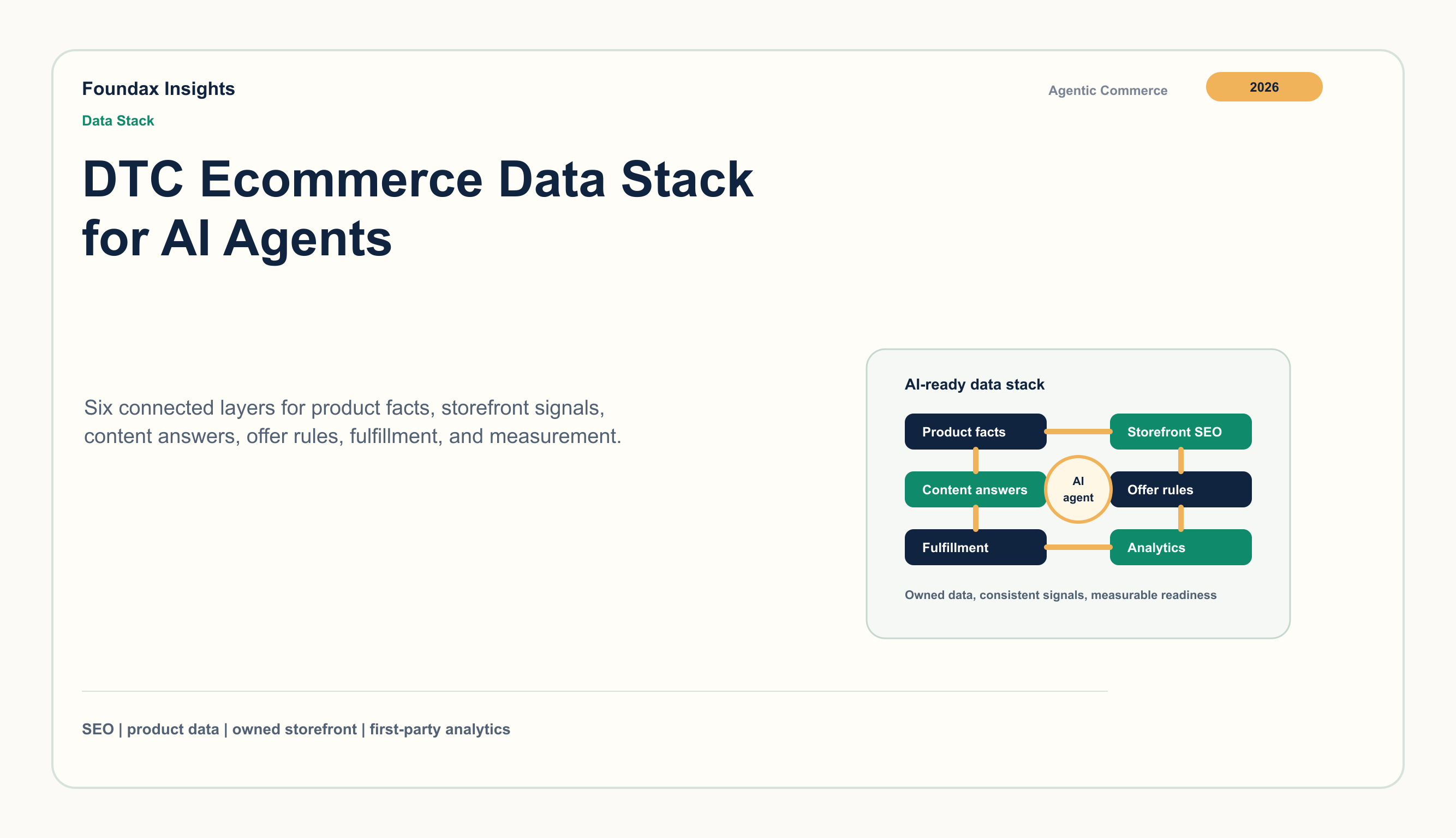
DTC Ecommerce Data Stack for AI Agents: Six Layers Brands Need in 2026
AI shopping does not only change the search box. It changes what a commerce system has to make legible. Google Search Central says Product structured data can expose price, availability, review ratings, shipping information, product variants, and merchant policies. Google Merchant Center's May 27, 2026 AI performance insights announcement adds a clearer signal: brands can inspect AI shopping share of voice, product term insights, product attribute insights, and attribute completeness. Shopify Engineering and Google Developers describe UCP as infrastructure for AI agents to discover and transact with merchants. AWS is also giving retailers an Agentic Shopping Assistant foundation that connects conversational shopping to a retailer's own catalog, data, and business rules.
For DTC brands, the first practical step is to build an owned data stack that search engines, shopping feeds, content systems, and future AI surfaces can read consistently. Protocols and new checkout surfaces matter, but they depend on the same foundation: clean product facts, stable pages, policy consistency, and measurable behavior.
The six layers
| Layer | What it owns | Why it matters |
|---|
| Product facts | Names, brand, SKU, GTIN/MPN, variants, attributes, images | Agents need exact product identity and comparison fields, not only persuasive copy. |
| Storefront SEO | Canonical URLs, sitemap, hreflang, metadata, Product JSON-LD | Crawlers and AI systems need stable page signals across markets. |
| Content answers | FAQs, use cases, comparison copy, care instructions, proof | Natural-language shopping questions need short, retrievable answers. |
| Offer rules | Price, currency, availability, promotions, shipping, returns, tax | Recommendations break when buying constraints are inconsistent. |
| Fulfillment facts | Delivery windows, return conditions, warranty, post-purchase steps | Shoppers often compare risk and convenience, not only product specs. |
| Measurement | Search Console, Merchant Center, first-party analytics, referral review | Teams need directional signals before they over-invest in a channel. |
1. Product facts are the base layer
Start with the products that already matter: the top sellers, best ad landing pages, highest-margin SKUs, and products with marketplace demand. For each product, make sure the source record contains name, brand, SKU, identifiers where available, variant attributes, category-specific fields, images, and accurate descriptions.
The important distinction is factual ownership. AI can help draft copy or flag missing fields, but product truth should come from supplier records, packaging, measurements, certificates, and operations rules. Do not invent attributes because a checklist asks for them.
2. Storefront SEO turns facts into crawlable signals
A DTC site needs pages that are stable, indexable, and internally consistent. That means canonical URLs, language alternates, sitemap entries, page metadata, and Product JSON-LD on product pages. Google recommends providing as much rich product information as available because different search experiences may use different enhancements.
Foundax supports this layer through page SEO metadata, sitemap and hreflang output, Product JSON-LD for PDPs, official Insights publishing, and Google/Search Console workflows. The practical value is operational: product pages become clearer, easier to validate, and easier to keep aligned with merchant-channel requirements.
3. Content answers reduce ambiguity
Product pages often say what a product is, but not which question it answers. AI shopping experiences are more likely to handle queries such as "is this bag waterproof enough for a rainy commute" or "which size works for a 14-inch laptop." Add FAQ, use-case, comparison, care, and compatibility content where it belongs.
Good answer content is specific. "Great for travel" is weak. "Fits under most airline seats and holds a 14-inch laptop, charger, and two packing cubes" gives a system something to retrieve.
4. Offer and policy rules must agree everywhere
Price, currency, availability, shipping, returns, warranty, and payment information must match across the product page, structured data, feeds, and policy pages. A small mismatch can turn into a hard trust problem for both search systems and shoppers.
Foundax's GMC alignment workflow uses preflight, dry-run, strict field matching, suppression controls for optional fields, and result tracking. That makes the data stack operational: teams see what is ready, what is skipped, and why.
5. Fulfillment is part of discovery
AI-mediated product comparison often includes delivery speed, return windows, warranty scope, and regional availability. For international DTC brands, fulfillment is not back-office detail. It is part of the buying answer.
Document delivery windows by market, return conditions, warranty terms, and region-specific limitations in a way that can be reused by product pages, policy pages, support workflows, and structured outputs.
6. Measurement should stay conservative
Google's AI performance insights for Merchant Center are a useful direction: share of voice, shopping funnel performance, product term insights, and product attribute gaps. But AI discovery remains fragmented. Use Search Console, Merchant Center, first-party analytics, referral analysis, and manual query reviews as directional evidence rather than proof of causality.
Where Foundax fits
Foundax is useful when a DTC team wants the data stack to live inside the operating workflow rather than across disconnected plugins. The platform connects product records, product SEO, Product JSON-LD, multilingual storefronts, content assets, sitemap and hreflang output, Google/GMC readiness checks, and first-party analytics.
Foundax helps teams make owned commerce data cleaner, more complete, and easier to validate across product pages, feeds, content, localization, and analytics workflows.
30-minute audit checklist
- [ ] Pick 10 priority products and list identity, offer, variant, policy, proof, and localization fields.
- [ ] Check that page, feed, and backend values agree for price, availability, URL, image, and variant data.
- [ ] Validate one PDP per major category for Product structured data.
- [ ] Add 3-5 product-specific FAQ answers to the products with the highest search or ad demand.
- [ ] Review shipping, return, warranty, and payment facts for market-specific mismatches.
- [ ] Review Merchant Center and Search Console alongside first-party events, referral patterns, and manual query logs so the team can see direction without overreading one report.
FAQ
What is the best ecommerce data stack for DTC brands?
The best stack connects product facts, storefront SEO, content answers, offer rules, fulfillment facts, and measurement. The exact tools can vary, but the layers need one shared source of truth.
Do DTC brands need UCP or an agent checkout protocol now?
Most independent brands should not start there. UCP and related protocols matter for the direction of the industry, but the near-term priority is cleaner owned product data, structured pages, feeds, policy consistency, and measurement.
Is this different from a traditional ecommerce tech stack?
Yes. A traditional stack focuses on displaying products and completing checkout for human shoppers. An AI-ready stack also makes product and policy facts machine-readable, consistent, and measurable.
Can AI fill missing product data automatically?
AI can help draft, translate, and detect gaps, but factual product attributes should come from authoritative business data. Invented attributes create trust and compliance risk.
How does Foundax help?
Foundax brings product records, SEO metadata, Product JSON-LD, content publishing, multilingual pages, sitemap/hreflang output, Google/GMC readiness workflows, and analytics into one operating system. Its role is to improve the operating inputs: product truth, structured pages, content publishing, localization, readiness checks, and measurement.
Related Reading
References