Why Marketplace Sellers Need a DTC Site in 2026
Marketplace sellers need a DTC site to build brand search, product depth, first-party customer data, SEO content, and margin visibility while still using platforms for reach.
Read more
In early 2026, Amazon launched Alexa for Shopping — an AI agent in the search bar. TikTok Shop raised EU commissions and tightened seller capital and after-sales responsibilities. Google AI Overviews hit 14% of shopping queries (up 5.6x). Platforms are shifting more cost and risk to sellers. A DTC site is one of the few channels you actually control.
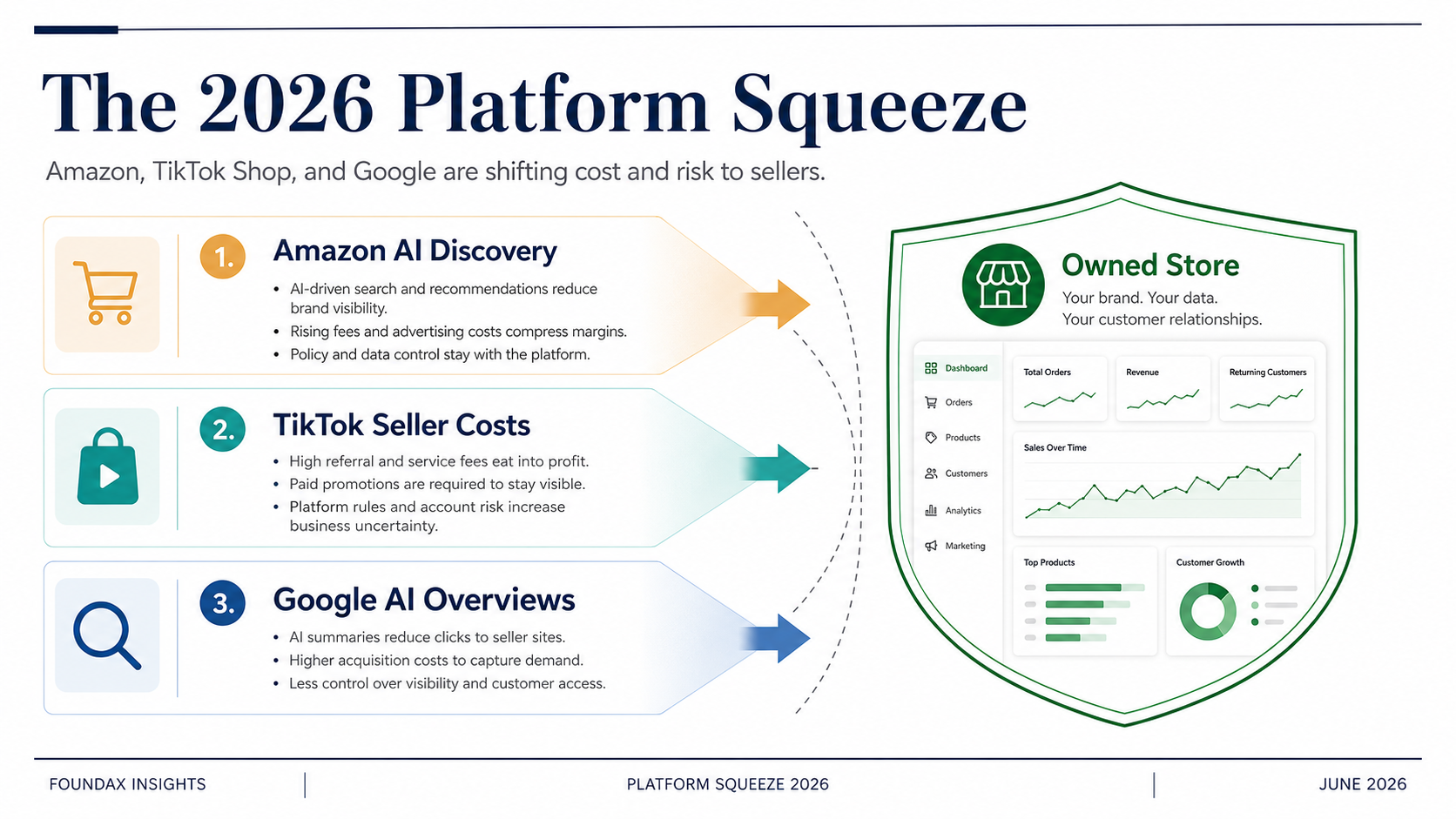
In the first half of 2026, three platform developments converged. Most sellers treated them as separate updates. Together, they signal a structural shift in who bears the risk in online commerce — and it is not the platforms.
First: On May 13, Amazon launched Alexa for Shopping — a single AI assistant that merges Rufus (used by over 300 million customers in 2025) with Alexa+ into the main search bar, product detail pages, and Echo devices. It handles conversational product discovery, generates AI overviews above search results, shows one-year price history, compares products across Amazon and other stores, and can even complete purchases on third-party websites on the buyer's behalf. The entry point for product discovery on Amazon is no longer a search results page — it is an AI-curated recommendation layer.
Second: TikTok Shop continues a pattern of rising seller costs. Marketing4eCommerce reported, citing TikTok's website, that TikTok Shop's commission rate in Germany, Spain, France, Italy, and Ireland rose from 5% to 9% on January 8, 2026. Forest Shipping separately reported that TikTok Shop raised the US cross-border POP security deposit from $500 to $1,500 effective December 15, 2025. TikTok Shop's own US return/refund policy, updated May 13, 2026, also gives sellers short review windows and states that refunds may be issued at the seller's cost when TikTok decides in favor of the customer. The signal is not a single fee line; it is a broader shift toward higher capital, compliance, and after-sales burden for sellers.
Third: Google AI Overviews now appear on 14% of shopping queries — a 5.6x increase from 2.1% in November 2025, according to Search Engine Land's March 18, 2026 report on Visibility Labs' analysis of 20.9 million shopping-query SERPs. Ecommerce stores, which were largely immune to AI Overviews when the feature launched, are now seeing their product and category pages compete with AI-generated answers that sit above both organic results and Shopping ads.
These are not isolated platform updates. They are three expressions of the same trend: platforms are restructuring the economics of online selling, and sellers are absorbing more of the cost and risk.
The question for every merchant is not whether this trend will continue. It is whether you have a channel you control when the next round of changes arrives.
---
For over a decade, selling on Amazon meant mastering a known system: title optimization, backend keywords, review scores, Sponsored Products, Buy Box strategy. The rules were complex but could be learned.
Alexa for Shopping changes what "discovery" means on Amazon.
A customer now types into the search bar: "I need a coffee maker for a small kitchen, under $50, easy to clean." The previous Amazon returned a search results page ranked by keyword relevance and sales velocity. Alexa for Shopping generates an AI overview, then surfaces recommendations based on product data, reviews, price history, and purchase patterns — all in a conversational interface.
For sellers, this shifts the optimization target. The old formula was keyword ranking × bid strategy. The new reality adds layers that sellers cannot directly control: AI-driven relevance scoring, personalized recommendation probability, and cross-store competitive context. Amazon's own documentation describes this as combining Rufus's product expertise with Alexa+'s personalized user understanding — a system designed to optimize for the shopper's experience, not the seller's visibility.
The cross-store dimension adds further complexity. Alexa for Shopping's "Shop Direct" feature lets the assistant compare products across Amazon and other online stores. "Buy for Me" can complete purchases on third-party websites. A seller's competition is no longer limited to other Amazon listings in the same category — it can be any product on the web that the AI determines is a better match.
The practical implication: Amazon product discovery is becoming less predictable and more AI-mediated. Sellers who built their entire business on Amazon search rankings are exposed to an optimization surface they cannot audit.
---
TikTok Shop's growth has been one of the fastest stories in ecommerce — from launch to a major channel in under three years, powered by short-video virality and live-shopping engagement. For small merchants, especially those new to cross-border selling, it offered accessible entry with organic reach potential.
But 2026 is revealing the platform's transition from growth to monetization.
The clearest signal: TikTok Shop's EU commission rate rose from 5% to 9% on January 8, 2026 in Germany, Spain, France, Italy, and Ireland, according to Marketing4eCommerce's report citing TikTok's website. For a seller generating €100,000 in annual EU revenue through those markets, that four-point increase represents a €4,000 cost increase before accounting for returns, logistics, or advertising spend.
Capital requirements are also tightening for some cross-border POP sellers. Forest Shipping reported that TikTok Shop raised the US cross-border POP security deposit from $500 to $1,500, effective December 15, 2025 for new merchants and with a January 14, 2026 top-up deadline for existing merchants. Because this is a logistics-provider report rather than a primary TikTok policy page, merchants should still verify current Seller Center requirements for their own account and region. As an operational signal, however, it points to a higher working-capital threshold for marketplace participation.
The after-sales burden is documented more directly in TikTok Shop's own US policy. The May 13, 2026 Customer Order Cancellation, Return, and Refund Policy gives sellers 2-4 business days to review refund-only requests depending on order value, says return/refund requests can be auto-approved when sellers do not act in time, and states that refunds may be issued at the seller's cost when TikTok Shop decides in favor of the customer. The takeaway is not that every return cost always falls on the seller; it is that platform rules increasingly determine how much operational risk the seller must absorb.
These changes are not arbitrary. They follow a familiar lifecycle: platforms subsidize growth to attract sellers, then monetize the locked-in seller base. TikTok Shop is not unique in this — it is simply executing the playbook faster than most.
---
Google has been a primary customer acquisition channel for DTC brands for two decades. The playbook is well understood: invest in SEO content, earn rankings, get clicks, convert to sales.
As of early 2026, that playbook has a new variable: AI Overviews on shopping queries.
The numbers are significant. Search Engine Land reported on March 18, 2026 that Visibility Labs analyzed 20,900,323 shopping keywords tied to SERPs with Shopping boxes. Of those, 2,919,229 triggered an AI Overview — 14.0% penetration, up 5.6x from 2.1% in November 2025. What was once a feature that primarily affected informational content is now expanding into commercial-search territory, appearing above both organic results and Shopping ads for product-category and comparison queries.
This does not mean SEO is dead. But it does mean the return on traditional organic content strategies is being reshaped. A buying guide that previously captured clicks at the top of the SERP may now sit below an AI Overview that answers the core query without requiring a click. Ecommerce sites that were "fairly immune" to AI Overviews in 2024 — in Visibility Labs' phrasing — no longer enjoy that insulation.
The response from sophisticated DTC brands is instructive: structured data markup, deeper proprietary content that AI cannot easily summarize, and diversified traffic sources that do not depend entirely on Google organic search. The merchants treating Google as their only customer acquisition channel are the ones most exposed to this shift.
---
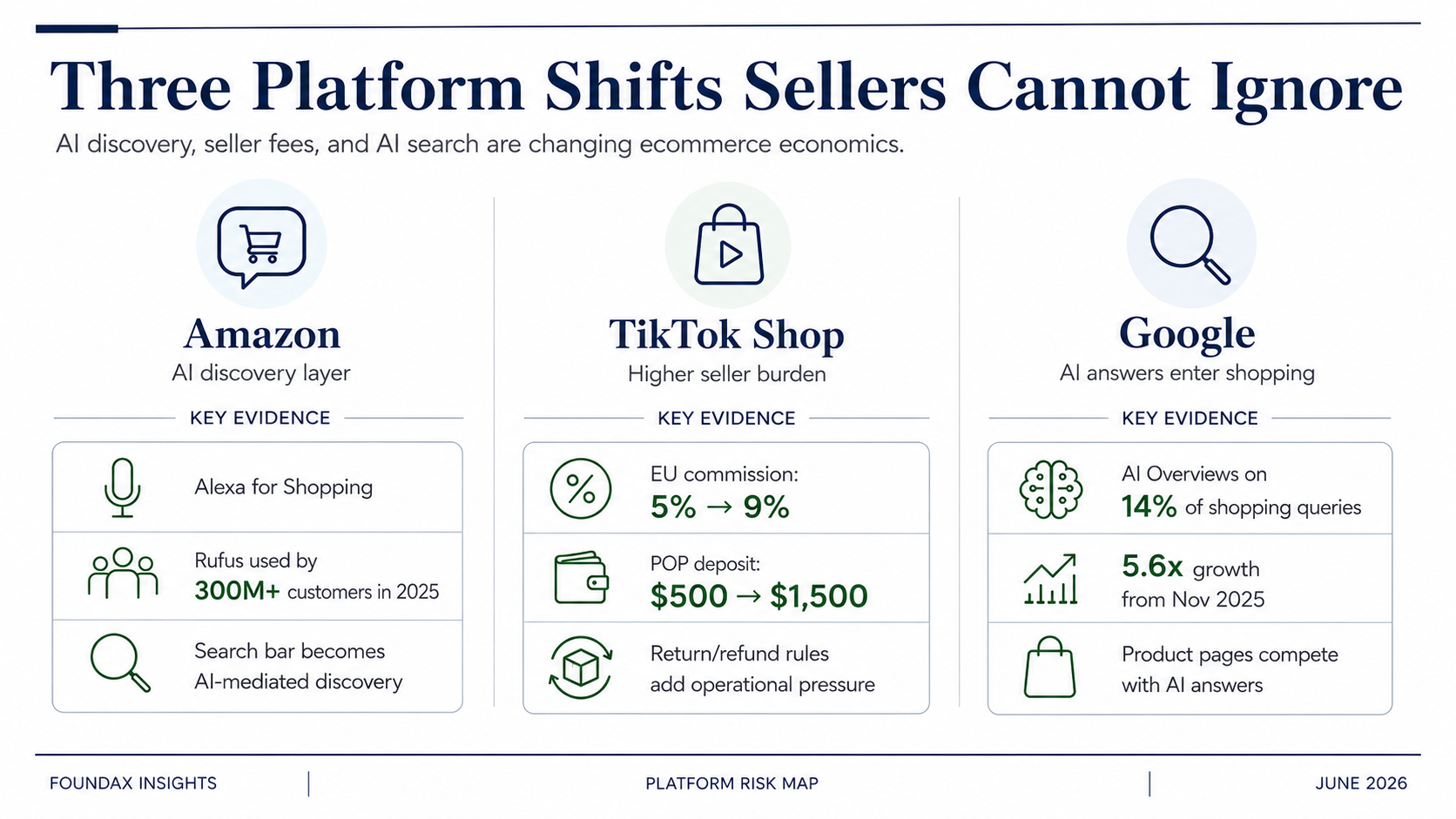
Look at these three developments together and a pattern emerges.
Amazon is layering AI between sellers and shoppers, making product discovery less directly controllable. TikTok Shop is raising costs across commissions, capital thresholds, and after-sales operations as it transitions from growth to monetization. Google is inserting AI Overviews into shopping queries, reducing click opportunities for some commercial searches.
In each case, the platform controls the channel. The merchant controls only what the platform permits. When the rules change — an AI restructuring, a fee increase, a SERP feature launch — the merchant absorbs the impact.
This is not a conspiracy. It is the natural lifecycle of platform-dependent commerce. Platforms invest to attract sellers. Once sellers are locked in — with inventory, reviews, sales history, and operations tied to the platform — the platform shifts from investment to extraction.
The merchants most exposed are those who sell exclusively through platforms. When Amazon restructures discovery, they have no DTC website with organic rankings. When TikTok raises costs, they have no email list to drive repeat purchases at near-zero marginal cost. When Google inserts AI Overviews above their content, they have no brand search volume to fall back on.
This is platform dependency. And it is becoming more expensive.
---
Every platform squeeze strengthens the case for owning at least one sales channel outright.
A DTC site — your own domain, your own customer experience, your own data — changes the power dynamic in three fundamental ways.
First, you own the customer relationship. When someone buys through your DTC site, you capture their contact information. You control the post-purchase experience: email sequences, loyalty programs, personalized offers. This is not possible on Amazon, where customer contact data is strictly controlled by the platform. It is not the default on TikTok Shop, where the relationship lives inside an app you do not own. Read more about this in our guide to Owned Web Assets: Building What Platforms Cannot Take Away.
Second, you own the data. Platform analytics show a curated slice of your business — impressions, clicks, conversions, filtered through the platform's attribution model. Your own-site analytics give you the full funnel: which content drives the highest lifetime value, which traffic sources convert best, which products have the best retention economics. Every customer interaction becomes data you can act on, rather than fuel for a platform's AI training.
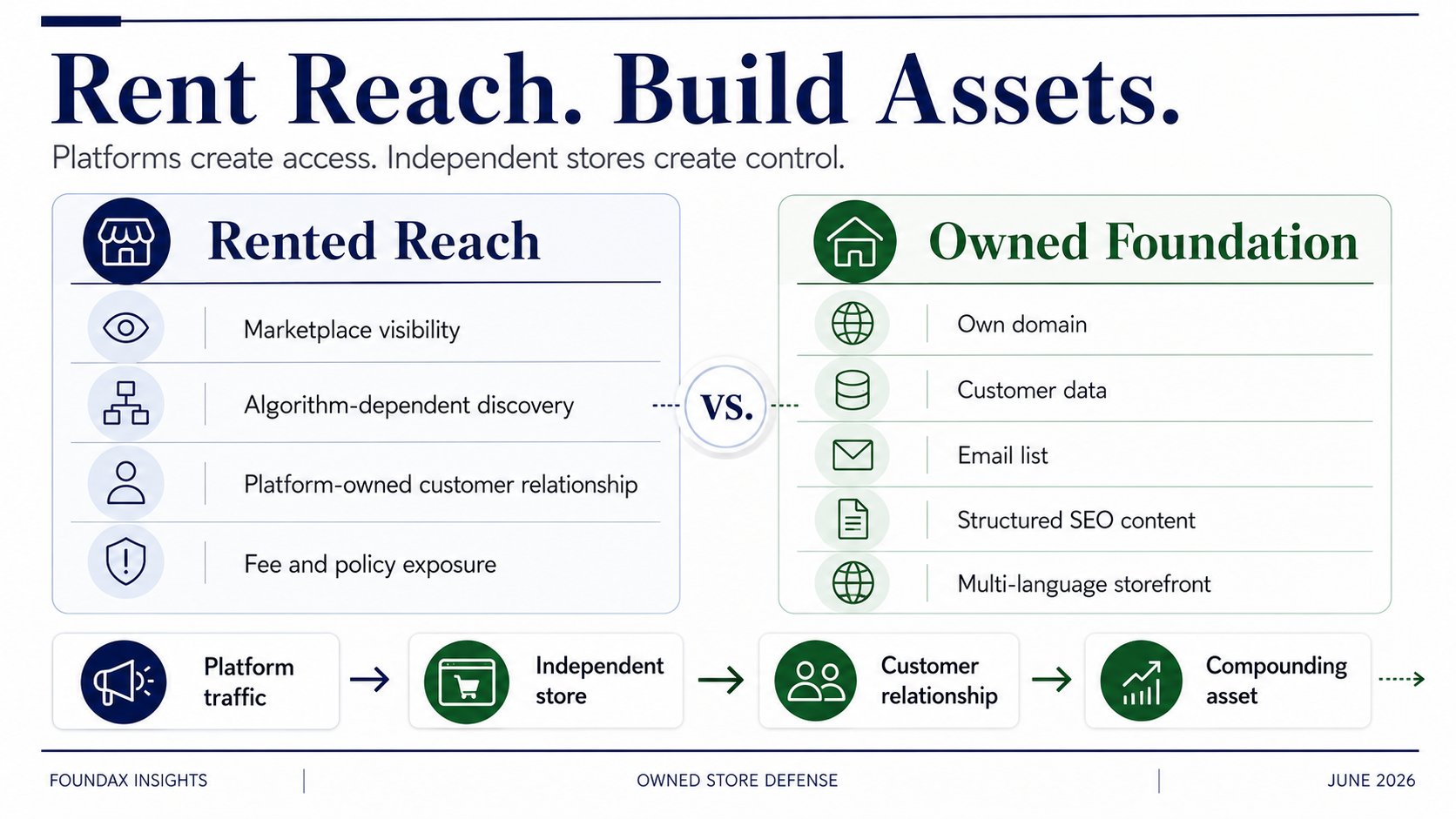
Third, you own the asset. An Amazon product page is rented visibility. A TikTok Shop listing is rented access. When the algorithm changes or the fees rise, that value can evaporate. A DTC site — with SEO content, backlinks, domain authority, and an email list — is a brand asset that compounds over time. It does not reset when a platform launches a new AI feature. It does not disappear when a commission rate changes. It is yours.
This is the strategic logic behind platforms like Foundax: making it viable for merchants to own a professional, multi-language DTC site at a cost comparable to — or lower than — a monthly platform ad budget. The barrier is no longer technical. It is the recognition that rented channels and owned channels serve fundamentally different purposes.
---
If you sell primarily through Amazon, TikTok Shop, or similar platforms, here is what matters most right now:
First, launch a DTC site this quarter. Every month you delay is a month of customer relationships you are not capturing and data you are not owning. Modern AI-powered website builders have removed the technical barrier. A functional, multi-language storefront with product management, checkout, and basic SEO can be live in days.
Second, start building your direct customer list immediately. Even a simple post-purchase email capture — a discount code for the next order, delivered by email — compounds over time. After a year, that list is your most defensible channel. No platform can revoke it. For actionable tactics, see our AI Shopping Visibility Checklist for 2026.
Third, invest in structured data and authoritative content on your own domain. As AI-generated overviews and AI shopping assistants become more prevalent in product discovery, your website needs to be machine-readable and citation-worthy. Product schema markup, buying guides with verifiable information, and category pages optimized for AI extraction are no longer optional — they are foundational. We covered the emerging rules in GEO Search Trends 2026.
These are not aspirational strategies. They are operational responses to structural changes already underway. The platforms have made their moves. The question is whether you make yours.
---
The default strategy in 2026 — sell where the customers are — is not wrong. Amazon has massive shopping intent. TikTok has discovery-driven reach. Google has search demand that no DTC site can replicate on its own.
But traffic is not a business. Traffic from a platform is rented. A business you own — with direct customer relationships, proprietary data, and brand equity — survives platform changes because it does not depend on any single channel.
The platform squeeze of 2026 is not a temporary cycle. It is the direction of travel. As platforms deploy AI at scale, they will use it to capture more of the value chain: discovery, decision-making, customer ownership. The merchants who build durable businesses will be those who use platforms for reach and their DTC sites for ownership.
Platforms are for renting. Your store is for building.
---
Yes. Modern website builders have reduced the operational overhead of running a store to a few hours per week. Start simple: product catalog, checkout, and email capture. Add SEO content and analytics as you grow. The goal is not to replace platform sales overnight — it is to build a direct channel that compounds while your platform business continues.
Through a distributed acquisition strategy. SEO content drives organic search traffic over time. Google Shopping ads capture high-intent buyers. Email marketing converts existing customers at near-zero marginal cost. Social media builds brand awareness and direct traffic. The difference from platform selling: every visitor lands on a site you control, and every conversion builds an asset you keep. It takes longer to build than launching on Amazon — but the asset appreciates rather than depreciates.
Amazon launched Alexa for Shopping in May 2026 — merging Rufus (used by 300M+ customers) with Alexa+ into a single AI assistant embedded in the search bar. It generates AI overviews of search results and product pages, supports conversational product discovery, and can compare products across Amazon and other stores. For sellers, this means product visibility is increasingly mediated by AI relevance scoring — a system sellers can influence through listing quality and structured data, but cannot directly control the way they could with keyword-based search rankings.
The cost has dropped dramatically. AI-powered website builders now offer complete storefronts — product management, multi-language support, payment integration, SEO tools — for monthly fees that are typically a fraction of what a small merchant spends on a single platform ad campaign. The question is less about affordability and more about recognizing that a DTC site and a platform listing serve different strategic purposes: one builds an asset, the other buys access.
As AI-generated overviews and AI shopping assistants become more common in product discovery, DTC sites need to be optimized for both human shoppers and AI systems. This means implementing structured data markup (JSON-LD for products, reviews, organization), creating authoritative content with verifiable sources, and maintaining accurate product feeds across Google Merchant Center and other channels. For more detail, see our GEO Search Trends 2026 article.
Yes — and this is one of the most significant shifts of the current era. Five years ago, competing with established DTC brands required a team: developer, designer, copywriter, SEO specialist. Today, AI tools handle product descriptions in multiple languages, generate SEO-optimized content, suggest pricing based on market data, and automate customer communication. The technology that used to cost six figures in annual headcount is now available by subscription. Small merchants now have access to tools of comparable quality to enterprise brands — the differentiator is execution, not budget.
---