Product Data Is Becoming the SEO Layer for AI Commerce Discovery
Ecommerce SEO used to start with pages: title tags, descriptions, backlinks, internal links, and content depth. Those basics still matter. AI shopping adds a second layer: product facts have to be structured enough for systems to read, compare, and verify.
The shift is visible across official platform releases. Google Merchant Center is preparing AI-powered shopping insights that include share of voice, funnel performance, product terms, and attribute completeness. Shopify Spring 26 positions Catalog as structured, queryable product infrastructure for AI surfaces. AWS describes agentic shopping assistants built around a retailer's own catalog, customer context, rules, and brand voice.
The practical takeaway is clear: product data is becoming the machine-readable layer underneath ecommerce discovery. Brands that keep product pages, feeds, policies, localized content, and analytics aligned give search and AI shopping systems clearer inputs to work with.
What Changed in 2026
- Google Merchant Center AI insights are designed to show how products are discovered on AI Mode, AI Overviews, and Gemini, including product terms and missing product attributes.
- Shopify says Catalog structures product data so agents can discover, understand, and recommend products, and reports that Catalog-powered AI searches convert at twice the rate of scraped-data searches in its own context.
- Shopify Engineering describes the hard part behind Catalog: inconsistent merchant schemas, product identity, and strict structured outputs so product IDs are preserved.
- AWS presents agentic shopping as something retailers can build on their own catalog, customer base, shopping environment, rules, and brand voice, not only through marketplace surfaces.
Why Keywords Alone Are Too Thin
A page can say "quiet espresso grinder" repeatedly and still fail a shopper query if the underlying data never states burr type, dimensions, noise context, price, availability, warranty, shipping region, and return terms. Keywords help a page be found. Structured product data helps a product be understood.
That distinction matters for AI-assisted discovery. Natural-language shopping questions often combine product attributes, constraints, and policies: "quiet grinder for a small apartment," "jacket under $150 with returns in Germany," or "skincare set safe for sensitive skin." Thin copy cannot carry all of that. A clean product data layer can.
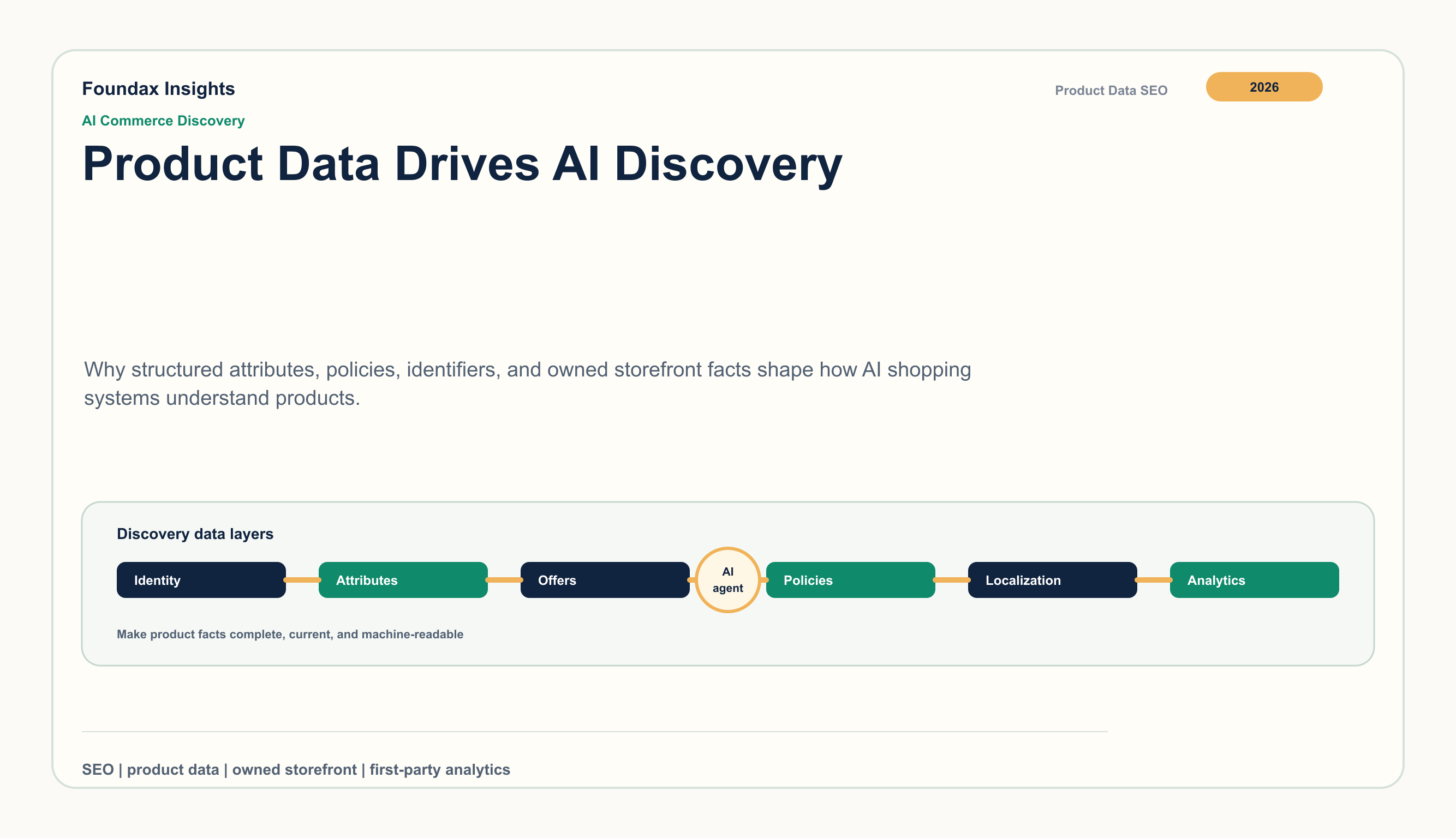
Six Product Data Layers to Make AI-Readable
Identity. Canonical URL, product name, brand, SKU, GTIN or MPN where available, and stable variant identity.
Attributes. Material, color, size, dimensions, compatibility, certifications, use cases, and category-specific specifications.
Offers. Price, currency, availability, sale windows, shipping cost, delivery promise, and return policy.
Content proof. Product descriptions, FAQ answers, buying guides, comparison notes, review context, and images with useful alt text.
Localization. Market-specific language, units, currency, compliance text, delivery expectations, and policy details.
Measurement. Merchant Center checks, Search Console directionality, referrer and UTM analytics, PDP behavior, and manual AI-surface observation.
Where Foundax Fits
Foundax helps teams manage owned storefront product records, SKU and variant structure, SEO metadata, multilingual pages, sitemap and hreflang output, and server-rendered Product JSON-LD. Those are the inputs that make product pages, search surfaces, and merchant feeds easier to keep aligned.
Foundax also supports Google-oriented workflows: Search Console verification, sitemap submission, Merchant Center preflight and sync, and bulk product import templates for Products, Options, SKUs, and GMC fields. The value is operational consistency. Product facts can be maintained once, checked before channel submission, published into multilingual storefront content, and measured through first-party analytics.
For a lean DTC team, that reduces the daily reconciliation work between product operations, content, SEO, localization, and feed management. Better product data becomes a workflow, not a spreadsheet cleanup project.
A Practical 30-Day Operating Plan
- Audit the top 20 products for missing identifiers, attributes, offers, policy facts, and localized copy.
- Compare the public PDP, Product structured data, and Merchant Center feed for mismatched price, availability, image, URL, and category fields.
- Add specific FAQ answers for pre-purchase questions that support real buying decisions instead of generic marketing claims.
- Track directional signals: product terms in Merchant Center where available, Search Console pages and queries, referrer and UTM behavior, and manual checks on AI shopping surfaces.
- Keep an experiment log so product data changes can be tied to visibility, click, and conversion movement over time.
FAQ
Is Product Data Replacing SEO?
Product data adds a machine-readable layer to SEO. Page quality, crawlability, internal links, content relevance, and performance still matter. AI commerce discovery also needs product facts that can be compared and verified.
Which Product Fields Matter Most for AI Shopping Discovery?
Start with canonical URL, product name, brand, identifiers, price, availability, image, category, core attributes, shipping, returns, warranty, localized descriptions, and FAQ answers. Category-specific specs matter because natural-language shopping queries often include those details.
What Does Shopify Catalog Signal for Non-Shopify Brands?
Shopify Catalog shows where the market is heading: structured and queryable product data. Brands outside Shopify still benefit from complete owned product pages, structured data, feeds, and policies because those inputs help search and shopping systems understand the offer.
How Does Foundax Improve AI-Shopping Readiness?
Foundax helps merchants keep owned product data, multilingual pages, Product JSON-LD, sitemap/hreflang, Google readiness workflows, and first-party measurement in one operating layer.
Where Should a Brand Start Before Advanced Protocol Work?
Most DTC brands should first fix owned product data, page/feed alignment, policy facts, localization, and measurement. Advanced protocol integrations work better when the product data foundation is already clean.
How Should a Small Brand Start?
Pick the products that already drive revenue. Fill missing attributes, align PDP and feed data, add practical FAQ content, verify structured data, and record visibility and click movement over several weeks.
Related Reading
References