Back to insights
DTC Tools#marketplace seller DTC site#Amazon seller website#DTC site strategy#brand search#first-party data

Why Marketplace Sellers Need a DTC Site in 2026

Marketplace sellers need a DTC site to build brand search, product depth, first-party customer data, SEO content, and margin visibility while still using platforms for reach.

Published Jun 30, 2026Reading time: 5 minFoundax
Why Marketplace Sellers Need a DTC Site in 2026

Why Marketplace Sellers Need a DTC Site in 2026

Why Marketplace Sellers Need a DTC Site in 2026

Marketplace sellers do not need a DTC site because marketplaces are disappearing. They need one because marketplaces are becoming more powerful, more automated, and more expensive to depend on exclusively.

A DTC site gives the seller a place to build assets that a marketplace account does not fully provide: brand search demand, long-form product education, first-party customer data, direct analytics, policy clarity, and a public product-data layer that can be read by search and AI shopping systems.

Brand Search Needs a Destination

Brand search should be treated as demand that has already become warmer than generic category traffic. If a shopper types the brand name, they are no longer only comparing features; they are checking legitimacy, policy, assortment, price confidence, and whether buying directly feels safe. A DTC site should answer those checks without making the visitor hunt through social posts or marketplace reviews.

The practical test is simple: search the brand name, the brand plus product name, the brand plus returns, and the brand plus shipping. If the results do not point to pages the team controls, the brand is letting others define the last step of the buyer journey.

If shoppers search for the brand after discovering it on Amazon, TikTok Shop, YouTube, Instagram, or a review site, they need a credible destination. The site should explain the product line, category point of view, policies, support, and reasons to buy directly.

Product Depth Does Not Fit in a Listing

This is especially important for categories where trust depends on detail: apparel sizing, beauty ingredients, electronics compatibility, home-goods materials, pet safety, supplements, warranties, replacement parts, or cross-border delivery expectations. A marketplace listing may mention these points, but it usually cannot organize them into a durable education path.

A strong DTC product page should work like a product brief and a sales page at the same time. It should tell the buyer what the product is, who it is for, when not to buy it, how to choose variants, how shipping works, and what support looks like after purchase.

Marketplace listings are constrained by templates. They are good for quick comparison, but weak for deeper education. DTC pages can publish use cases, comparison tables, care instructions, sizing detail, materials, compatibility, certifications, and market-specific policy context.

Customer Data Changes the Business

That data also changes how the seller makes product decisions. Search queries show language customers actually use. Support tickets show what the product page failed to explain. Reviews show which use cases deserve more visibility. Repeat purchase behavior shows which products can support lifecycle marketing. Without a DTC site, these signals remain fragmented or unavailable.

A marketplace order may produce revenue without producing a reusable relationship. A DTC site can capture email consent, purchase history, support questions, review feedback, source channel, product interest, and repeat-purchase behavior.

Margin Visibility Improves Decisions

This second lens matters when platform economics shift. A product that looks profitable on gross revenue may be weak after commission, storage, refunds, duties, ads, and support. A DTC channel lets the seller compare contribution margin by product and source. It also shows whether content, email, organic search, or referral traffic can reduce reliance on paid marketplace demand.

Platform dashboards show platform performance. A DTC site adds a second lens: direct traffic, organic search, referral, paid, email, product-level conversion, repeat purchase, and support cost.

What to Build First

The first version does not need every feature. It needs operational truth. Product facts must match inventory. Policy pages must match actual service levels. SEO titles and descriptions must match buyer intent. The sitemap must expose indexable pages. Analytics must separate source quality. If these basics are wrong, more design or more campaigns will not fix the channel.

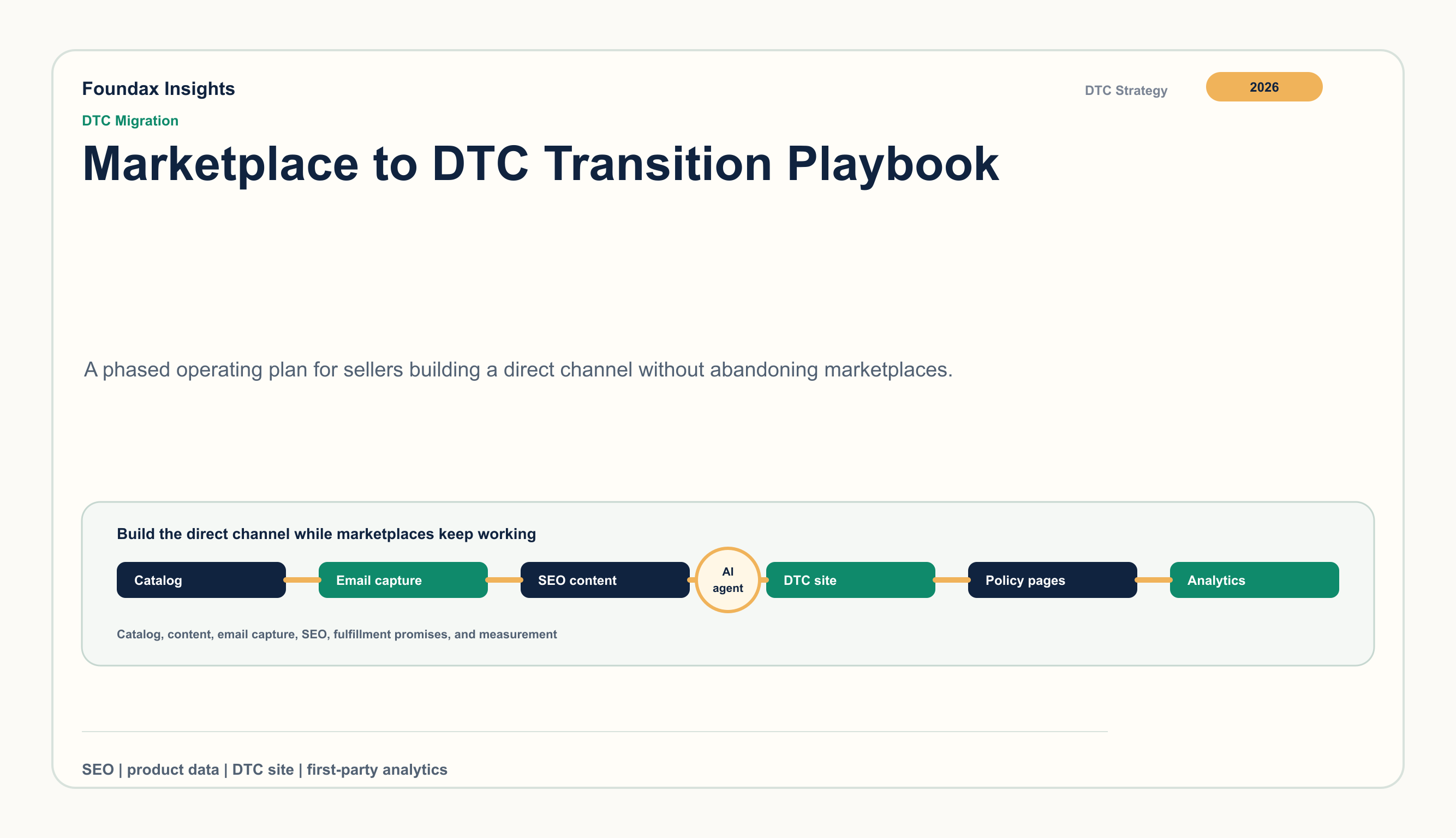
Start with a brand home page, 5-10 priority product pages, shipping and return policies, privacy and contact pages, email capture, Search Console, sitemap, Product JSON-LD, and content pages that answer real buyer questions.

Where Foundax Fits

For a small team, the hard part is not creating one page. The hard part is keeping product data, localized copy, Merchant Center readiness, content updates, and measurement aligned after the first launch. Foundax is meant to reduce that operational split, so the team can treat the DTC site as a maintained growth asset rather than a one-time side project.

Foundax gives marketplace-first sellers a direct-channel operating layer: site SEO settings, sitemap and robots, Product JSON-LD, Merchant Center preflight and sync, Search Console workflows, Content Studio publishing, localization, and first-party analytics.

FAQ

Do marketplace sellers need a DTC site if most sales still happen on Amazon?

Yes, if they want to build brand search, customer data, product depth, and measurement outside the platform account.

What should the first version include?

A credible brand home, priority product pages, policies, contact, email capture, sitemap, Search Console, Product JSON-LD, and a few pages answering real buyer questions.

Is this mainly an SEO project?

SEO is one part. The larger project is operating a direct channel where product facts, customer data, content, policies, and analytics stay connected.

Related Reading

References