Why Marketplace Sellers Need a DTC Site in 2026
Marketplace sellers need a DTC site to build brand search, product depth, first-party customer data, SEO content, and margin visibility while still using platforms for reach.
Read more
Amazon, TikTok Shop, Temu, and SHEIN still matter, but 2026 platform changes make direct-channel discipline more important for DTC sellers.
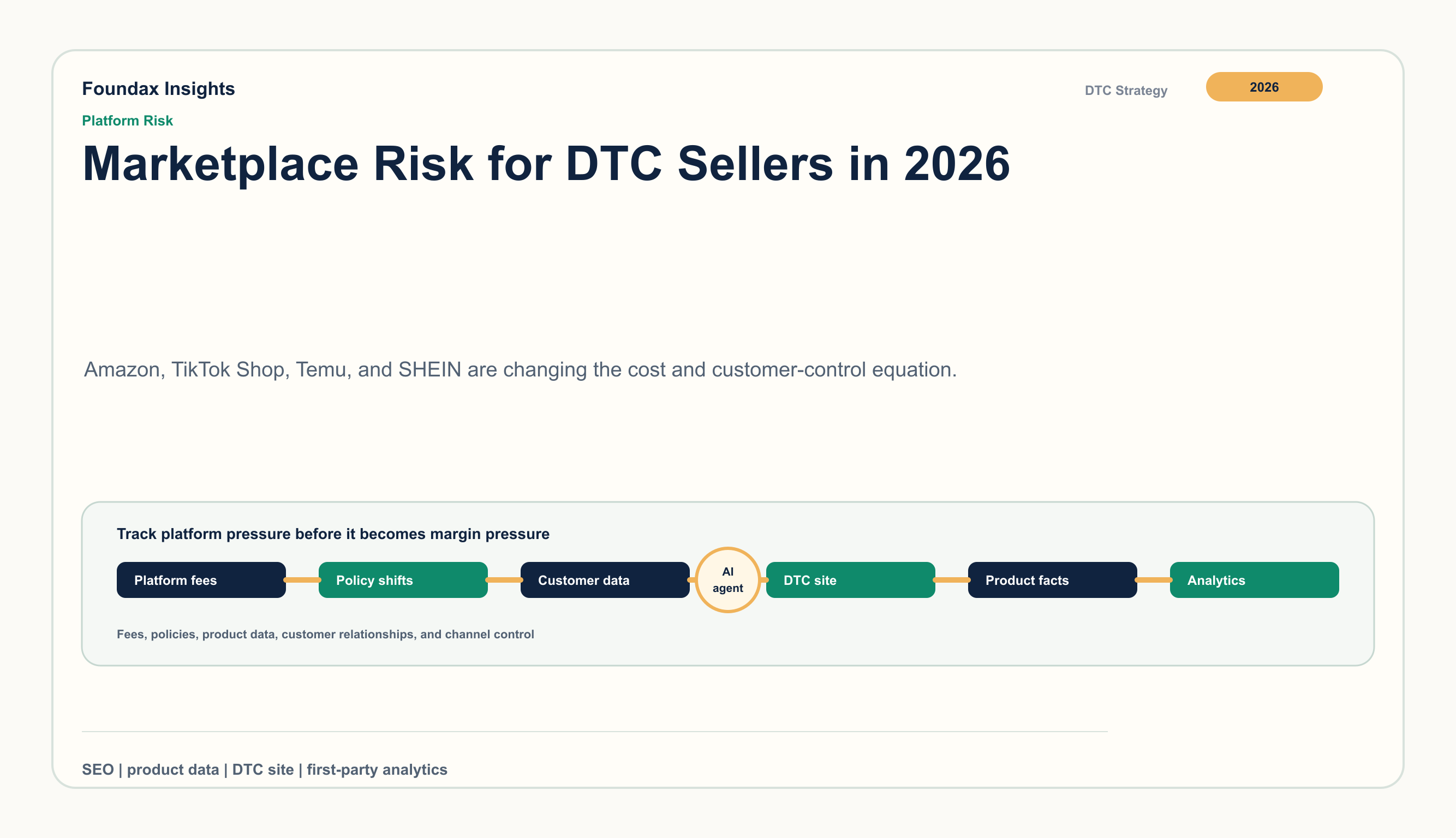
Marketplace selling is still useful in 2026, but the risk profile has changed. Amazon is adding AI assistance to the shopping interface. TikTok Shop is maturing into a higher-cost channel with clearer seller responsibilities. Temu and SHEIN are facing customs and advertising pressure that changes the economics of ultra-low-price commerce.
The point is not to abandon platforms. The point is to stop letting every important business asset live only inside them. A DTC seller can keep using marketplaces for reach while building a direct channel for product facts, brand search, customer data, content, and measurement.
Amazon announced Alexa for Shopping on May 13, 2026, combining Rufus and Alexa+ into a shopping assistant. Amazon says Rufus helped more than 300 million customers in 2025 research, compare, and buy products. The new experience includes conversational search, AI summaries, price history, personalized guides, and shopping actions.
For sellers, this changes presentation control. A listing becomes one input into an AI-mediated comparison, not always the full surface the buyer studies. Titles, attributes, reviews, pricing, availability, and offer quality need to be accurate enough to survive summarization.
TikTok Shop remains strong for social discovery, but public seller reporting shows more mature economics. Reports documented EU commission changes from 5% to 9% in several markets from January 8, 2026, with category exceptions. Cross-border POP deposit reporting also points to greater working-capital pressure for some sellers.
The official TikTok Shop Seller Center return and refund policy updated May 13, 2026 matters because it describes seller responsibilities across fulfillment methods, auto-approval windows, refund-only review periods of 2-4 business days depending on order value, and cases where the seller bears cost when TikTok Shop decides for the customer. Those rules must be modeled into margin.
The low-price cross-border model benefited from favorable parcel economics. Avalara reports that the EU approved ending the EUR150 customs duty exemption on February 11, 2026, with an interim EUR3 flat-rate customs duty from July 1, 2026. The EU Council cited about 4.6 billion low-value parcels entering the EU in 2024, more than 91% from China.
Modern Retail also reported that SHEIN's US Google Shopping ad impression share fell to 0% on April 26, 2025, while Temu fell to 0% earlier that month. These signals show that cost pressure can move through fees, ranking systems, seller requirements, or supplier negotiations.
A direct channel should hold the assets that platforms do not fully give back: complete product facts, brand education, customer email consent, support learnings, shipping and return policies, localized copy, Product JSON-LD, Search Console data, Merchant Center feed quality, and first-party analytics.
Foundax keeps site SEO settings, sitemap and robots, PDP Product JSON-LD, Google Merchant Center preflight and sync, Search Console verification and sitemap submission, Content Studio publishing, multilingual content operations, and first-party analytics in one workflow. That helps teams keep public pages, product feeds, content, localization, and measurement aligned.
Yes, when the unit economics work. The risk is relying on them as the only place where demand, customer relationships, product facts, and measurement exist.
The biggest risk is losing control of the customer relationship and product narrative while costs and rules change.
Start with priority SKUs, publish complete DTC product pages, connect Search Console, prepare Merchant Center data, add email capture, and publish content that marketplace listings cannot hold.
Yes. AI shopping systems need structured, current product facts across pages, feeds, policies, and content.