Why Foundax Built a Storefront Agent, Not a Tool-Calling Bot
We can state the ambition plainly: Foundax may be building one of the strongest independent storefront agents for DTC operators. That is a product thesis, not a market trophy claim. The important part is why we chose this architecture.
A storefront agent should not be a chat box wrapped around fifty admin actions. Independent ecommerce operations have too many moving parts: site structure, product facts, SEO content, Google Merchant Center readiness, shipping rules, payment settings, refund policy, promotions, orders, and analytics. If a model only sees a tool list, every action becomes a one-shot bet.
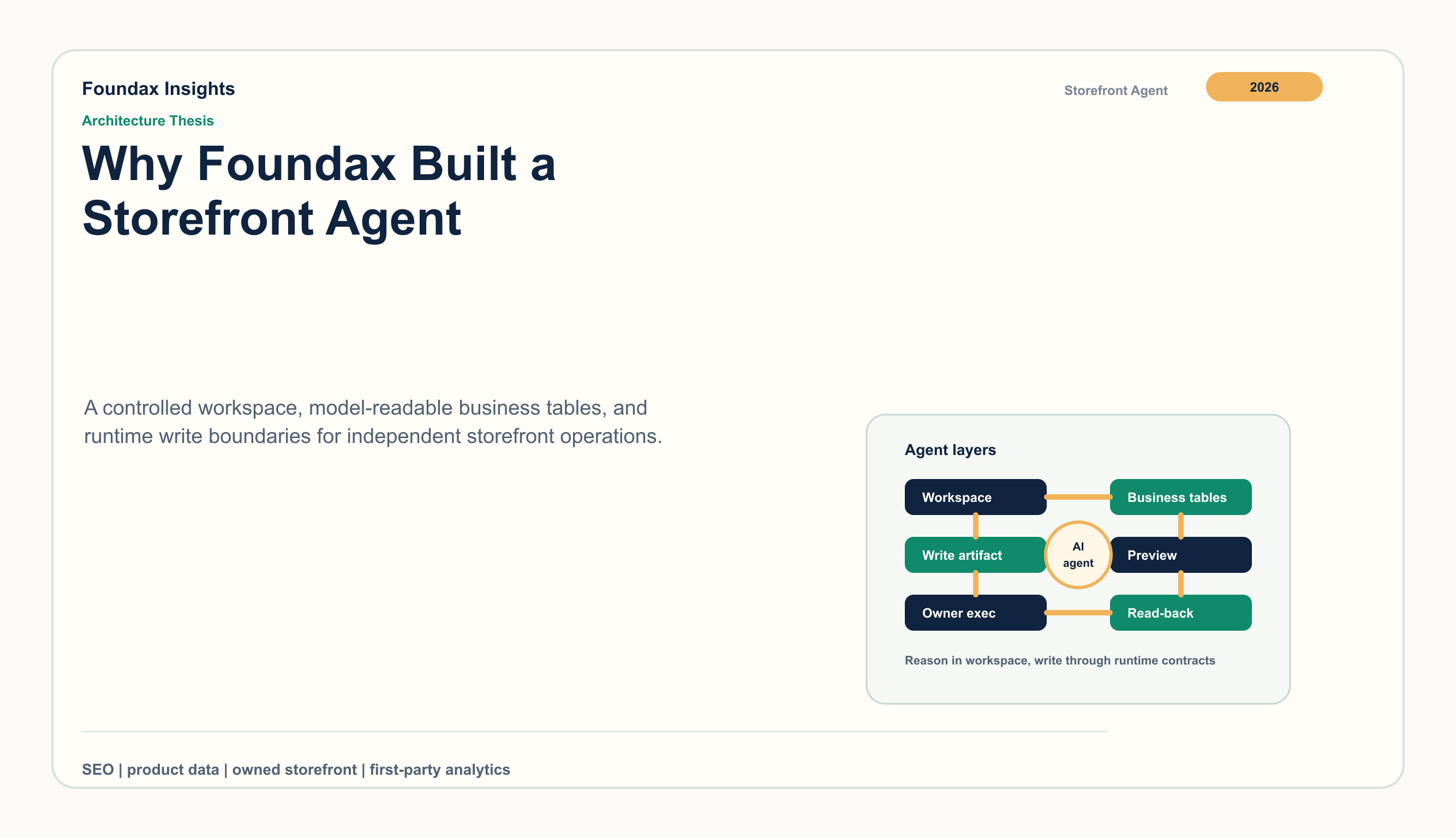
Foundax took the harder path: let the agent reason like a coding agent inside a controlled workspace, then make every write pass through merchant-scoped runtime contracts. The model can inspect, compare, draft, and stage changes. The runtime owns permission, preview, confirmation, owner execution, and read-back.
Why ecommerce agents are becoming infrastructure
Agentic commerce is no longer just a demo category. Google announced UCP, Business Agent, new Merchant Center attributes, and agentic shopping tools on January 11, 2026. Shopify Engineering describes UCP as a layered protocol where merchants and agents discover capabilities, negotiate what they can handle, and complete or hand off transactions. Shopify's June 18, 2026 agentic commerce guide says AI agents rely on structured product data, pricing, inventory, shipping, and checkout rules to decide what to surface.
Anthropic's agent engineering guidance is useful here: workflows are predictable for predefined paths, while agents are useful when flexibility and model-driven decisions are needed. Storefront operations need both. Merchants need a flexible agent that can investigate messy context, but they also need a predictable authority boundary when a change touches live business data.
Why simple tool-calling breaks down
A tool-calling bot can be useful for narrow tasks. It can answer a question, call a read API, or submit a form-shaped update. The problem appears when the task crosses domains. Updating a product page for AI shopping visibility can require product attributes, SEO metadata, Product JSON-LD constraints, localized content, GMC fields, policy facts, and analytics context.
In a thin wrapper model, those concerns are mixed together. The model chooses an admin action, fills arguments, and the system hopes the choice was right. That is hard to debug because reasoning, staged diff, validation, and execution are blended into one moment. It is also risky because the model may not know which scope, locale, object version, or owner permission should govern the write.
The Foundax pattern: workspace first, runtime writes
Foundax prepares a constrained workspace for the agent. The sandbox policy is versioned as the versioned Foundax workspace sandbox policy; repo and data mounts are read-only, work and outputs mounts are writable, network and package installation are denied by default, and path traversal or outside-mount access is rejected. The workspace includes scoped merchant data, repo/code context, a memory layer, and business-table indexes.
That lets the agent inspect before it writes. It can read the current scope, compare rows, produce a report, stage virtual-table patches, validate a diff, and submit structured output. It is closer to a coding-agent workflow than a chatbot. But it is not unrestricted local execution: it cannot silently mutate the production repo, read secrets, or write arbitrary database rows.
Business tables make operations model-readable
Foundax does not ask the model to memorize the production database. Store operations are projected into scoped, typed virtual business tables. Current table surfaces cover catalog products, variants, images, Google Merchant Center settings, site pages, SEO articles, Content Studio items, shipping/payment/refund/warranty/promotion/tax rules, recent orders, SKU sales summaries, and analytics metrics.
These tables are model-visible, not provider-callable. Their write mode is workspace update mode, and the compiler boundary is a runtime-internal compiler boundary. In plain terms: the model can reason over business rows and stage patches, but the runtime decides whether those patches are valid and how they map to owner services.
The write boundary is the moat
The most important part is not the number of tools. It is the write boundary. For confirmable writes, Foundax uses a structured writeArtifact contract with operation ID, owner action, merchant targets, updates, preview rows, read-back tool IDs, risk level, and source evidence. The manifest explicitly treats final confirmation as a runtime confirmation card, not a chat message.
The bridge compiles that artifact into a validated business changeset. Runtime validation checks the operation, action policy, merchant scope, preview, read-back, and owner executor expectations. Only then can the owner layer execute. After execution, read-back closes the loop so success is based on real state, not model prose.
What this unlocks for independent storefronts
This architecture is designed to support a closed loop across site building, product onboarding, SEO and Content Studio work, catalog and GMC readiness, shipping/payment/refund/promotion/tax operations, and analytics-informed iteration. Where these surfaces are implemented, the agent can work from structured business context instead of guessing from a tool list.
The practical outcome for a DTC team is not a magical autonomous operator. It is a safer operating layer: inspect the current store, propose a concrete change, show the diff, ask for confirmation, execute through the right service, and read back the result.
What we do not claim
Foundax does not claim to implement UCP, ACP, AP2, direct agent checkout, ChatGPT checkout, Copilot selling, or autonomous shopper purchasing. We do not claim guaranteed ranking in Google AI Mode, ChatGPT, Gemini, Copilot, or any external AI shopping surface. We do not claim the agent replaces the merchant.
Our claim is narrower and more defensible: independent storefronts need an agent architecture that understands business context and writes through controlled runtime contracts. Foundax is building that layer.
FAQ
What is an independent storefront agent?
It is an AI system designed to help operate an owned ecommerce storefront: product data, SEO content, pages, policies, catalog readiness, and analytics. It should understand merchant scope and business objects, not just answer generic chat questions.
How is this different from a tool-calling bot?
A tool-calling bot usually exposes APIs directly to a model. Foundax gives the agent a controlled workspace and typed business tables, then routes writes through validation, preview, confirmation, owner executors, and read-back.
Can the Foundax agent update products or content safely?
Where a surface is implemented, the model stages scoped changes and the runtime applies them through product, site-content, or commerce adapters. The agent does not freestyle-write production database rows.
Does Foundax support UCP, AP2, or autonomous checkout?
No. Foundax currently focuses on owned-storefront readiness and operations. UCP/AP2/direct agent checkout should not be treated as existing Foundax merchant capabilities.
Why do virtual business tables matter?
They give the model a stable business grammar: rows, fields, scope, read-back tables, and writable columns. That makes ecommerce operations easier to inspect, diff, validate, and explain.
How should a DTC brand prepare for storefront agents?
Start with structured product data, consistent SEO metadata, clear policy facts, multilingual content where relevant, and a workflow that separates AI drafting from owner-confirmed execution.
Related Reading
References