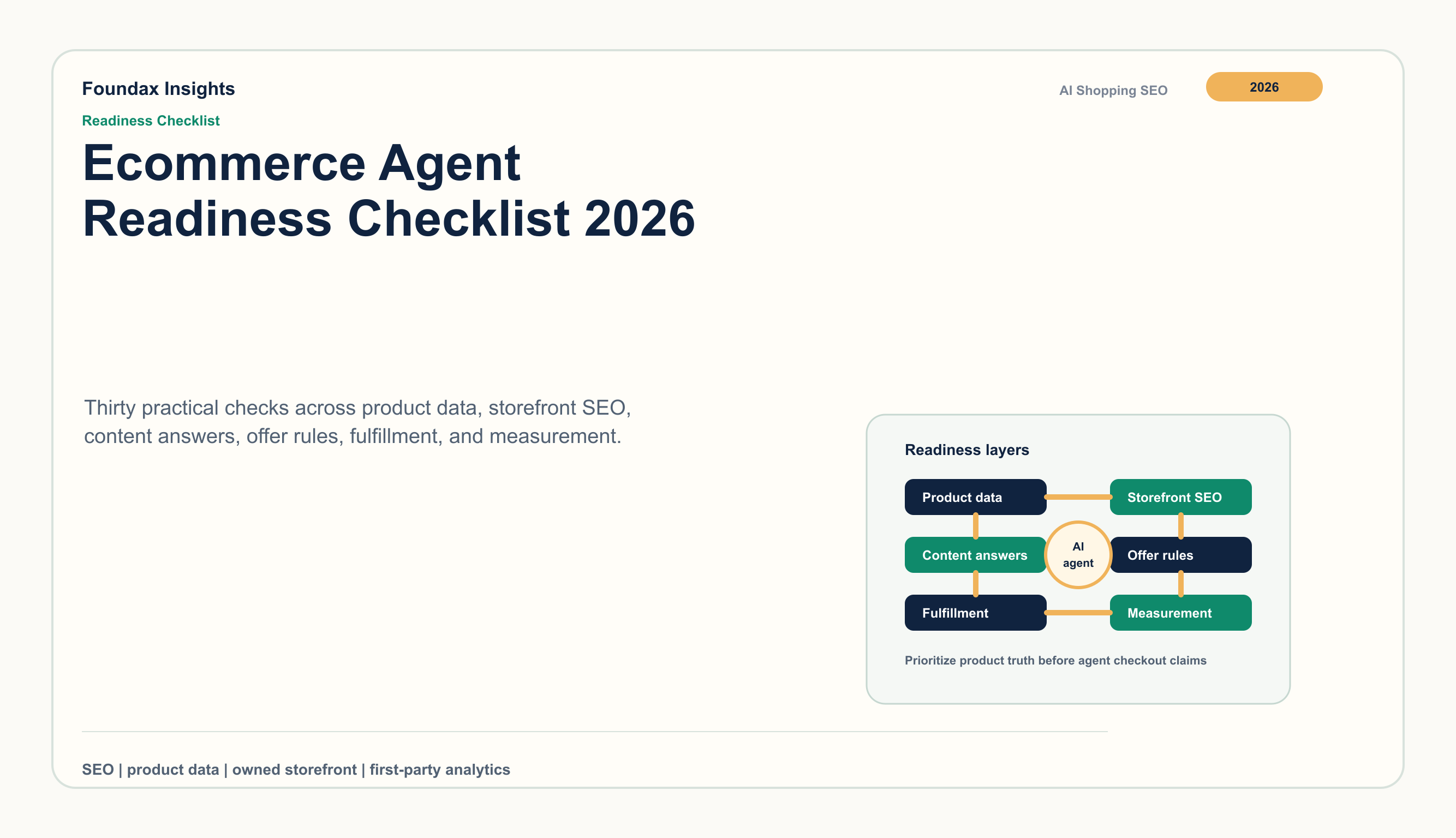
Ecommerce Agent Readiness Checklist: 30 Steps for DTC Brands in 2026
AI shopping is moving from a search box problem to an operating-data problem. Google documents product structured data for prices, availability, reviews, shipping and returns; Merchant Center has begun surfacing AI-oriented product and attribute insights in selected markets; Shopify describes agentic commerce as a catalog and product-data workflow; AWS has packaged an assistant architecture for retailers; and ChatGPT shopping results use merchant and third-party metadata. None of that means a brand can guarantee AI inclusion. It does mean product facts, policy facts and localized storefront pages need to be easier to parse.
Use this checklist as an operating audit. Mark each item as must fix, improve next or monitor. A brand does not need every advanced field on day one, but it does need a reliable source of truth before it asks AI systems, search engines or merchant channels to understand the offer.
The 30-point readiness checklist
Product data
- Core Product JSON-LD or equivalent structured product facts are present on every important PDP.
- Product identifiers, canonical names, brand, SKU, GTIN or MPN are consistent across storefront and feeds.
- Variant-level price, availability, image, size and color facts do not conflict with parent products.
- Category-specific attributes are stored as fields, not only buried in long copy.
- Product images, alt text and supporting media explain what the shopper is actually comparing.
- A clear owner maintains the factual product source of truth before content teams rewrite it.
Storefront SEO signals
- Canonical URLs are clean, indexable and free of avoidable redirect chains.
- Sitemaps include published product, content and localized pages with current lastmod values.
- Hreflang alternates point to real localized URLs and are reciprocal across markets.
- Every indexable PDP has a unique title, meta description and H1 that match shopper intent.
- Shipping, return, privacy and support pages are crawlable and consistent with checkout policy.
- Mobile performance and page stability are good enough for product comparison sessions.
Content answers
- Top PDPs answer sizing, compatibility, care, materials, delivery and returns questions.
- Use-case copy says who the product is best for and when it is not the right fit.
- Comparison tables and specs make trade-offs scannable without exaggerated claims.
- Reviews, ratings and proof points are shown only when they come from a real source.
- FAQ content is present and can be marked up where appropriate, without treating rich results as guaranteed.
Offer and policy rules
- Price, sale price, currency and availability match between page, cart and merchant feeds.
- Inventory states distinguish in stock, out of stock, preorder and region-specific availability.
- Shipping windows, rates and thresholds are explicit for each target market.
- Return, warranty and exchange rules are clear enough for assistants and shoppers to quote safely.
- Payment, tax and duty notes are accurate for the markets where the offer is active.
Fulfillment and localization
- Market pages use local delivery, policy and support facts rather than direct translation only.
- Localized PDPs keep the same product truth while adapting units, currency and buyer questions.
- Post-purchase tracking and support expectations are visible before checkout.
- Teams can identify which market or locale owns each unresolved product-data gap.
Measurement
- Search Console query, page and indexing movement is reviewed as a directional signal, not proof of AI inclusion.
- Merchant Center AI insights are reviewed when they are available in the account and market.
- First-party analytics and referral data are checked for new shopping, assistant or comparison traffic patterns.
- Manual AI-shopping query checks are logged with date, market, query and caveats so teams do not overread one result.
How to score the audit
| Score | Meaning | Practical next step |
|---|
| 0-10 | Fragmented | Fix core product facts, canonical pages, sitemap coverage and policy pages before chasing agent channels. |
| 11-20 | Search-ready but uneven | Improve variant data, localized PDPs, product FAQ and offer-policy consistency. |
| 21-26 | Agent-readable foundation | Add measurement discipline, market-specific pages and feed QA. |
| 27-30 | Operationally strong | Keep monitoring evidence, content freshness and merchant-channel changes. |
Where Foundax fits
Foundax is useful when the readiness work needs to become a repeatable system instead of a spreadsheet. The current product can support product records, page SEO metadata, core Product JSON-LD on PDPs, multilingual published pages, sitemap and hreflang output, official content publishing, Google Search Console and Merchant Center readiness workflows, dry-run checks and first-party analytics.
Foundax should not be described as a guarantee of AI ranking, automatic inclusion in shopping assistants, UCP or AP2 implementation, autonomous checkout, or automatic invention of missing price, shipping or warranty facts. The safer promise is operational: keep product truth, localized content, SEO signals and channel checks aligned so teams can reduce avoidable gaps.
FAQ
How often should a DTC brand run this checklist?
Run a full audit before major launches, market expansion or feed changes. For active catalogs, review the top revenue products monthly and the full catalog quarterly.
What should we fix first if the score is low?
Start with product identifiers, canonical PDPs, price and availability consistency, sitemap coverage and crawlable policy pages. Those are foundational signals for both search and merchant channels.
Does FAQPage JSON-LD guarantee rich results or AI visibility?
No. FAQ content can make product answers clearer and can support structured data where appropriate, but search features and AI surfaces are controlled by external systems.
Do we need developer work to become agent-ready?
Usually yes for structured data, feed quality, hreflang and measurement. Content teams can improve product answers, but the operating system needs clean data and publish workflows.
How does Foundax help without overclaiming AI results?
Foundax helps teams publish localized content, maintain product facts, expose core product structured data, check GMC readiness and monitor first-party signals. It improves the inputs; it does not promise external ranking outcomes.
Related reading
Sources