AI Website Builder Maintenance: What Happens After Launch?
AI can generate a website quickly, but ecommerce teams still need ownership for content updates, product data, checkout, analytics, SEO, localization, and operational maintenance.
Read more
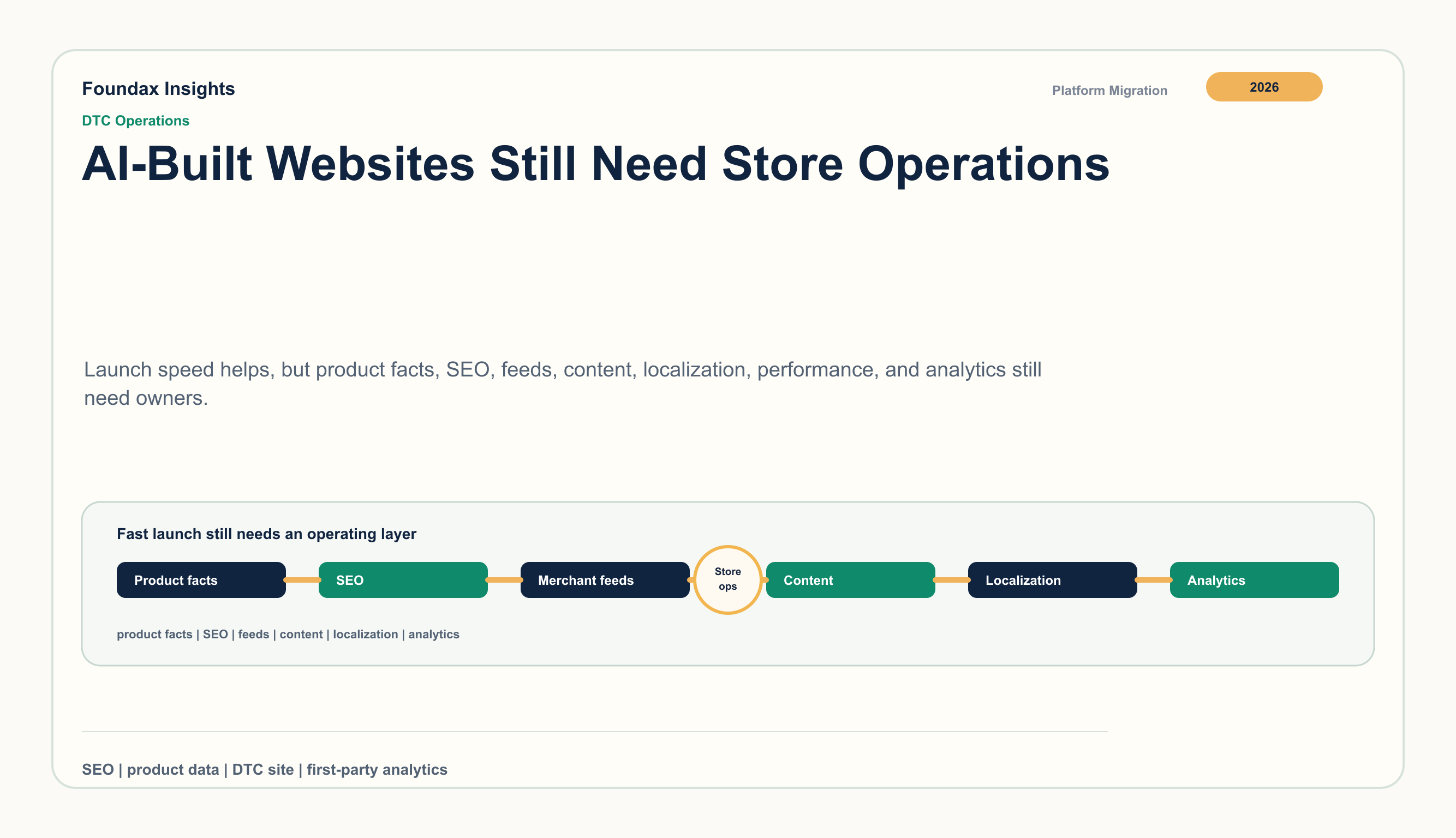
AI website builders can shorten the first launch, but DTC teams still need post-launch operations for product facts, SEO, feeds, content, localization, performance, and analytics.
AI website builders can shorten the first launch. A founder can describe a brand, provide a product idea, choose a direction, and get a usable site surface far faster than a traditional design-and-development cycle. That speed is valuable. It lowers the cost of testing a category, publishing a campaign, or proving that a product line deserves more investment.
The mistake is treating launch speed as operating maturity. A DTC site becomes difficult after it meets real inventory, real buyers, real policies, real markets, and real measurement. The page can look finished while the business still lacks a reliable way to keep product facts, SEO, feeds, content, localization, policies, scripts, and analytics aligned.
a16z's analysis of AI web app builders describes a category that lets more users turn natural-language intent into working web experiences. For ecommerce, that means the first version of a storefront can arrive much earlier in the process.
Earlier launch changes the first week, not the next year. After launch, the team still has to answer operational questions:
These questions do not disappear because the page was generated quickly. They become more important because the site reaches the public sooner.
A useful post-launch review assigns ownership by layer. Each layer changes after launch, and each layer can drift.
| Layer | What changes | Healthy signal |
|---|---|---|
| Product facts | price, availability, variants, identifiers, images, attributes | PDP, structured data, feed, and analytics labels describe the same product |
| Site SEO | title, description, canonical, robots, sitemap, internal links | important URLs are publishable, indexable, and connected |
| Merchant feeds | required attributes, images, landing-page facts, shipping and return context | issues are caught before submission and routed to a product owner |
| Content | guides, FAQs, comparisons, policy explainers, campaign pages | content links to current products and answers real buying questions |
| Localization | language, currency context, delivery, returns, support, market search intent | each locale is a market page, not a translated shell |
| Performance | images, scripts, widgets, tags, third-party code | critical pages remain fast enough for real traffic |
| Analytics | source, page, product, cart, checkout, purchase, refund, return, locale, device | weekly review can explain demand and friction without manual reconstruction |
An AI-built site that lacks owners for these layers is not a bad site. It is an unfinished operating system.
Generated pages often start from copy, layout, and broad product descriptions. Ecommerce operations need more exact facts: SKU structure, variant attributes, identifiers, inventory, price, media, material, size, compatibility, availability, shipping context, return context, and product family labels.
Google's Product structured data guidance and Merchant Center product data specification both reinforce the same principle: public pages and product records should describe the same item accurately. If the visible PDP says one thing, structured data says another, and the feed carries a third version, the team has created an operating problem.
The right question is not whether the first generated PDP looks good. It is whether the product can change next month without breaking PDP copy, schema, feed fields, content links, support answers, and analytics labels.
An AI builder can draft title tags and descriptions. It may even create plausible section headings and FAQs. DTC SEO needs governance beyond first-draft copy: canonical paths, sitemap inclusion, robots rules, locale alternates, Product JSON-LD, internal links, published content, and page performance.
The Search Console Core Web Vitals report groups real-user URL performance by LCP, INP, and CLS. That is a reminder that post-launch SEO includes operational quality, not only text generation. International SEO adds another layer: Google's localized-page guidance relies on coherent localized versions, not thin text conversion around stale business facts.
Generated metadata is a starting point. Operating SEO means knowing what changed, what was published, what is indexable, and which page facts need to stay aligned with products and content.
Generated content can give a brand a fast content base: homepage copy, product descriptions, FAQs, buying guides, comparison sections, and policy explainers. The risk is that nobody owns the refresh cycle after launch.
Content becomes dangerous when it slowly stops describing the business. A buying guide links to a discontinued product. A policy explainer uses an old return window. A localized page promises delivery the market cannot support. A campaign page keeps an expired offer alive.
DTC content should be treated as an operating asset. Important pages need an owner, a trigger for review, and links back to current product or policy facts. More generated pages are not automatically more growth. Connected, maintained pages are.
AI-assisted translation can speed up localization, but market fit is not the same as translated text. A localized page should reflect currency expectations, delivery options, return language, support context, legal expectations, product naming, sizing, and search intent.
The common failure is a polished translated page that carries the wrong business promise. For a buyer, that is worse than awkward copy because it can create a service issue after purchase. For search and shopping systems, it also weakens the relationship between locale, content, product data, and market intent.
A generated website can launch without a measurement model, but it cannot improve without one. DTC teams need to understand where traffic comes from, which landing pages create product interest, which content assists discovery, which SKUs create checkout friction, where refunds and returns concentrate, and how behavior changes by locale and device.
First-party commerce analytics should stay close to the store's events. GA4 and other tools can add useful diagnostic context, but the business should not need a spreadsheet rescue every time the team asks whether a product page is working.
Use the first 30 days after an AI-assisted launch to install operating discipline.
| Week | Review | Output |
|---|---|---|
| 1 | priority products, PDP facts, images, variants, identifiers | product truth checklist |
| 2 | metadata, sitemap, robots, Product JSON-LD, Search Console, feed preflight | search and channel checklist |
| 3 | buying guides, FAQs, policies, localized pages, internal links | content ownership map |
| 4 | scripts, performance, analytics events, source/product/funnel reporting | measurement and performance baseline |
The goal is not to slow down launch. The goal is to make fast launch survivable.
Foundax is designed around the operating layer after the first build. Current capabilities include product records, page publishing, site SEO settings, sitemap and robots output, Search Console verification and sitemap submission, server-side PDP Product JSON-LD, strict Merchant Center preflight and sync, Content Studio with draft/published separation, multilingual content operations, first-party analytics, and GA4 as supplemental diagnostics.
For a DTC team, the value is that generated or edited pages can be connected to the facts that keep the store trustworthy: products, public URLs, structured data, feeds, content, localization, policies, and measurement.
Yes. They can reduce the cost of first launch, campaign testing, and early brand exploration. The post-launch operating model still has to be designed.
Product facts usually drift first: variants, prices, inventory, identifiers, images, PDP copy, structured data, feed fields, and analytics labels stop describing the same product.
No. SEO also needs canonical paths, sitemap governance, robots rules, Product JSON-LD, internal links, published content, localized versions, and performance review.
Localize market facts, not only text. Delivery, returns, currency, support, sizing, compliance language, and search intent should be adapted per market.
Foundax connects product records, page publishing, SEO settings, sitemap/robots, PDP Product JSON-LD, Merchant Center preflight, Search Console, Content Studio, multilingual operations, and first-party analytics in one operating path.