A practical framework for choosing an ecommerce tech stack when your brand needs localized storefronts, structured product data, AI shopping visibility, and daily operating control.
For multi-market DTC brands, choosing an ecommerce platform is no longer just a template decision. The real question is whether the stack can keep storefronts, product data, checkout, SEO, analytics, and AI shopping visibility aligned after launch.
1. Why platform choice changed in 2026
Independent ecommerce merchants still rely on the same broad acquisition buckets:
Paid Search
Paid Social
Creator and affiliate traffic
Marketplace spillover
SEO and AI discovery
Owned channels like email and SMS
What changed is the pressure on each layer.
Higher-quality acquisition is more expensive and less forgiving
Recent benchmark data makes the pattern clear:
WordStream / LocaliQ's 2025 Google Ads Benchmarks found that 87% of industries saw CPC increases in Google Ads, while average CPC rose 12.88% year over year. For most categories, buying the click itself did not get easier. WordStream / LocaliQ Google Ads Benchmarks 2025
The same benchmark shows average CPL rising from $66.69 to $70.11, a 5.13% year-over-year increase. That is a more commercially meaningful signal than CPC alone because it is closer to what merchants actually pay for a usable lead. WordStream / LocaliQ Google Ads Benchmarks 2025
WordStream / LocaliQ's 2025 Facebook Ads Benchmarks reports that Facebook leads campaigns saw average CPL rise 20.94% to $27.66, with 9 of 15 industries posting higher CPL. Even when some traffic metrics fluctuate, qualified acquisition can still get more expensive. WordStream / LocaliQ Facebook Ads Benchmarks 2025
EMARKETER forecasts US retail media ad spend at $60.32B in 2025 and $71.09B in 2026, a 17.8% increase. Brands are still pushing more budget into commerce-linked media rather than backing away from paid acquisition. EMARKETER 2026 Retail Media Forecast
Tinuiti's 2026 retail media outlook reinforces the same direction: retail media remains one of the fastest-growing segments in digital advertising, which means merchants are being pushed toward channels that depend more on structured product inputs and closed-loop measurement. Tinuiti 2026 Outlook
The implication is not that every metric rises in a straight line.
It is that higher-quality acquisition has become more expensive, while the broader acquisition environment has also become more volatile, more fragmented, and more dependent on structured product inputs.
Distribution is becoming more product- and feed-driven
Platforms are also shifting away from manual targeting logic toward machine-led product distribution.
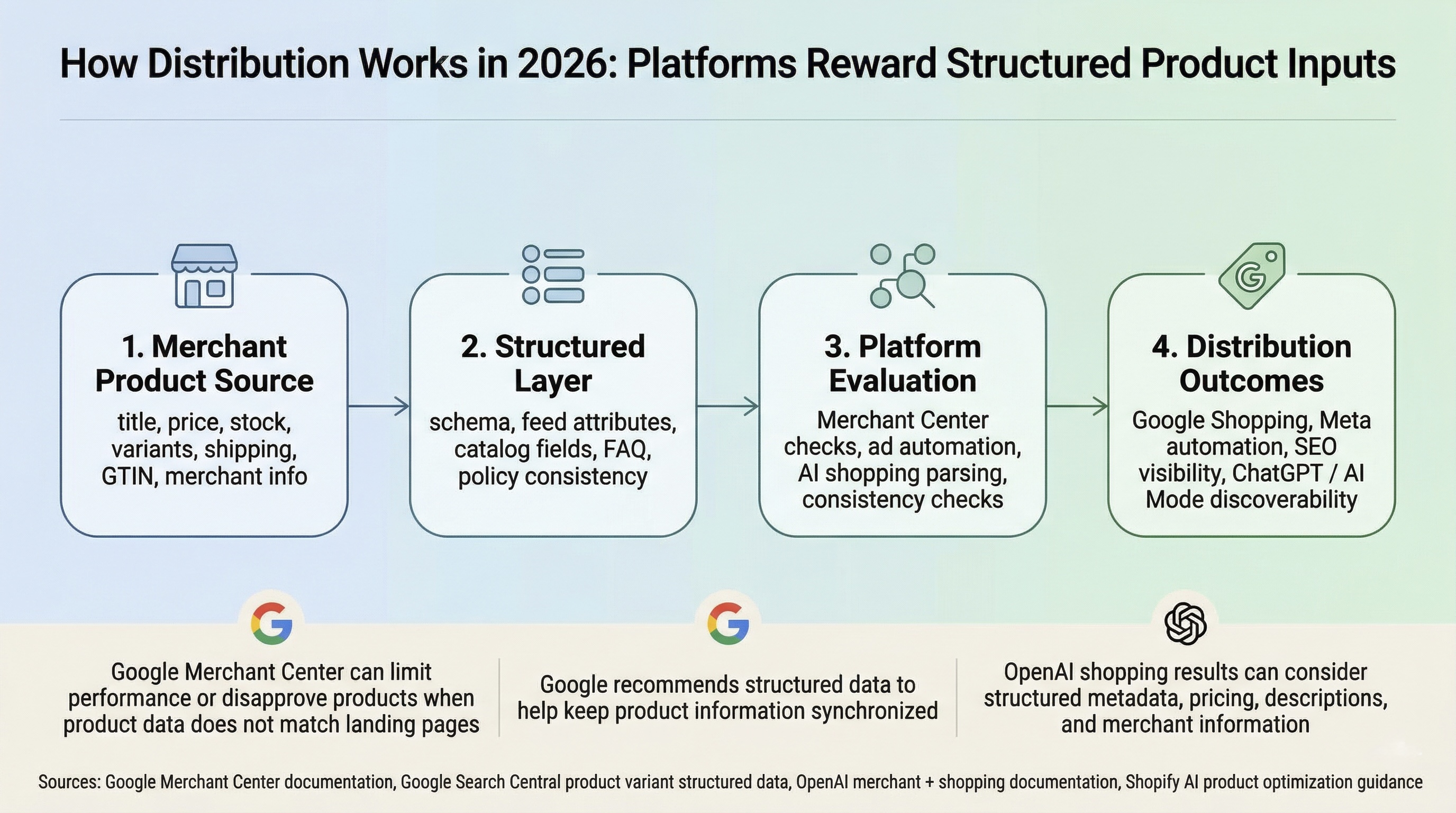
The operating loop is increasingly straightforward: cleaner merchant product inputs feed cleaner structured layers, which lead to better platform evaluation and better distribution outcomes.
Tinuiti reported that Advantage+ Shopping Campaigns reached 38% of Meta retail ad spend in Q1 2025, up from 24% a year earlier. Tinuiti Q1 2025
By Q3 2025, Performance Max accounted for 68% of Google Shopping listings spend among retailers running both campaign types. Tinuiti Q3 2025
Google Merchant Center warns that when submitted product data does not match the website, products may be disapproved or continue to show with limited performance, including lower impressions and clicks. Google Merchant Center: product data quality violations
Google also recommends structured data when using automatic item updates so site data and Merchant Center data stay aligned. Google Merchant Center: stay approved
In other words, the ad platform increasingly wants structured product truth, not just creative and audience inputs.
AI shopping entry points are no longer theoretical
OpenAI, Google, and Shopify have all made this shift explicit:
OpenAI now lets merchants participate in ChatGPT product discovery through product feeds. OpenAI merchants
OpenAI says ChatGPT shopping can consider structured metadata, pricing, descriptions, and merchant information. Shopping with ChatGPT Search
Google introduced AI Mode shopping in May 2025 and highlighted the scale and refresh frequency of the Shopping Graph. Google, May 20 2025
In March 2026, Google expanded more personalized shopping recommendations in the U.S. Google, Mar 17 2026
Tinuiti’s Q1 2026 AI Citation Trends Report already tracks ChatGPT, Google AI Mode, Google AI Overviews, Gemini, Copilot, and Meta AI in one citation framework. In January 2026, social media accounted for 9% of total citations, and social content was cited more than 4x as often by AI Overviews as by Gemini. Tinuiti Q1 2026 AI Citation Trends
Shopify now has official guidance on optimizing products for AI platforms, including titles, images, product organization, variants, barcodes, and FAQs. Shopify: Optimizing your products for AI platforms
That means merchants are no longer choosing a platform just for storefront delivery.
They are choosing the system that determines whether their catalog can be understood well enough to earn distribution.
2. Why merchants now need precision, not just more spend
When traffic gets more expensive and platforms become more automated, the answer is not simply “buy more traffic.”
The answer is to make each unit of traffic more precise and more efficient.
That depends on infrastructure, not just campaign tactics.
Merchants increasingly need:
region-specific storefronts that match region-specific traffic
cleaner structured product data
tighter consistency between PDPs, feeds, structured data, and policy content
stronger organic and AI discoverability to offset paid pressure
That is why a lot of “media buying problems” are actually platform problems in disguise.
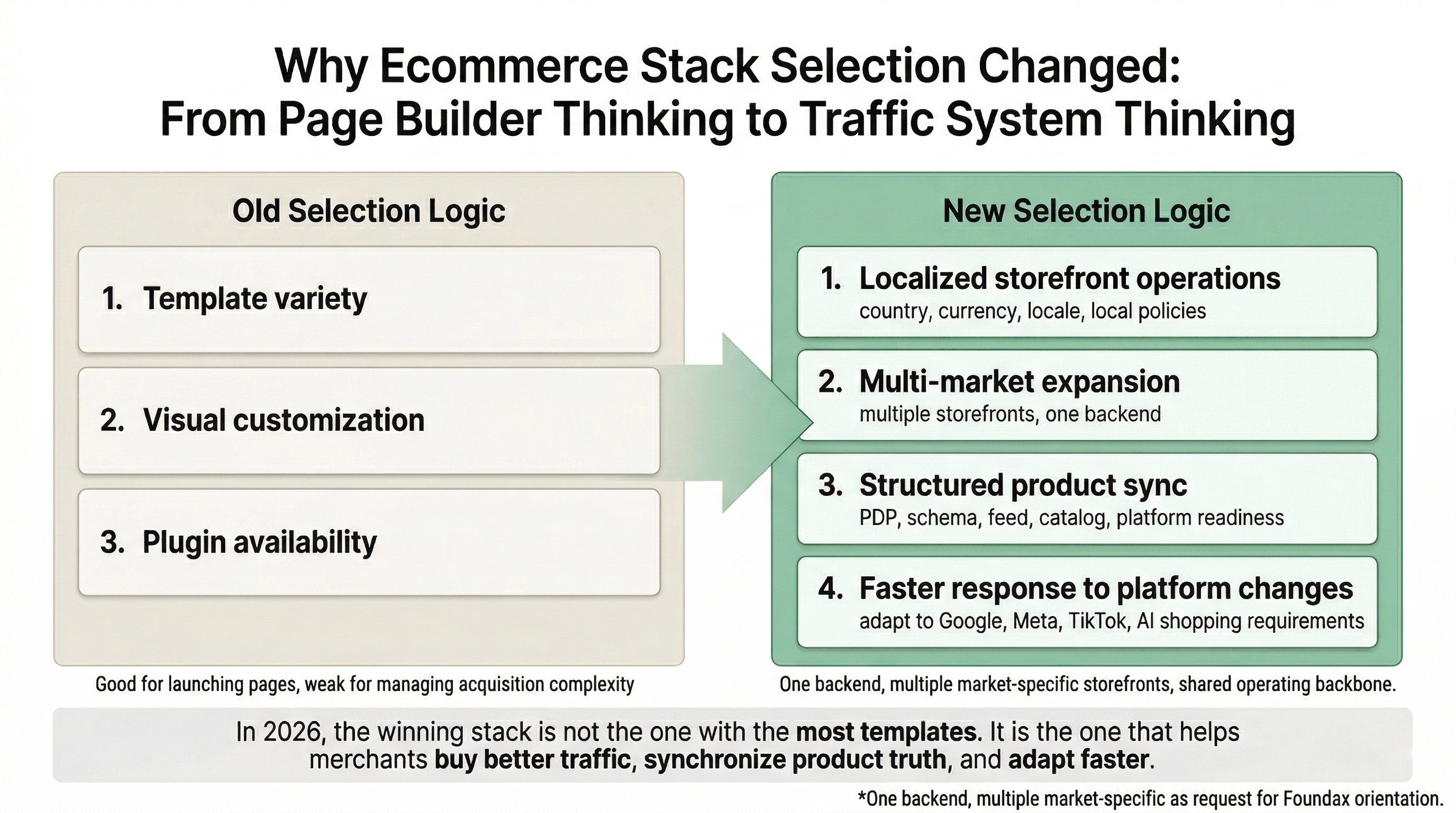
3. The 3 platform questions that matter more than template variety
The more durable 2026 growth loop is not “launch first, patch SEO later, add plugins later.” It is “build market-specific sites, structure product truth, synchronize channels, and let that same data support ads, SEO, and AI discovery.”
1) Can the platform support localized regional operations and multi-market expansion at the same time?
If you want more precise traffic, each market should usually have a clearer operational surface:
language
pricing and currency
tax and shipping promises
local FAQs and policy content
But if every new market means a new disconnected stack, operations become unmanageable.
That is why the real requirement is not “one site that awkwardly covers the world.”
It is “market-specific storefronts with centralized backend control.”
Foundax is relevant here because it already models site creation around marketCountry, currency, and enabled locales, while letting one account manage multiple websites from the same backend.
2) Can the platform connect cleanly to media platforms and synchronize structured product data?
This is where many stacks become too plugin-dependent.
Google’s own docs make the stakes clear:
mismatched product data can reduce impressions or trigger disapprovals
pricing, sale windows, shipping, GTIN, and other product attributes matter
Merchant API attributes now extend into more detailed structured product representations
Foundax’s current product implementation matters because it exposes this operational layer directly:
site-level SEO Workspace for publication state, primary domain, Google connection, Search Console, GMC preflight, and sync state
product-level SEO Workbench for source mapping, required checks, suggested checks, suppression, JSON-LD, GMC payloads, and Dry-run diffs
site-level ads conversions workspace for Google, Meta, and TikTok connection, verification, strategy control, and delivery visibility
That is much more useful than a vague “Google integration supported” claim.
3) Can the platform help you capture natural demand and increase recognition by Google Shopping and AI systems?
Merchants cannot rely on paid acquisition alone.
Google Search Central has long been explicit that variant relationships such as ProductGroup, variesBy, and hasVariant are critical for machine understanding. Google Search Central: Product variants
Foundax already supports the building blocks needed for this layer:
language-specific page SEO configuration
runtime injection of metadata including canonical and alternates
server-rendered Product JSON-LD on PDPs
dynamic robots.txt and sitemap.xml output tied to published and accessible pages
That combination is operationally important because the same structured truth supports both paid and organic visibility.
4. Why choosing a tool now means choosing an adaptation engine
In 2026, templates and visual customization are getting easier to generate.
That is not where the long-term advantage lives.
The harder part is whether your platform can keep up when Google, Meta, TikTok, ChatGPT, and other surfaces change how they evaluate merchants, products, and feeds.
That is why merchants should now ask:
Can this platform support market-by-market site operations?
Can it keep product data synchronized across website, feed, and structured output?
Can it support ads, SEO, and AI discovery using the same source of truth?
Can it productize new platform requirements quickly, instead of forcing merchants back into plugin stacking and custom patches?
Why Foundax becomes more relevant in that environment
The strongest reason to look at Foundax is not page aesthetics.
It is that Foundax is being built as an AI-native SaaS workflow rather than as a traditional CMS plus plugin pile:
SEO, product data, content, and sync workflows are being designed as one operating loop
merchants can inspect what machines are actually reading
AI capabilities are already embedded into Builder and Content Studio workflows, rather than bolted on as a separate helper
That matters because in the next wave of ecommerce infrastructure, the winning platforms will not be the ones with the longest theme marketplace.
They will be the ones that can turn changing platform requirements into merchant-usable workflows fast enough.
The most important ecommerce platform question in 2026 is no longer “Can I build a unique site?” It is “Can this system keep my acquisition engine aligned with how discovery platforms now work?”
Why can’t brands choose an ecommerce platform in 2026 by looking only at templates and the editor?
Because templates and editors mainly answer “can we build it?” The harder 2026 question is whether the platform can absorb traffic, distribute products, and support acquisition, search, and operations efficiently. The real differences increasingly sit in product structure, data sync, page performance, multi-market operations, and publishing agility.
Why does product-data structure now affect paid acquisition efficiency and AI distribution directly?
Because ad platforms, merchant systems, and AI discovery surfaces increasingly depend on product data that is readable, syncable, and comparable. If title, attributes, variants, availability, price, and landing-page structure are unstable, platforms struggle to understand the catalog and struggle to deliver it efficiently.
Why does the platform affect off-site acquisition cost, not just site-building speed?
Because the site determines landing-page speed, conversion flow, tracking quality, content support, and product-sync reliability. In practice, the platform influences not only how fast a team can publish, but also whether incoming traffic can be converted, measured, and improved economically.
How should a brand choose between one global storefront and regional storefronts?
If language, pricing, payment methods, tax logic, delivery expectations, and media strategy already differ materially by market, regional storefronts usually support growth better than one global site. If those differences are still limited, one storefront may be enough for now. The real test is whether market variation has started to hurt conversion or operating efficiency.
Which foundational capabilities should matter most when evaluating an ecommerce platform in 2026?
Start with five checks: support for regional operations, strong structured product data, maintainable content and SEO workflows, reliable distribution paths into ads and commerce surfaces, and alignment between backend data and the customer-facing site. Good templates still matter, but they should not outrank those foundations.