Cross-Border Ecommerce#how to sell consulting services#how to package expertise as a service#consulting offer#sell outcomes not services
How to Sell Consulting Services by Packaging Your Expertise
Stop selling unstructured time and start selling specific outcomes. Learn how to map your professional experience to a recurring buyer problem, set clear boundaries, and validate your first consulting offer.
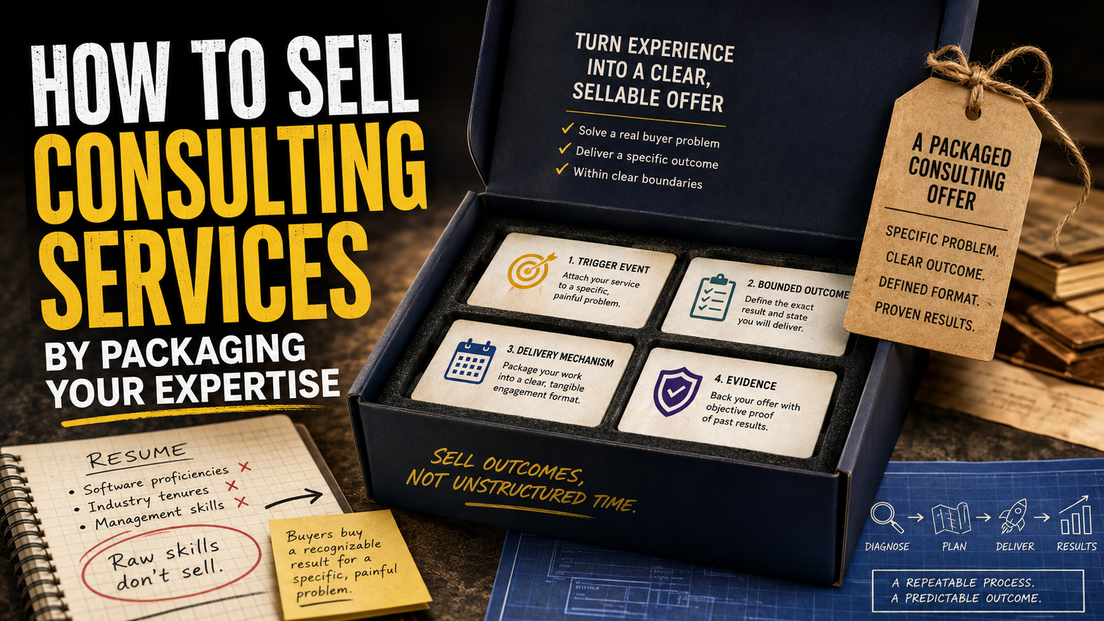
When professionals transition from employment to consulting, they often default to a familiar habit: they try to sell their resume. They pitch a list of software proficiencies, industry tenures, and management skills, hoping a client will figure out how to put those raw materials to use.
Businesses rarely buy raw skills. They buy a recognizable result for a specific, painful problem. To sell consulting services successfully, you must shift from asking "What can I do?" to "What concrete outcome can I deliver, and how can I prove it?" Packaging your expertise means translating years of varied corporate tasks into a bounded, testable service offering that buyers can immediately understand and trust.
The Outcome-Positioning Framework
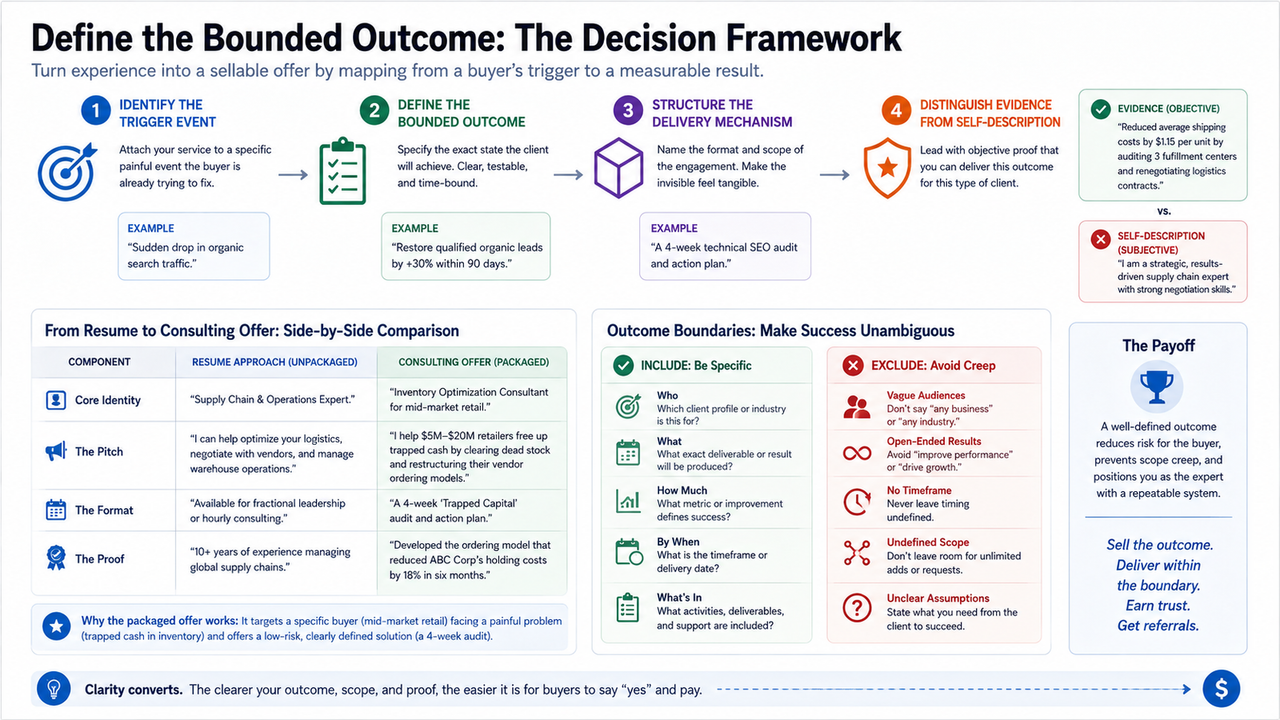
A sellable consulting offer connects a recurring buyer problem to a specific result, delivered within clear parameters. To package your knowledge, map it across these four parts.
1. Identify the Trigger Event
Clients do not wake up wanting to hire a consultant; they wake up wanting to make a headache go away. Your service must attach itself to a specific trigger.
Weak: "I help companies with marketing."
Strong: "I help B2B software companies rebuild their lead pipelines after a sudden drop in organic search traffic."
2. Define the Bounded Outcome
Consulting engagements fail when the definition of success is left vague. Buyers need to know exactly what they are purchasing. You are selling an outcome, not an indefinite retainer. Define the exact state the client will achieve when the engagement concludes.
3. Structure the Delivery Mechanism
Unpackaged consulting sounds like "I will advise you for 10 hours a week." Packaged consulting gives the buyer a tangible framework. Will the engagement be a 30-day intensive audit? A set of customized standard operating procedures (SOPs)? A 90-day implementation sprint? Naming the format makes an invisible service feel like a concrete product.
4. Distinguish Evidence from Self-Description
Trust is the currency of consulting sales. However, many new consultants confuse self-description with evidence.
Self-Description (Subjective): "I am a strategic, results-driven supply chain expert with strong negotiation skills."
Evidence (Objective): "In my last corporate role, I audited three underperforming fulfillment centers and renegotiated logistics contracts to reduce average shipping costs by $1.15 per unit."
If you do not have consulting case studies yet, use corporate outcomes only where your agreement and permissions allow it. Otherwise, create original public teardowns or self-initiated models that do not reuse confidential employer material.
Translating a Resume into a Consulting Offer
To see how packaging works in practice, consider a hypothetical example of a corporate Supply Chain Manager attempting to become an independent consultant.
If this professional relies on their resume, their pitch is unfocused. By running their history through the outcome-positioning framework, they can extract a specific, highly sellable service.
Component
Resume Approach (Unpackaged)
Consulting Offer (Packaged)
Core Identity
"Supply Chain & Operations Expert."
"Inventory Optimization Consultant for mid-market retail."
The Pitch
"I can help optimize your logistics, negotiate with vendors, and manage warehouse operations."
"I help $5M–$20M retailers free up trapped cash by clearing dead stock and restructuring their vendor ordering models."
The Format
"Available for fractional leadership or hourly consulting."
"A 4-week 'Trapped Capital' audit and action plan."
The Proof
"10+ years of experience managing global supply chains."
"Developed the ordering model that reduced ABC Corp's holding costs by 18% in six months."
The packaged offer works because it targets a specific buyer (mid-market retail) facing a painful problem (trapped cash in inventory) and offers a low-risk, clearly defined solution (a 4-week audit).
Design the Smallest Paid Test
The most difficult hurdle for a new consultant is convincing a client to sign a five-figure implementation contract. To overcome this, package a portion of your expertise into a "Gateway Offer"—the smallest paid test a client can buy to experience your methodology with minimal financial risk.
A Gateway Offer diagnoses the problem and provides a roadmap.
Instead of selling: A $25,000 custom CRM migration.
Sell: A $1,500 CRM Architecture Blueprint. You spend two weeks auditing their current messy data and hand them a step-by-step migration plan.
At the end of the blueprint phase, the client has a valuable asset they can execute themselves. However, because you have demonstrated your expertise, diagnosed their exact pain points, and built trust, the natural next step for the client is to hire you to implement the very roadmap you just designed.
Frequently Asked Questions
Should I charge hourly or by the project for my first consulting offer?
Charge by the project (flat fee) whenever possible. Hourly billing penalizes you for working quickly and makes budgeting unpredictable for the client. A flat fee for a packaged outcome aligns your goals with the client's: they want the result, and you are incentivized to deliver it efficiently.
How do I prove I can deliver if I don't have past consulting clients?
Use results from your employment history only when you can substantiate them and your agreement and permissions allow disclosure. Otherwise, create proof through original public expertise: publish clearly labeled teardowns, self-initiated examples, or frameworks that demonstrate how you think without reusing confidential material.
Do I need to pick a niche immediately to sell my services?
Yes, but a niche is a starting point, not a life sentence. To get your first clients, you must be specific enough to be noticeable. It is significantly easier to sell a service positioned as "Financial modeling for pre-seed healthcare startups" than "General financial consulting." Once you secure cash flow and client results, you can expand your positioning to adjacent industries.