Owned Web Assets: Why Brands Still Need Their Own Website
AI and social platforms make publishing easier, but brands still need owned web assets where positioning, proof, content, SEO, and conversion paths can compound.
Read more
Structure your professional experience into a clear consulting offer. This framework helps you define a recurring customer problem, choose a delivery model, and build an acquisition path before you launch.
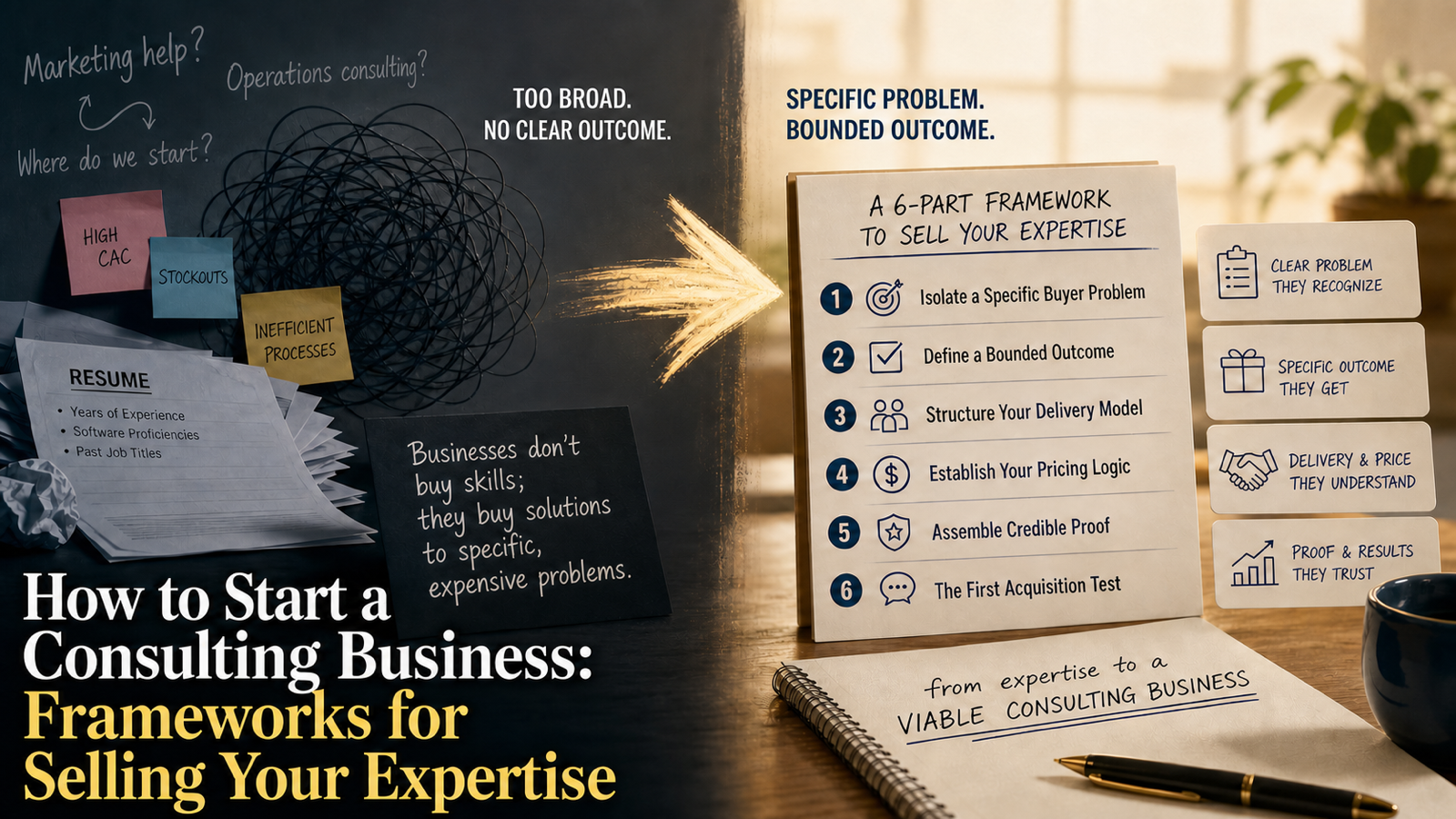
The most common mistake new consultants make is selling their resume. They list their years of experience, software proficiencies, and past job titles, expecting clients to connect the dots. But businesses do not buy skills; they buy solutions to specific, expensive problems.
Turning your professional experience into a viable consulting business requires a fundamental shift in perspective. You must repackage what you know into a structured offer where the buyer can immediately recognize the problem, understand the promised result, evaluate your proof, and see exactly how the work is delivered and purchased.
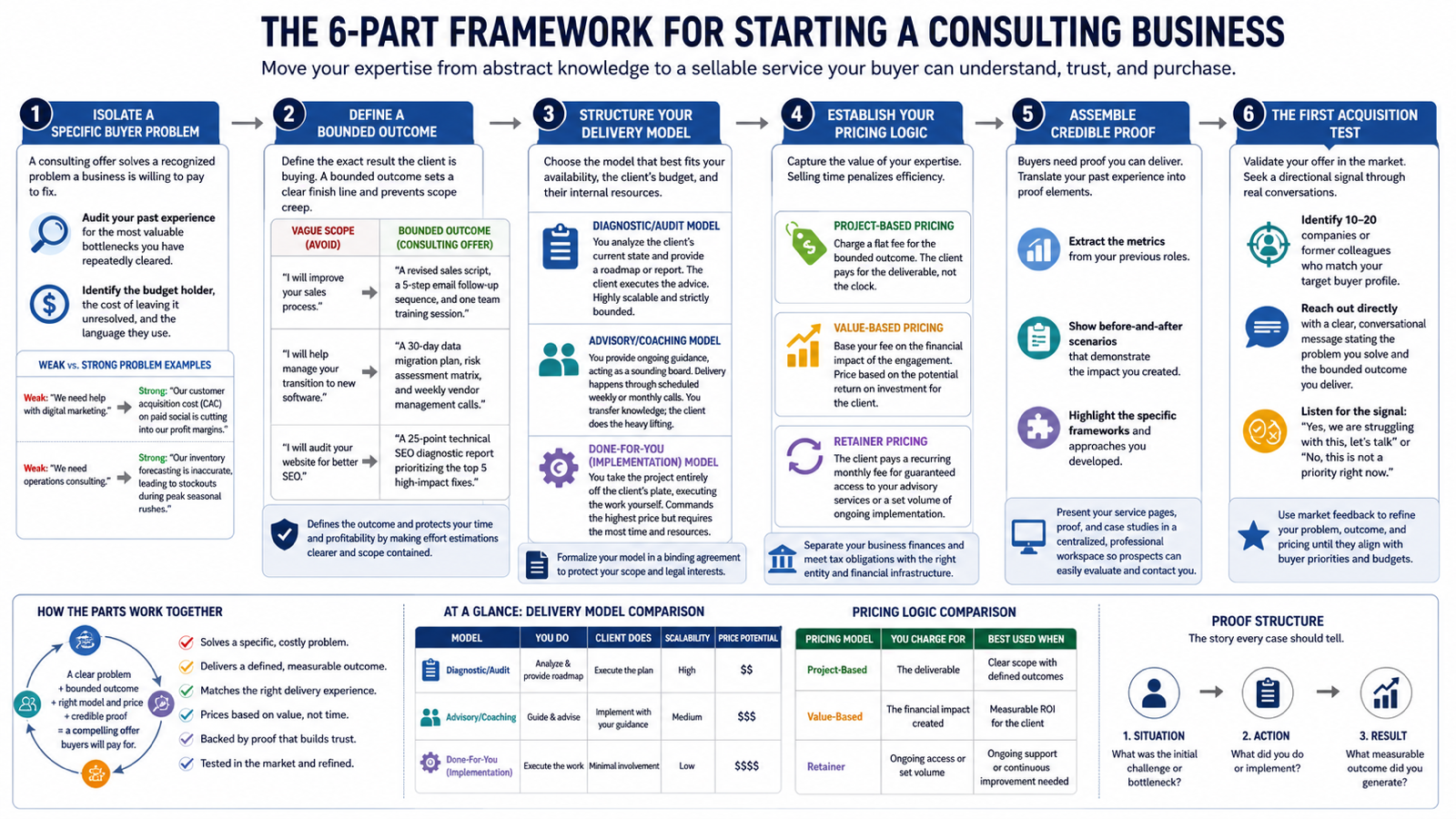
This transformation relies on a six-part decision framework that moves your expertise from abstract knowledge to a sellable service.
A consulting offer only exists if it solves a recognized problem that a business is willing to pay to fix. Generalist positioning (e.g., "marketing consultant" or "HR expert") forces the buyer to figure out how to use you. Specific positioning isolates a pain point they are already actively trying to solve.
To find your buyer problem, audit your past experience for the most valuable bottlenecks you have repeatedly cleared.
Identify who holds the budget to solve this problem, what it costs them to leave it unresolved, and what language they use to describe it.
Once the problem is clear, you must define the exact result the client is buying. Without a bounded outcome, consulting engagements suffer from severe scope creep, where the client assumes you are available to fix adjacent issues at no extra cost.
A bounded outcome provides a clear finish line. It tells the client exactly what they walk away with when the engagement concludes.
| Vague Scope (Avoid) | Bounded Outcome (Consulting Offer) |
|---|---|
| "I will improve your sales process." | "A revised sales script, a 5-step email follow-up sequence, and one team training session." |
| "I will help manage your transition to new software." | "A 30-day data migration plan, risk assessment matrix, and weekly vendor management calls." |
| "I will audit your website for better SEO." | "A 25-point technical SEO diagnostic report prioritizing the top 5 high-impact fixes." |
By defining the outcome, you also protect your own time and profitability, making it easier to estimate the effort required to fulfill the contract.
You can deliver the same bounded outcome in multiple ways depending on your availability, the client's budget, and their internal resources. Selecting the right delivery model clarifies how the client will experience your expertise.
Pricing logic determines how you capture the value of your expertise. While many beginners default to an hourly rate because it feels familiar, selling time penalizes efficiency. If you get faster at solving a problem through experience, an hourly rate means you earn less for doing a better job.
Instead, build your pricing logic around the project or the value delivered:
No matter how clear your problem and outcome are, a buyer will not purchase without proof that you can deliver. If you are starting out and do not have consulting case studies yet, you must translate your corporate or past experience into proof elements.
Extract the metrics, before-and-after scenarios, and specific frameworks you developed in your previous roles. Structure your proof by highlighting the initial situation, the action you took, and the measurable result.
Once your positioning and proof are structured, you need a centralized place for prospects to evaluate them. Foundax serves as an editable website and content workspace where you can present your service pages, publish your translated proof and case studies, and offer a clear, professional inquiry path for prospective clients to contact you.
The final stage of starting a consulting business is validating your offer in the market. Do not wait for a perfect brand identity to begin testing whether businesses will actually pay for your solution.
Identify 10 to 20 specific companies or former colleagues in your network who match your target buyer profile. Reach out with a direct, conversational message that clearly states the problem you solve and the bounded outcome you deliver.
The goal of this initial acquisition test is not a finalized contract on the first message, but a directional signal. You are looking for a clear "Yes, we are struggling with this, let's talk" or a "No, this is not a priority right now." Market feedback will immediately reveal if your problem is too broad, your outcome too vague, or your pricing logic misaligned with the buyer's budget. Refine the framework based on these conversations to build a sustainable pipeline.
Transition away from hourly billing and use project-based or value-based pricing. Define a strict scope of work with a specific deliverable, and tie your price directly to the business outcome you provide the buyer. Calculate the baseline value of the problem you are solving for the client, and price your offer based on the potential return on investment rather than the hours it takes you to complete the work.
Outline the exact deliverables, milestones, and revision limits in your initial project proposal before any work begins. Build your bounded offer so the client knows exactly what is included. If a buyer requests additional features or services outside this scope, acknowledge the request and present a separate price quote for the new work rather than absorbing it into the original project.
Leverage your past professional career experience as your initial proof of competence. Frame your previous internal achievements as evidence of your ability, detailing the specific problems you solved and the measurable outcomes you generated. To secure your first buyer, pitch a highly specific, smaller-scale audit or strategy roadmap to build trust and demonstrate your framework before proposing a larger implementation project.
Evaluating a Realistic AI Side Hustle: From Skills to Paid Services