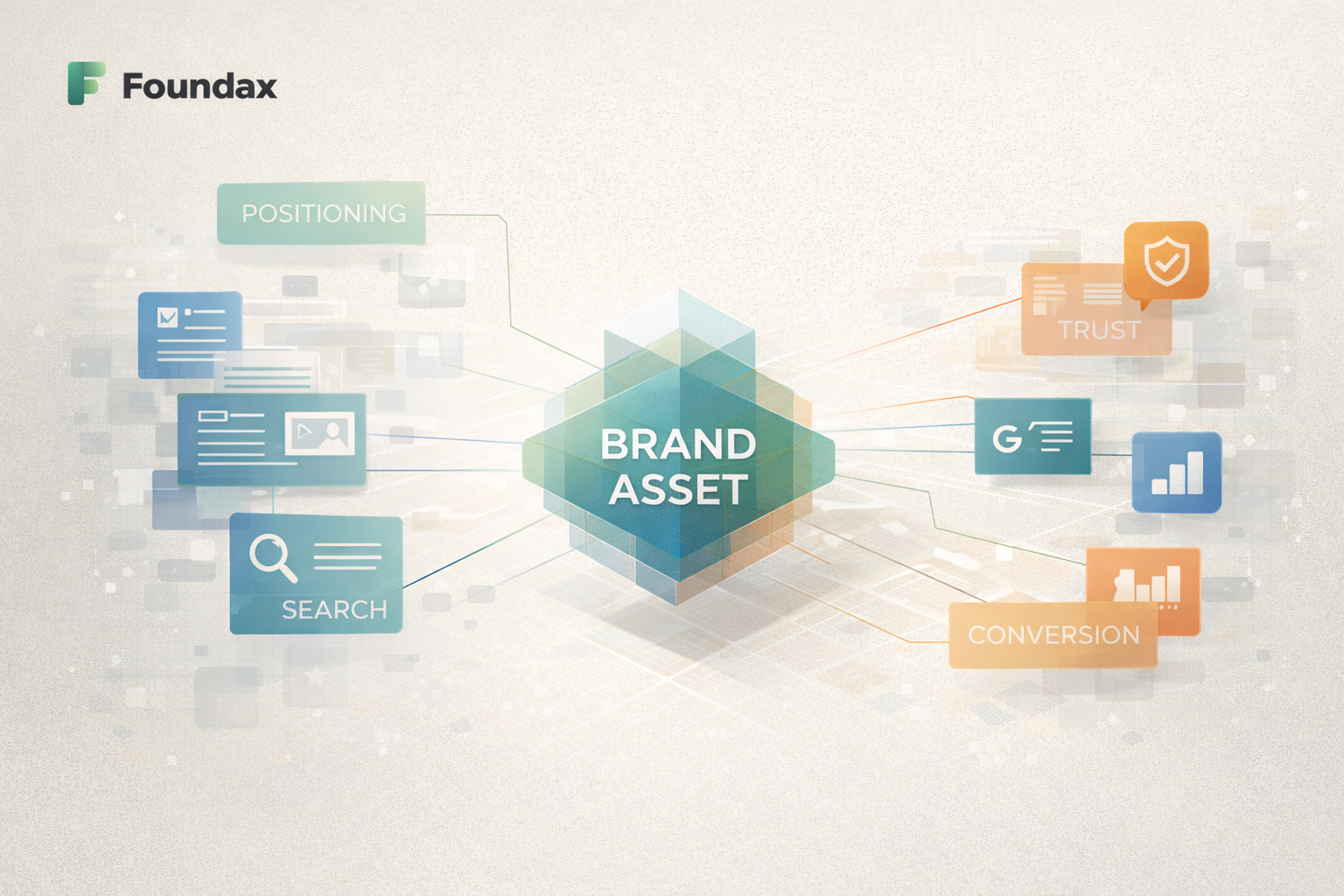
Publishing is easier than ever, but durable brand assets still need an owned surface. A website gives your positioning, proof, content, FAQs, SEO, and conversion paths a place to compound.
Individuals finally have the operating conditions to build brand seriously
Historically, people did not neglect brand because they failed to understand it. They neglected it because the cost was too high.
To build a credible brand presence, you needed copy, visuals, structure, service positioning, case studies, FAQs, regular content, and some level of consistency across channels. Each task felt manageable in isolation. Together, they became operationally heavy.
That is why many “personal brands” used to stop at the shallow layer: a few social accounts, some sporadic content, a short profile, maybe a portfolio page.
AI changes this.
Today, one person can do a meaningful amount of what used to require multiple collaborators: clarify positioning, rewrite messaging, draft articles, generate FAQs, assist page building, localize content, and keep site assets updated. AI does not create a brand for you, but it does lower the operating cost of building one.
That is why 2026 is not just another moment when “brand is important.” It is a moment when smaller operators finally have the practical conditions to treat brand like a serious operating asset.
AI did not make brand less valuable. It made it more valuable.
One common misconception about the AI era is that if pages, visuals, and copy are all easier to generate, then brand should matter less.
The opposite is happening.
AI made production cheaper. It did not make user trust cheaper.
Users still ask the same fundamental questions:
- Who are you?
- What are you actually good at?
- Why should I trust you?
- How are you meaningfully different from the dozens of similar options around you?
- Will I remember you next time?
AI does not automatically create memorability. It does not automatically create trust. So a paradox appears:
The more content there is, the more brand matters. The easier pages become to produce, the more valuable consistent expression becomes. The more tools are democratized, the more positioning and recall matter.
Ahrefs found that 74.2% of newly published webpages in April 2025 showed signs of AI-generated content. The headline is not just that AI content is everywhere. The deeper point is that the internet will increasingly overflow with content that feels superficially acceptable.ahrefs.com
That means the scarce asset is no longer “Can you make a page?” It is “Can you still be remembered when many pages look similar?”
The challenge is not only content oversupply. The channels changed too.
Why personal brand in 2026 is no longer just “build a homepage”
Brand assets are no longer just a profile page or a polished bio. In practice, they work more like a searchable, revisitable content system. People discover you through search, AI summaries, recommendations, and content paths, and those entry points need to converge into one coherent identity.
If this were only a content-volume problem, the story would be simpler. But distribution itself is changing.
Alphabet said in its 2025 Q1 earnings call that AI Overviews already reached more than 1.5 billion monthly users. Pew Research Center later found that when AI summaries appear on Google results pages, users click traditional result links less often than when no AI summary is present.abc.xyz pewresearch.org
That matters because the old logic of “some traffic is enough” gets weaker in a summary-first environment. Users increasingly scan conclusions first, evaluate the source quickly, and only then decide whether to click through.
As the decision path gets shorter, brand becomes more important. In low-attention environments, users lean more on signals like:
- Do I recognize this name?
- Does this source feel coherent and professional?
- Is this something I would trust enough to keep reading?
- Will I be able to find this person or company again?
Edelman’s 2025 brand trust work reinforces this direction: relevance, responsiveness, and clear action become central to brand trust in volatile environments. In practice, that means users want brands that feel both credible and repeatedly findable.edelman.com
What is the difference between a personal brand website and a social profile?
A social profile is usually borrowed distribution. It can help people notice you, but it rarely holds your case studies, FAQs, searchable structure, offer explanation, and next-step conversion path in one place.
That is why serious personal brand assets usually need an owned surface. A website or content hub gives you one place where positioning, proof, content, and action can reinforce each other over time.
The stronger AI gets, the more STP matters again
People often talk about AI in terms of efficiency. That is only part of the story.
Once everyone’s production efficiency rises, differentiation returns to one of the oldest strategic frameworks in marketing: STP — Segmentation, Targeting, Positioning.
1) Segmentation: not everyone is your customer
AI makes it easy to produce lots of material. It also tempts people into saying a little bit about everything. The result is often more output but less clarity.
2) Targeting: not all traffic is worth chasing
As distribution becomes more fragmented, visibility is no longer the same thing as useful attention. The ability to choose a target audience clearly, and speak in terms that audience recognizes, becomes more valuable.
3) Positioning: not what you can do, but how people remember you
How do brand assets connect to content SEO?
Content SEO is not just a traffic tactic. When content is organized around a stable point of view, it becomes one of the mechanisms that compounds a brand over time. Search visibility and brand recall start reinforcing each other instead of competing for attention.
Why does AI make personal brands easier to produce and easier to forget?
Because AI reduces the cost of producing pages, visuals, and copy for everyone. That makes output easier, but memorability harder. The more content looks acceptable, the more users rely on positioning and consistency to decide whom to remember. Positioning has never been a feature list. It is the sentence that remains in someone’s mind after they leave. In an AI era, that matters even more, because “we can generate pages,” “we use AI,” and “we can ship fast” are no longer distinctive claims by themselves.
So the renewed importance of brand in 2026 is not mysterious. It is just the market rewarding teams and individuals who can still define themselves clearly when production is easy for everyone.
In homogeneous markets, the winner is often not the one with the most features
This logic becomes especially visible in AI markets.
There is no shortage of model wrappers, workflow tools, demo pages, and feature bundles. What is scarce is cognitive position.
Manus reportedly built up a waitlist of roughly 2 million people during its invite period in 2025, and later disclosed run-rate and ARR milestones through company channels. Whether every number remains durable is a separate question. What matters strategically is that clear positioning can compound very quickly when the market is noisy.reuters.com manus.im
MiniMax’s 2025 financial disclosure tells a similar story from another angle: scale came not just from model capability, but from being legible enough to travel across markets and user segments.minimax.io
OpenClaw is useful in a different way. It is not cited here as proof of commercial scale. It is useful because it shows how even an open-source project can state its purpose so clearly that users instantly understand what it is for.github.com
That pattern extends far beyond AI. In highly similar markets, people remember the offer that is easiest to categorize and easiest to trust.
So what are “brand assets” in 2026?
By this point, “brand” cannot stay abstract.
In 2026, brand assets are not just logos, slogans, and visual style systems. At minimum, they include:
- a stable identity statement
- a coherent tone and positioning system
- a website or homepage that can hold search traffic, intros, case studies, FAQs, offers, and contact paths
- a content entry point that compounds your ideas over time
- a revisit path that does not depend entirely on platform algorithms
- a structure that turns exposure into trust and trust into conversion
That is what brand asset really means today.
It is a searchable, linkable, revisit-able, update-able system. It is not a lucky post. It is not a temporary wave on a social platform. It is not “a decent-looking page.”
It is the thing that makes you easier to find, easier to trust, and easier to remember when the user comes back with the same need later.
Why the real job is to protect your attention for the high-value parts
Once you define brand assets this way, the question stops being whether to build them. The question becomes how.
The answer is hiding in the earlier logic.
AI lowers production cost. But it also raises the stakes of sameness. If pages, content, and product expression are all easier to make, then the market rewards the teams that spend more attention on the brand itself — not the teams that burn most of their time rebuilding the same infrastructure over and over.
The high-value work is:
- deciding who you serve
- clarifying what makes you different
- keeping expression consistent
- building a coherent content spine
- ensuring users see the same underlying identity across surfaces
The low-return but time-consuming work is everything underneath it:
- rebuilding page structures manually
- maintaining publishing flow by hand
- keeping multi-page consistency in sync
- stitching together FAQs, service pages, content, and conversion paths repeatedly
- fixing the same structural problems every time the site evolves
Those tasks matter. But they are infrastructure tasks, not the brand itself.
That is why it increasingly makes sense to offload more of the infrastructure layer and preserve your time for the parts that actually create differentiation.
If you are a solo operator or small team, which brand assets should you build first?
If you do not want to overbuild from day one, start with these layers:
- one clear page that explains who you are, who you help, and what problem you solve
- a small set of case-study, FAQ, or service pages that help visitors evaluate you
- three to five recurring content themes tied to a stable positioning
- one explicit contact, consultation, or conversion path so attention does not dissipate
The point is not to ship everything at once. The point is to create a structure that lets content, search, and trust accumulate instead of resetting every time.
Foundax is not just “a tool to make pages”
If you interpret Foundax narrowly as a website builder, you miss the more important part.
Foundax is more useful when you understand it as infrastructure for turning fragmented expression into a compoundable brand system.
It does not define your positioning for you. It does not generate conviction for you. It does not invent your point of view.
What it does support is the layer that tends to consume time, fragment execution, and create inconsistency:
- search entry points
- content surfaces
- site structure
- FAQs and case pages
- multi-page consistency
- branded publishing rhythm
- the connective tissue between visibility, trust, and conversion
That is the real SaaS value in this environment. Not replacing your thinking, but helping your thinking survive contact with execution.
Conclusion
If the whole argument had to collapse into one sentence, it would be this:
AI is making production cheaper, which is exactly why brand is becoming more expensive again.
Brand used to look like a late-stage enterprise concern. Now AI has opened the door for individuals to participate in brand-building seriously. But at the same time, AI has intensified sameness and compressed user attention.
That is why 2026 is a good moment to stop treating brand like a luxury layer and start treating it like infrastructure.
In a noisier, faster, more homogeneous internet, the teams and individuals that endure are rarely the ones with the most content. They are the ones with the clearest position, the most stable expression, and the most complete path back to themselves.
---
If you want the product-and-distribution argument for why the web is becoming strategically important again, read the companion article: AI Lowered Build Costs, Not App Friction. Why More Products May Return to the Web. If you are ready to turn proof, FAQs, and content into long-term brand assets, review pricing.
FAQ
What is the real difference between personal brand assets and a social profile?
Social profiles are usually distribution entry points inside borrowed platforms. They can help people notice you, but they rarely hold search visibility, proof, FAQs, service framing, and return paths in one stable system. Personal brand assets are the owned layer that lets those elements accumulate instead of resetting with each platform update.
Why does an AI era make websites, FAQs, and long-term content more important for personal brands?
Because more judgments now happen inside search results, AI summaries, recommendation surfaces, and short-form evaluation paths. People often decide whether to trust you after scanning your framing, FAQ, examples, and structure, not after reading everything you have ever posted. That makes structured brand surfaces more valuable than scattered activity alone.
What kinds of content should personal-brand SEO start with?
Start with content tied directly to real business questions: service explainers, methodology pieces, case breakdowns, decision-stage FAQs, comparisons, and recurring client questions. Those formats match search intent better and strengthen positioning at the same time.
How should STP show up in a personal brand website and content system?
Segmentation determines whom the site is actually built for. Targeting determines which problems, queries, and conversion paths deserve priority. Positioning determines why the homepage framing, proof, FAQ angles, and editorial themes feel memorable. STP is not abstract strategy here. It becomes visible in the structure of the site itself.
What kinds of content are most likely to compound into durable brand assets?
Usually content that does not expire with platform cycles and continues to answer real audience questions: case studies, frameworks, FAQs, decision guides, point-of-view articles, and clear boundaries around what you do and do not solve. The more often a page can be searched, cited, and revisited, the more it behaves like an asset rather than a short-lived post.
Related reading
---
References
- Ahrefs, 74% of New Webpages Include AI Content Read the source
- Alphabet Investor Relations, 2025 Q1 Earnings Call Read the source
- Pew Research Center, Google users are less likely to click on links when an AI summary appears in the results, July 22, 2025 Read the source
- Edelman, 2025 Trust Barometer Special Report: Brands Read the source
- Reuters, Beijing boosts AI startup Manus, as China looks for the next DeepSeek, March 21, 2025 Read the source
- Manus, Manus Update: $100M ARR, $125M revenue run-rate Read the source
- MiniMax, MiniMax Global Announces Full Year 2025 Financial Results Read the source
- OpenClaw GitHub repository Read the source