Cross-Border Ecommerce#how to build a portfolio with no experience#portfolio with no clients#portfolio examples without paid work#spec work portfolio
How to Build a Freelance Portfolio With No Client Experience
Create ethical substitute proof when you lack paid case studies. Use self-initiated samples, process walkthroughs, and small pilots to demonstrate your reasoning and build trust with your first clients.
Clients buy predictability, not raw skills. When you enter the independent market without a history of paid client outcomes, your portfolio must engineer that predictability from scratch. You cannot invent testimonials or claim hypothetical revenue results, but you can document your commercial reasoning, demonstrate your execution speed, and prove your baseline competence through targeted, unpaid projects.
A new portfolio should never pretend that a practice project was a paid client result. Instead, it must clearly categorize the work, focus on the problem-solving process, and present the final asset as a deliberate business solution.
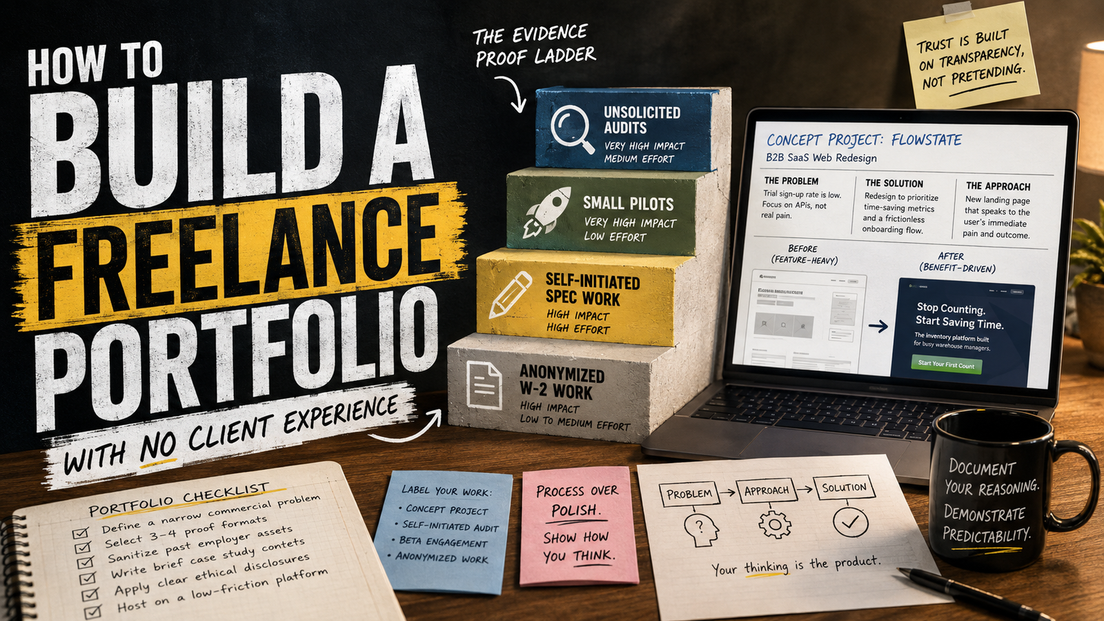
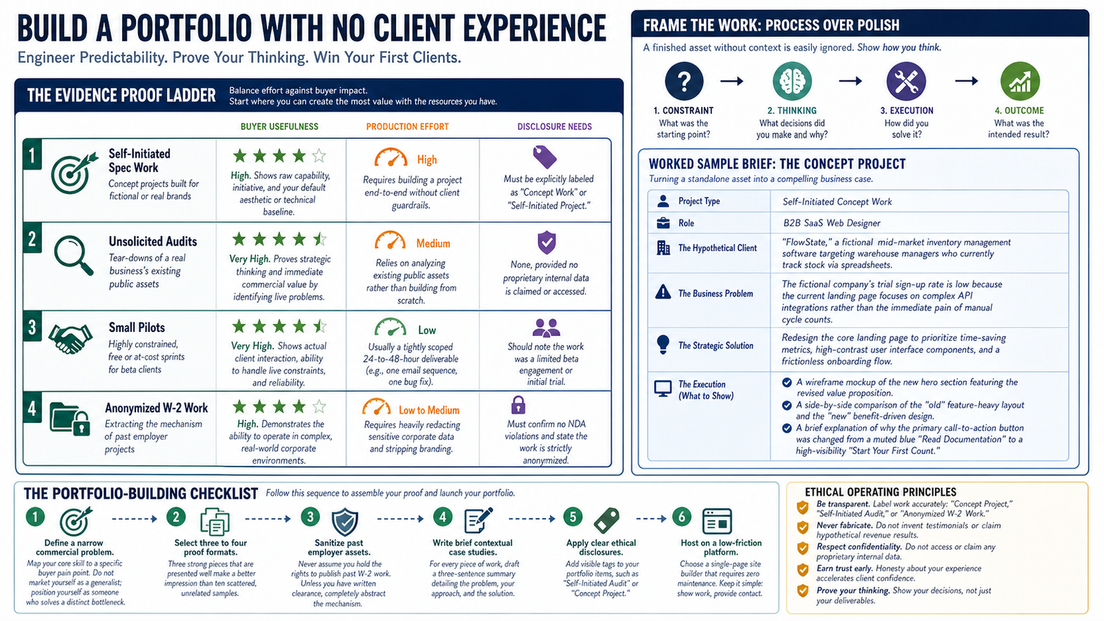
The Evidence Proof Ladder
Not all unpaid work carries the same weight. You must balance how much effort a piece takes to produce against how persuasive it is to a buyer. This proof ladder compares the four primary ways to demonstrate your value without a traditional client roster.
Evidence Format
Buyer Usefulness
Production Effort
Disclosure Needs
Self-Initiated Spec Work (Concept projects built for fictional or real brands)
High. Shows raw capability, initiative, and your default aesthetic or technical baseline.
High. Requires building a project end-to-end without client guardrails.
Must be explicitly labeled as "Concept Work" or "Self-Initiated Project."
Unsolicited Audits (Tear-downs of a real business's existing public assets)
Very High. Proves strategic thinking and immediate commercial value by identifying live problems.
Medium. Relies on analyzing existing public assets rather than building from scratch.
Use public information only, avoid implying endorsement, and do not include confidential or restricted material.
Small Pilots (Highly constrained, free or at-cost sprints for beta clients)
Very High. Shows actual client interaction, ability to handle live constraints, and reliability.
Low. Usually a tightly scoped 24-to-48-hour deliverable (e.g., one email sequence, one bug fix).
Should note the work was a limited beta engagement or initial trial.
Prior Employer Work (only where your agreement and written authorization permit it)
High. Can demonstrate the ability to operate in complex, real-world corporate environments.
Medium. Requires a rights and confidentiality review before publication.
Obtain written permission or create a fresh, self-initiated example without employer material.
Framing the Work: Process Over Polish
A finished asset without context is easily ignored. Case studies differentiate your freelance portfolio from a simple gallery of images and demonstrate professional thinking, not just execution. When building proof without paid clients, the framing carries the weight.
Instead of uploading a standalone logo design, a solitary blog post, or a code snippet, you must wrap the asset in a narrative. Explain the initial constraint, the decisions you made, and the intended outcome. Showing a potential client how you think through a problem is often more persuasive than the final artifact itself.
Worked Sample Brief: The Concept Project
When you have no client brief, you must write one for yourself. This structure turns a standalone self-initiated asset into a compelling business case.
Project Type: Self-Initiated Concept Work
Role: B2B SaaS Web Designer
The Hypothetical Client: "FlowState," a fictional mid-market inventory management software targeting warehouse managers who currently track stock via spreadsheets.
The Business Problem: The fictional company's trial sign-up rate is low because the current landing page focuses on complex API integrations rather than the immediate pain of manual cycle counts.
The Strategic Solution: Redesign the core landing page to prioritize time-saving metrics, high-contrast user interface components, and a frictionless onboarding flow.
The Execution (What to Show):
A wireframe mockup of the new hero section featuring the revised value proposition.
A side-by-side comparison of the "old" feature-heavy layout and the "new" benefit-driven design.
A brief explanation of why the primary call-to-action button was changed from a muted blue "Read Documentation" to a high-visibility "Start Your First Count."
The Portfolio-Building Checklist
Use this structured sequence to assemble your proof and launch your portfolio efficiently.
Define a narrow commercial problem. Map your core skill to a specific buyer pain point. Do not market yourself as a generalist; position yourself as someone who solves a distinct bottleneck.
Select three to four proof formats. Three strong pieces that are presented well make a better impression than ten scattered, unrelated samples.
Sanitize past employer assets. Never assume you hold the rights to publish past W-2 work. Unless you have written clearance, completely abstract the mechanism or build a new concept piece that mimics the complexity of your previous job without exposing proprietary data.
Write brief contextual case studies. For every piece of work, draft a three-sentence summary detailing the problem, your approach, and the solution.
Apply clear ethical disclosures. Add visible tags to your portfolio items, such as "Self-Initiated Audit" or "Concept Project," to maintain total transparency with prospects.
Host on a low-friction platform. Choose a single-page site builder that requires zero maintenance. Your goal is to host your work and provide a clear contact method, not to manage complex web infrastructure.
Frequently Asked Questions
Do I need to tell prospects that a portfolio piece was a personal project?
Yes. Labeling work as a "Concept Project" or "Self-Initiated" builds immediate trust. Clients value the initiative it takes to build a speculative project, but claiming a fictional brand was a paying client permanently destroys your credibility the moment they check your references.
How many samples do I need to launch my freelance business?
Three to six tightly curated, niche-matched samples are enough to start. A highly focused portfolio out-converts a scattered gallery. Do not dilute your strongest three pieces by adding mediocre college assignments or unrelated hobby projects just to increase visual bulk.
Can I use W-2 employer work in my freelance portfolio?
Review your employment agreement, confidentiality obligations, and ownership terms first. Obtain explicit written permission before publishing employer or agency material. If permission is unavailable, create a fresh, self-initiated example without copying protected or confidential material; seek qualified advice when the rights are unclear.