Consulting Pricing Models: Fixed, Hourly, or Retainer?
Compare the pros and cons of common consulting pricing structures. Decide whether an hourly, fixed-fee, retainer, or value-linked model best fits your service scope, risk level, and ongoing responsibilities.
Every time you draft a proposal from scratch, you absorb the risk of undefined boundaries. Setting a price is not just about picking a number; it is about allocating risk, defining exact responsibilities, and establishing a protocol for when a client inevitably asks for additional work. Choosing between hourly, fixed-fee, retainer, or value-linked pricing dictates who pays the penalty for inefficiency, delays, and scope creep.
If you frequently face price pressure or find yourself performing uncompensated revisions, the root cause is rarely the dollar amount. It is usually a mismatch between the pricing model and the certainty of the project's scope.
How to Match Your Pricing Model to Project Risk
No single pricing structure works for every engagement. The right choice depends entirely on how well you can predict the required effort and how much control you have over the client's internal bottlenecks.
Pricing Model
How It Works
When It Fits (Low Risk)
When It Fails (High Risk)
Hourly
Billing for exact time spent.
Discovery phases, highly ambiguous projects, or troubleshooting where scope is unknown.
Repetitive tasks where you become faster over time, effectively penalizing your own efficiency.
Fixed-Fee
A single set price for a strictly defined deliverable.
Productized services, audits, or standardized deliverables with a predictable workflow.
Engagements dependent on client data, subjective approvals, or open-ended strategic advisory.
Retainer
A recurring fee for a guaranteed block of time, access, or ongoing deliverables.
Ongoing advisory, fractional executive roles, or routine monthly maintenance.
Short-term turnarounds, highly variable monthly workloads, or clients who refuse to define "fair use."
Value-Based
Pricing based on a percentage of the financial impact (revenue gained or costs saved).
High-trust relationships where baseline metrics are crystal clear and you control the outcome.
Implementation relies heavily on the client’s team, or baseline metrics are non-existent/messy.
Hybrid
Combining models (e.g., fixed fee for a diagnostic phase, hourly for implementation).
Complex transformations requiring an initial audit before execution can be accurately scoped.
Simple, transactional tasks where blended models overcomplicate the buying process.
Controlling Scope with a Reusable Service Card
Consultants often absorb unplanned requests because the initial proposal outlined the goal but failed to restrict the inputs and revisions. To decouple your time from scope creep, build a reusable "Service Card" for your core offerings.
A Service Card acts as a firm boundary. By presenting your services as distinct, bounded products, you shift the conversation from "What can you do for us?" to "Here is exactly what this engagement includes."
Standard Service Card Framework:
Service Name: [e.g., Supply Chain Vulnerability Audit]
Target Outcome: [e.g., A prioritized risk matrix of tier-1 and tier-2 suppliers]
Required Client Inputs: [e.g., Full access to procurement software and vendor contracts by Day 3. Note: Delays in inputs pause the delivery timeline.]
Deliverables: [e.g., One 15-page PDF report, one 60-minute executive presentation.]
Included Revisions: [e.g., One round of factual corrections within 5 days of delivery. Subjective redesigns or new data requests require a change order.]
Out of Scope (Explicit Exclusions): [e.g., Vendor contract renegotiation, implementation of new procurement software.]
Hypothetical Pricing Decision and Change-Order Path
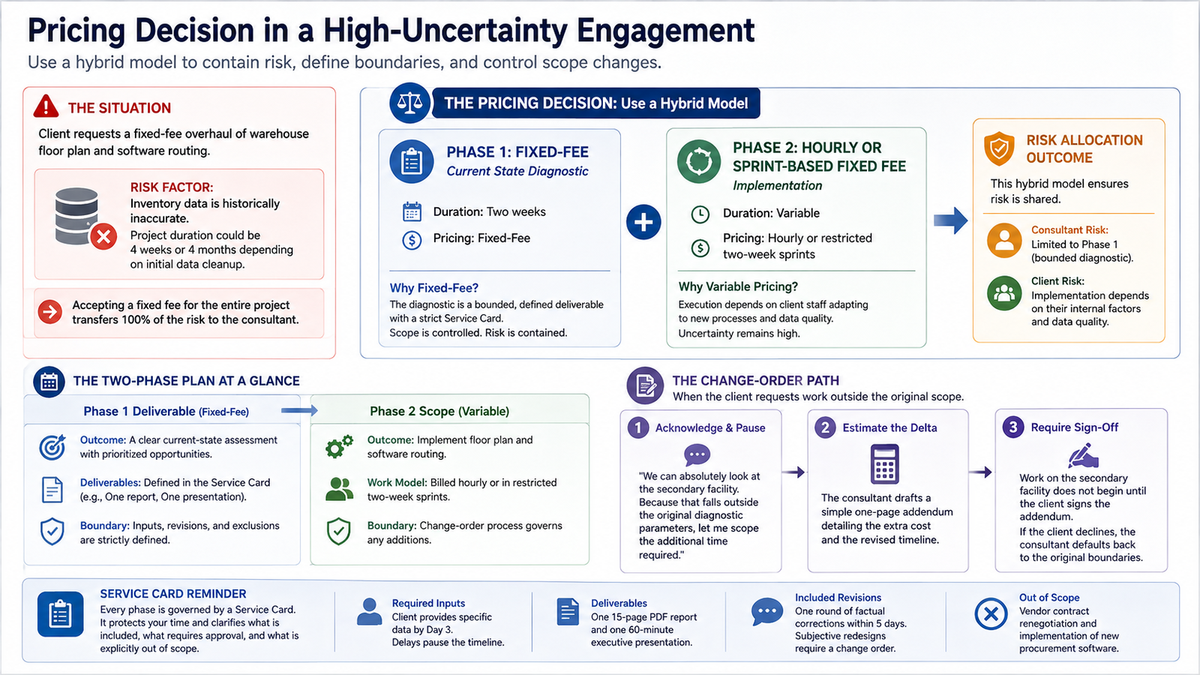
Consider a scenario where an operations consultant is hired to streamline a mid-sized distributor's warehouse workflow.
The Assumptions:
The client requests a fixed-fee proposal to completely overhaul their warehouse floor plan and software routing. However, the consultant knows that the client’s existing inventory data is historically inaccurate, meaning the project could take four weeks or four months depending on what the initial data cleanup reveals.
The Pricing Decision:
Accepting a fixed fee for the entire project transfers 100% of the risk to the consultant. Instead, the consultant implements a Hybrid Model:
Phase 1 (Fixed-Fee): A bounded, two-week "Current State Diagnostic" using a strict Service Card.
Phase 2 (Hourly or Sprint-Based Fixed Fee): Implementation of the floor plan and software routing, billed hourly or in heavily restricted two-week sprints, because the execution depends on the client’s warehouse staff adapting to the new processes.
The Change-Order Path:
During Phase 1, the client asks the consultant to also evaluate their secondary distribution center in another state—a classic scope expansion. The consultant relies on a predetermined change-order protocol:
Acknowledge and Pause: "We can absolutely look at the secondary facility. Because that falls outside the original diagnostic parameters, let me scope the additional time required."
Estimate the Delta: The consultant drafts a simple one-page addendum detailing the extra cost and the revised timeline.
Require Sign-Off: Work on the secondary facility does not begin until the client signs the addendum. If the client declines the extra cost, the consultant firmly defaults back to the original boundaries of the Service Card.
Frequently Asked Questions
How do I transition an existing hourly client to a fixed-fee or retainer model?
Frame the transition around their benefit: budget predictability. Explain that an hourly model makes their monthly costs volatile. Propose a fixed-fee or retainer based on an audit of their average past usage, emphasizing that this guarantees their access to you while locking in their expenditure.
What should I do if a client refuses to sign a change order but still demands the extra work?
Point directly back to the original signed agreement and the "Out of Scope" section of your Service Card. Keep the conversation purely operational, noting that your current capacity is allocated strictly to the agreed-upon deliverables. Offer them a choice: swap an existing deliverable of equal size for the new request, or approve the change order to expand the project size.
Is value-based pricing realistic for a solo consultant?
Yes, but only if you have direct access to the client's financial baselines and the authority to drive the outcome. If you are advising on strategy but the client's internal team executes poorly, your value-based fee will suffer. Value-based pricing requires high trust, transparent data sharing, and usually an airtight contract detailing how the "value" will be measured and audited.