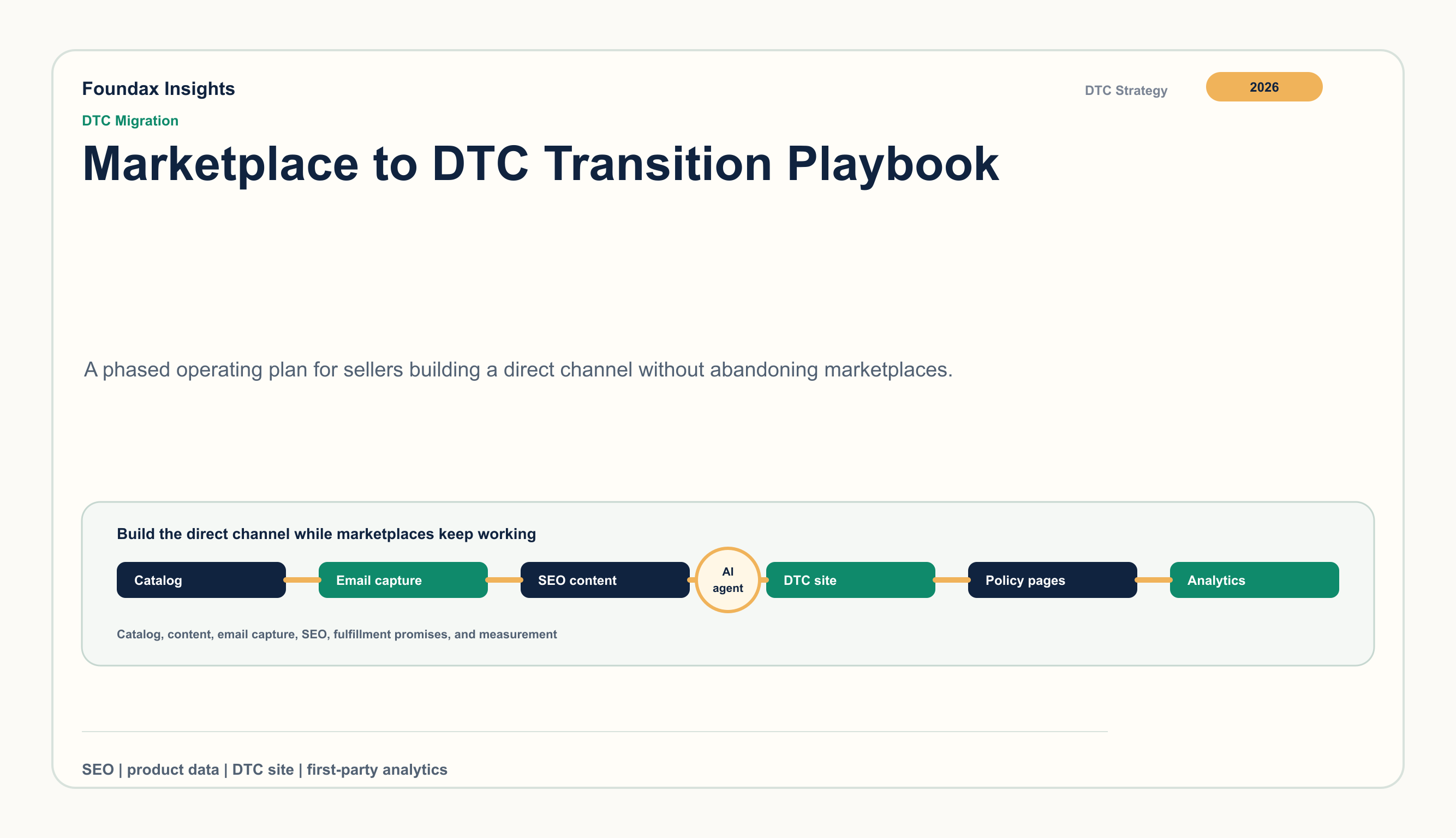
Google Shopping vs Marketplace Discovery: How DTC Brands Should Split Search Intent, Platform Demand, and First-Party Growth
Google Shopping, marketplaces, and a DTC brand site solve different growth jobs. The right channel mix depends on intent, product data quality, margin, customer ownership, and what the team can measure after discovery.
Google Shopping and marketplaces both put products in front of shoppers, but they do not create the same business.
For a DTC brand, the question is not whether Google Shopping is better than Amazon, TikTok Shop, eBay, or another marketplace. That question is too broad to be useful. A better question is: which channel should handle search intent, which channel should handle platform demand, and where should the brand build the product data, content, customer context, and measurement that compound over time?
A marketplace can create reach quickly because the shopper is already inside a buying environment. Google Shopping can bring high-intent shoppers to a product page when the product data and landing page are strong. A DTC brand site turns those visits into a longer-term asset: product education, first-party analytics, email capture, repeat purchase, localized content, policy clarity, and a customer relationship the brand can actually learn from.
The mistake is treating these channels as interchangeable traffic sources. They are different operating models.
The Channel Question Most DTC Teams Ask Too Late
Many brands only compare channels after revenue becomes uneven: marketplace sales are up but margin is thin, paid Shopping campaigns bring clicks but weak landing pages fail to convert, or the brand site has content but no clean product feed.
By then, the team is already managing three versions of the same product: one for the marketplace listing, one for Merchant Center, and one for the site. Prices drift. Images drift. Variant names drift. Return language changes in one place but not another. The marketplace team optimizes for platform rank, the paid team optimizes for ROAS, and the ecommerce team tries to explain why the direct site does not convert as expected.
The channel decision should start earlier, at the product-fact layer.
Ask these questions before scaling a channel:
Is this product mostly discovered through search intent, platform browsing, creator demand, or brand-led education?
Does the buyer need comparison, proof, sizing, ingredients, compatibility, policy clarity, or use-case education before purchase?
Can the team keep price, availability, variants, shipping, returns, and product attributes consistent across page, feed, and marketplace listing?
Which channel gives the brand enough customer insight to improve the next launch?
After fees, media, returns, support, fulfillment, and content work, which channel actually improves contribution margin?
Those questions separate channel strategy from traffic buying.
Google Shopping Is An Intent Capture Layer
Google Shopping is strongest when the buyer is already expressing a product need. The query may include a category, material, use case, size, compatibility requirement, price range, brand comparison, or problem to solve.
That intent is valuable because it can land on a page the brand controls. A good product page can explain the difference between similar SKUs, show sizing or fit guidance, answer delivery and return questions, link to buying guides, surface reviews, and capture first-party behavior that helps the team improve the next campaign.
Google's Merchant Center product data specification is explicit that Google uses product information to match products with relevant queries, and that accurate, correctly formatted data helps avoid disapprovals or display issues. Google Search documentation also explains that Product and Merchant listing structured data can supply price, availability, shipping, return, and other product details to Google surfaces.
That means Google Shopping is not only a media channel. It is a data-quality channel. Weak titles, thin descriptions, missing identifiers, mismatched prices, broken variant URLs, vague images, and inconsistent return information create operational drag before the paid media question even begins.
Use Google Shopping when:
Search demand already exists for the category, product type, problem, or comparison.
The product page can answer the buyer's decision, not just show a checkout button.
The team can maintain Merchant Center feed quality and Product structured data.
Margin can support paid clicks, content work, feed operations, and landing-page iteration.
The brand wants first-party analytics on how search visitors behave after the click.
Google Shopping becomes weaker when the product has little search demand, the category is highly commoditized, the page does not educate, or the product data changes faster than the team can keep the feed clean.
Marketplaces Are Demand And Trust Environments
A marketplace is not just another place to list products. It is a complete shopping environment with its own ranking logic, listing template, reviews, fulfillment expectations, customer account system, fee model, and comparison frame.
That can be a real advantage. A new buyer may trust the marketplace more than an unfamiliar brand site. A commodity or replenishment product may benefit from platform search and reviews. A creator-led product may convert inside a social shopping surface because the demand was created there. A brand testing a new market may use a marketplace to learn category demand before investing in local content and infrastructure.
But the tradeoff is structural: the platform shapes the customer's memory of the purchase. The buyer may remember the platform, the delivery promise, and the listing comparison more than the brand. The team may get sales data but less behavioral context. The listing has to compete inside the platform's layout and price pressure. The channel can be useful and still be a poor place to build long-term brand memory.
Use marketplaces when:
The category already has strong platform demand.
The product benefits from marketplace trust, reviews, fulfillment expectations, or category comparison.
The brand needs faster market validation or distribution before deeper site investment.
The item is simple enough to sell in a platform template without heavy education.
Incremental reach is worth the fee, policy, and customer-data tradeoffs.
Marketplaces become dangerous when they become the only source of demand, the only place reviews accumulate, or the only environment where buyers understand the product.
The DTC Site Is The Control Layer
A DTC site should not be treated as a prettier checkout page. Its strategic role is to hold the parts of the business that should not be fully delegated to a platform: product truth, education, policies, localization, analytics, retention, and brand memory.
The brand site is where a team can explain a product in its own logic. It can publish comparison guides, fit explainers, ingredient education, warranty details, use-case pages, local market pages, and post-purchase support content. It can show the relationship between a product, a collection, a guide, and a policy page. It can distinguish a first-time search visitor from a returning customer. It can connect content, product views, carts, orders, refunds, and support questions.
That does not mean every sale should happen on the brand site. It means the brand site should be the place where the team keeps the clearest version of the business.
If a product only exists as marketplace listing copy, the brand loses the ability to teach the category. If a product only exists as an ad feed, the brand loses the broader decision context. If a product exists as a structured, content-supported, localized, measurable page on the brand site, every channel has a stronger base to point back to.
Product Data Is The Shared Operating Asset
The same product should not have three unrelated truths.
A jacket should not have one title in Merchant Center, a different title on the PDP, another size system on a marketplace, and a return policy that only appears in a footer. A skincare item should not use one ingredient name in a product page, another in the feed, and a third in a marketplace attribute table. A luggage product should not show one dimension in inches, one in centimeters, and one only as a marketing phrase.
For Google Shopping, Merchant Center and structured data need clean facts. For marketplaces, the listing template needs clean facts. For the DTC site, the buyer needs clean facts in human language. The output formats differ, but the source should be governed.
A practical product-data model should define:
Core identifiers: brand, GTIN or MPN where applicable, SKU, variant options, canonical product relationship.
Commercial facts: price, currency, sale price, availability, shipping, returns, tax or duty context where relevant.
Buyer facts: materials, size, fit, dimensions, compatibility, care, warranty, certifications, use cases.
Media facts: primary image, lifestyle images, variant images, alt text, video or comparison visuals.
Channel rules: which fields are required for Merchant Center, marketplace listings, PDPs, and localized pages.
Governance: who can change the field, where it publishes, and how mismatches are detected.
Without that base, channel expansion creates copy-and-paste operations that look cheap at first and become expensive later.
The Real Comparison Is Margin, Learning, And Dependency
A simple revenue comparison can mislead DTC teams.
A marketplace may show strong gross sales while reducing margin through referral fees, fulfillment costs, ads, discounts, returns, and platform promotions. Google Shopping may look expensive on a last-click ROAS report while creating first-party visitors who later return through email, organic search, direct traffic, or retargeting. A brand site may look slower at first while building content and customer data that reduce acquisition dependence later.
The better comparison has three layers.
Contribution margin: include media spend, marketplace fees, payment cost, fulfillment, returns, support, discounts, content work, feed operations, and agency or internal labor.
Learning value: measure how much the channel teaches the brand about search demand, product questions, price sensitivity, local-market needs, objections, review language, and repeat purchase.
Dependency risk: ask what happens if ranking logic changes, fees increase, inventory rules change, listing requirements shift, ad costs rise, or a product is temporarily restricted.
The right channel mix is not the one with the cleanest dashboard. It is the one that grows revenue while improving the brand's ability to understand and serve its own customers.
A Better Decision Matrix
Strategic question
Google Shopping
Marketplace
DTC brand site
Best job
Capture search intent and route it to relevant product pages
Access platform demand and comparison traffic
Build product education, first-party insight, retention, and brand memory
Main input
Merchant Center feed, landing page quality, Product structured data, tracking
This matrix works best when the team updates it by product line, not by brand average. A hero SKU, replenishment product, accessory, bundle, and seasonal item may need different channel roles.
How AI Shopping Changes The Stakes
AI-assisted shopping does not remove the need for product operations. It raises the cost of messy inputs.
Google's AI-powered shopping insights for Merchant Center are designed to help retailers understand discovery across AI Mode, AI Overviews in Search, and the Gemini app. OpenAI's shopping documentation says merchant and product metadata can influence how merchant options are shown, including factors such as availability, price, quality, and whether the merchant is the maker or primary seller.
The practical implication for DTC teams is straightforward: product facts need to be consistent where machines and shoppers can inspect them. PDP content, structured data, Merchant Center records, marketplace listings, reviews, policies, and local pages should reinforce the same reality.
AI shopping makes vague product pages weaker, not stronger. It rewards teams that can maintain a clean product record, expose it clearly, and connect it to useful content and policies.
How To Split The Channels In Practice
Start with the product, not the channel.
For each priority SKU or collection, assign a primary job:
Demand capture: the product already has search demand. Prioritize Google Shopping, PDP quality, structured data, product feed health, and content that answers comparison questions.
Demand borrowing: the product benefits from platform trust or social discovery. Prioritize marketplace listing quality, reviews, fulfillment, pricing discipline, and a plan to bring learning back into the brand's product record.
Demand building: the product needs education or category creation. Prioritize the DTC site, buying guides, comparison content, lifecycle capture, and local-market pages before scaling spend.
Then make the channel roles explicit:
Google Shopping should not send users to thin pages.
Marketplaces should not become the only place reviews and product learning accumulate.
The DTC site should not become a passive catalog with no measurement and no content strategy.
Product data should not be rewritten from scratch for each channel.
This turns channel planning into operations, not opinion.
Where Foundax Fits
Foundax is useful when the brand wants the DTC site to become a real operating base, not just another destination URL.
The relevant capabilities are specific:
Site SEO settings, sitemap, robots, Search Console verification, and sitemap submission help the brand manage discoverability from the site side.
Google Merchant Center preflight and sync help teams check product fields before sending them into external shopping surfaces.
Content Studio gives teams a place to publish buying guides, comparison pages, market-specific education, and product-supporting content with draft and published states.
Multilingual content operations help local pages carry local product facts instead of only translated copy.
First-party analytics, with GA4 as supplemental diagnostics, helps teams compare search, referral, paid, direct, marketplace-adjacent traffic, and content-to-product paths.
The value is not that one tool replaces every marketplace. The value is that the brand has a stronger base for product truth, public pages, content, localization, Google channel operations, and measurement before it decides how aggressively to use each external channel.
A 30-Day Channel Audit
Week 1: pick five SKUs and map channel jobs. Choose one hero product, one repeat-purchase product, one accessory, one bundle, and one seasonal item. Decide whether each SKU is demand capture, demand borrowing, or demand building.
Week 2: audit product facts. Compare PDP, Merchant Center feed, structured data, marketplace listing, images, price, availability, shipping, returns, and variant names. List every mismatch.
Week 3: fix one product line deeply. Rewrite the PDP, clean the feed, update structured data, improve marketplace fields, add or refresh a buying guide, and make analytics labels clear.
Week 4: review margin and learning. Compare contribution margin, repeat purchase, customer insight, search queries, content-assisted sessions, marketplace review language, and support questions. Then decide which channel gets more investment next month.
FAQ
Is Google Shopping better than selling on marketplaces?
Not universally. Google Shopping is stronger when the brand can capture search intent on a strong product page and measure what happens after the click. Marketplaces are stronger when platform demand, trust, reviews, and comparison behavior matter more than first-party customer context.
Should a DTC brand use both Google Shopping and marketplaces?
Often, yes. The healthier approach is to assign different jobs. Use marketplaces for incremental platform demand and validation, use Google Shopping for high-intent search demand, and use the DTC site as the base for product data, content, analytics, and customer retention.
What product data matters most for Google Shopping?
Start with accurate title, description, image, link, price, availability, brand, identifiers, variants, shipping, return information, and landing page consistency. The exact requirements depend on product type and market, so Merchant Center documentation should remain the operating reference.
Why does the DTC site still matter if marketplaces already convert?
Because conversion is not the only asset. The brand site helps the team build category education, collect first-party behavior, explain policies, improve repeat purchase, localize for different markets, and reduce dependence on a single platform's rules.
How should teams measure marketplace vs Google Shopping performance?
Compare contribution margin, new-customer quality, repeat purchase, refund rate, support burden, review quality, product-data issues, and what the team learns from each channel. Gross sales alone can hide fee pressure and dependency risk.