AI Shopping Visibility Checklist for Ecommerce Brands
A merchant checklist for making products easier to understand across AI shopping surfaces: product data, structured markup, feeds, policies, content, and measurement.
Read more
A practical guide to product identity, offer data, variant attributes, policies, reviews, FAQ content, and localization fields that make a DTC catalog easier for search and AI shopping systems to understand.
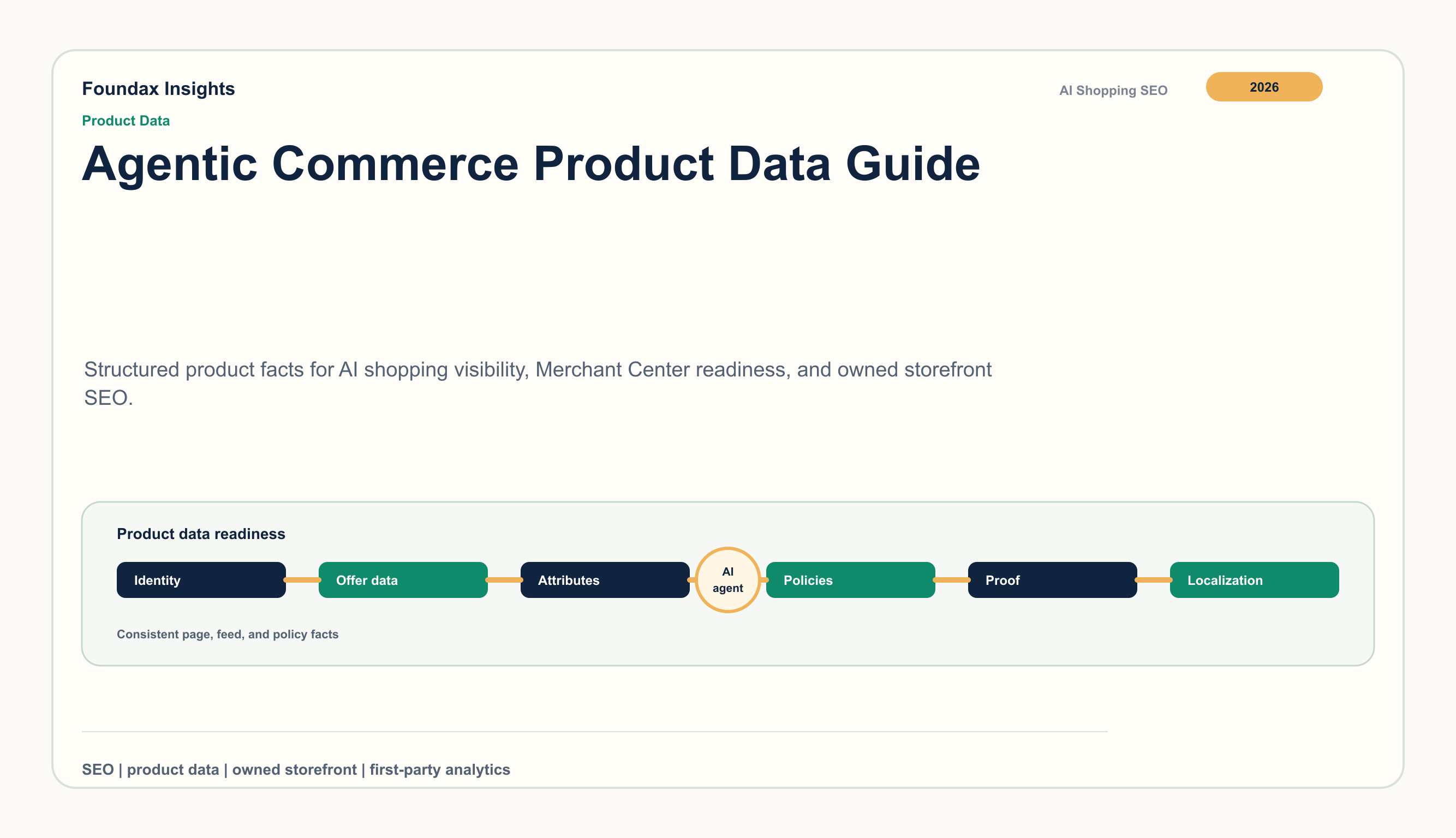
AI shopping agents do not evaluate a product page the same way a shopper does. They need product facts that can be retrieved, compared, and trusted: product identity, price, availability, variants, attributes, policies, reviews, and localized context.
Google's Product structured data documentation says product pages can provide richer information such as price, availability, review ratings, shipping, returns, and variant details. Google Merchant Center's AI-powered shopping insights, announced on May 27, 2026, explicitly calls out product term insights and product attributes insights, including color, style, material, and attribute completeness. Shopify's agentic commerce work points in the same direction: Catalog and UCP are about making commerce data available to AI surfaces and agents in a structured way.
This guide translates those signals into an operator checklist for DTC brands. It does not promise ranking in Google AI Mode, ChatGPT, Gemini, Copilot, or any other AI surface. It explains which product data fields make your owned storefront easier for search and AI shopping systems to understand.
---
Traditional ecommerce teams often treat product data as back-office material: enough to show a PDP, feed a search filter, and send a marketplace upload. Agentic commerce raises the standard. When a shopper asks, "find a lightweight waterproof tent for two people under $300 that ships quickly," an AI system needs structured facts to compare products: weight, waterproof rating, capacity, price, inventory, delivery time, return rules, warranty, and product reviews.
A beautiful page can still be difficult to parse if the facts are scattered across paragraphs, images, tabs, and disconnected policy pages. The practical goal is not to write for robots instead of people. The goal is to make the same facts clear to both.
| Field group | What to include | Why it matters |
|---|---|---|
| Product identity | Product name, brand, SKU, GTIN/MPN, canonical URL, primary image | Helps systems identify the exact product rather than a generic category page. |
| Offer data | Price, currency, availability, sale price, condition, product URL | Lets comparison and shopping experiences filter by real buying constraints. |
| Variant attributes | Color, size, material, gender/age group, dimensions, weight, compatibility | Matches natural-language intent such as "black leather laptop sleeve for 14-inch MacBook". |
| Policy facts | Shipping cost, delivery window, return policy, warranty, payment options | Reduces ambiguity when AI systems compare total cost and purchase risk. |
| Proof and content | Reviews, ratings, FAQs, use cases, comparison copy, care instructions | Gives systems and shoppers answers beyond the bare catalog record. |
| Localization | Local language, currency, market-specific shipping/returns, hreflang | Avoids treating translated copy as enough for multi-market commerce. |
Not every category needs every field. Apparel needs size, color, material, gender, and care instructions. Electronics need compatibility, model numbers, specifications, warranty, and accessories. Cross-border products need region-specific delivery, return, tax, and currency clarity.
Google Search Central describes two practical paths for product data: add Product structured data to product pages, upload product data through Merchant Center feeds, or use both. The important point is consistency. If the page says a product is in stock but the feed says it is out of stock, or if the price differs across surfaces, the product becomes harder to trust.
For owned storefronts, use JSON-LD Product markup as the technical baseline. At minimum, confirm that product pages expose:
The markup should reflect the visible page and actual business rules. Do not add fake reviews, invented identifiers, or generic attributes just to fill fields.
Use this workflow before you publish or refresh a catalog for AI shopping visibility.
Do not start by fixing every SKU. Pick the products that already get traffic, ad spend, marketplace demand, or sales. For each product, create a row with identity, offer, attributes, policy, proof, and localization fields.
Check whether product page data, Merchant Center feed values, and internal product records agree. Prioritize mismatches in price, availability, URL, image, variant, and shipping data. These mismatches are more damaging than missing nice-to-have copy.
Run representative PDPs through Google's Rich Results Test and the Schema.org validator. Treat errors as blockers and warnings as prioritization signals. The goal is not to chase every enhancement; it is to make the core product object understandable and accurate.
Use category-specific attributes rather than generic copy. Apparel, furniture, beauty, electronics, outdoor gear, and accessories all have different comparison fields. If customers ask the question in natural language, the attribute probably deserves a structured home.
AI shopping experiences often need short, direct answers: fit, compatibility, return limitations, care instructions, bundle contents, and warranty scope. Add FAQ or PDP sections that answer those questions clearly.
Foundax helps DTC teams manage the owned-storefront side of this work: product records, SEO metadata, Product JSON-LD, multilingual storefronts, content assets, sitemap and hreflang output, and Google/GMC readiness workflows. The SEO workspace and product SEO preview surface structured-data checks and GMC-derived payload previews so operators can see gaps before they push changes.
The boundary matters. Foundax does not guarantee inclusion or ranking in AI shopping results. It does not implement UCP, ACP, AP2, or autonomous agent checkout for merchants. It helps teams make their owned ecommerce data cleaner, more consistent, and easier to validate.
No. Structured data improves clarity and eligibility for some search and shopping experiences, but no platform guarantees ranking or inclusion. Treat it as infrastructure, not a ranking promise.
Use both when possible. Page structured data helps search systems understand the PDP. Merchant Center feeds help Google Shopping and Merchant Center workflows understand catalog data. Consistency across both is the real goal.
Fix identity and offer fields first: product name, URL, image, brand, identifiers, price, currency, availability, and variant data. Then improve category-specific attributes and policy facts.
AI can assist with copy and gap detection, but factual attributes must come from product truth: supplier data, packaging, measurements, certificates, and operations rules. Do not invent fields to satisfy a checklist.
Agentic commerce depends on systems being able to discover, compare, and act on product facts. The more complete and consistent your owned product data is, the easier it is for search and AI shopping systems to interpret your catalog.