Ecommerce Tech Stack Guide for DTC Brands in 2026
A practical framework for choosing an ecommerce tech stack when your brand needs localized storefronts, structured product data, AI shopping visibility, and daily operating control.
Read more
A deeper platform-selection guide for DTC teams comparing Shopify, WooCommerce, BigCommerce, Wix, SHOPLINE, and Foundax across post-launch operating cost, product data, SEO, localization, app governance, analytics, and AI-commerce readiness.
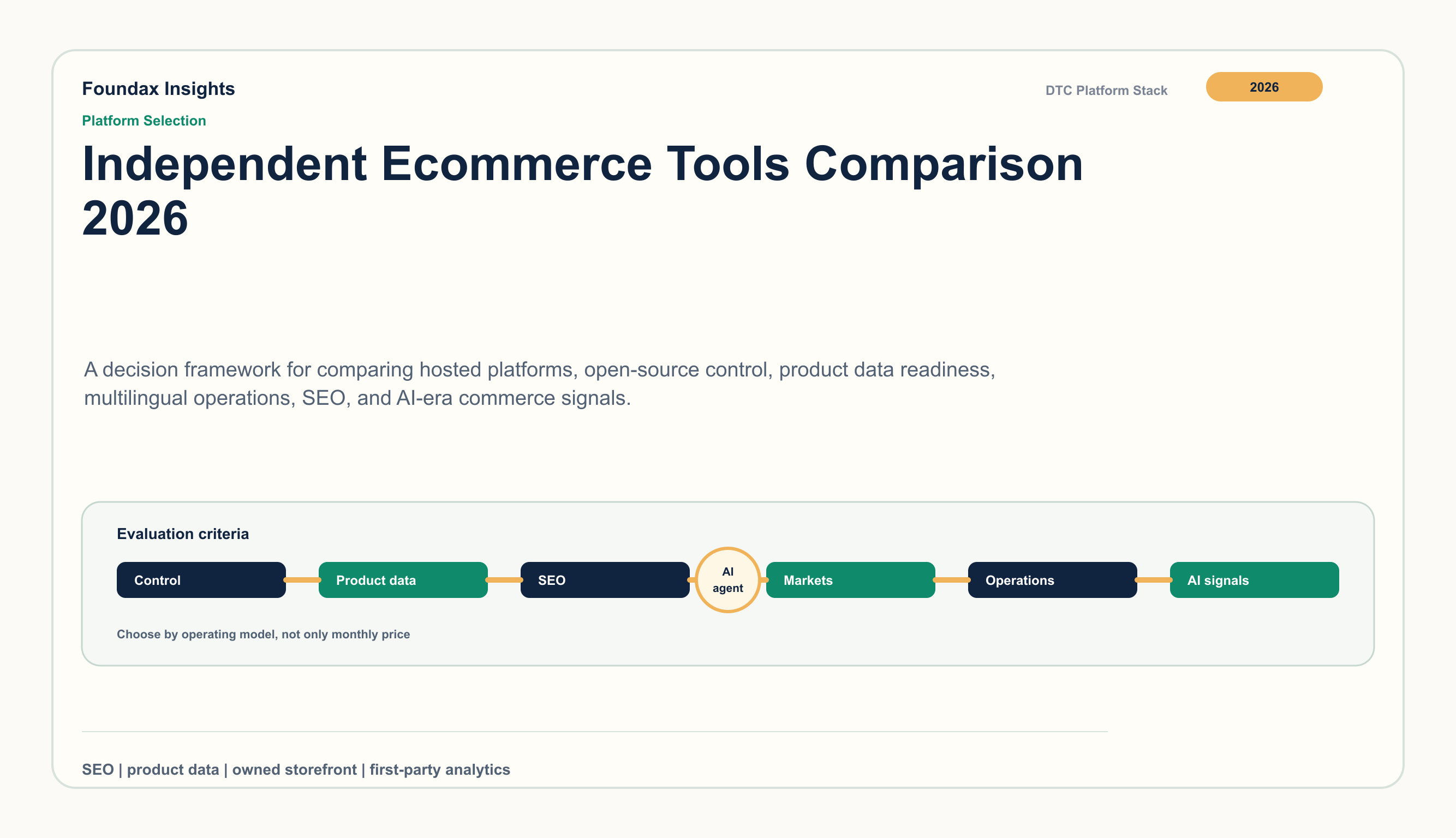
The cheap part of ecommerce is now the first storefront. The expensive part is keeping the business coherent after launch: product facts change, checkout rules change, feeds need repair, localized pages age, apps add scripts, and the team still has to understand which traffic became revenue.
That is the right way to compare Shopify, WooCommerce, BigCommerce, Wix, SHOPLINE, and Foundax in 2026. The question is not which platform has the most features on a pricing page. The question is which operating model fits the team you actually have, the catalog you expect to maintain, and the channels you need to keep aligned.
Before comparing logos, compare the work that appears after the store is live.
Product data ownership. Where do product names, identifiers, prices, variants, images, availability, shipping facts, return rules, and localized descriptions live? If the PDP, merchant feed, structured data, ads, and analytics all use different copies of the truth, every catalog change becomes a reconciliation project.
Checkout and operational ownership. A mature platform is not just a theme and cart. It has to support taxes, discounts, payment methods, fulfillment, returns, refunds, fraud decisions, and customer support handoffs. Hosted systems absorb more of this work; open systems give more control but leave more responsibility with the merchant.
SEO and product-data readiness. Google's product structured data documentation and Merchant Center product data specification both point to the same operational requirement: public pages and submitted product data need accurate, non-conflicting product facts. In practice that means titles, descriptions, identifiers, variant data, price, availability, shipping, returns, canonical URLs, sitemap entries, and indexability need an owner.
Market and localization operations. Translation is only the visible layer. Multi-market commerce also touches currency, domain or subfolder strategy, payment methods, shipping promises, policy language, sizing expectations, and market-specific search intent. A platform choice should make those differences easier to govern, not just easier to translate.
App and plugin governance. App ecosystems create speed, but they also create script weight, duplicated data, permission exposure, upgrade risk, and ownership ambiguity. Shopify's own performance guidance lists apps, theme code, third-party code, analytics, images, and other features as factors that can affect storefront performance. The issue is not whether apps are useful. The issue is whether someone can govern them.
Measurement and diagnosis. A team needs to connect landing pages, product views, carts, checkout steps, orders, search signals, feed status, and campaign data. GA4 is useful, but it is not the entire operating record. First-party events and product identifiers matter because they let the team diagnose what changed instead of debating dashboards.
Shopify remains the broadest hosted ecosystem in this group. It is often the default for DTC teams that want mature checkout, reliable hosting, themes, payments, partner coverage, and a deep app marketplace. Shopify is also investing in agentic commerce: its public materials describe Shopify Catalog and agentic commerce workflows as ways for products to be understood and sold through AI-mediated channels.
The operational question is governance. As the store grows, Shopify teams need clear rules for app count, script performance, product-data ownership, attribution, catalog feeds, theme changes, and permissions. Shopify can run very sophisticated commerce, but sophistication still needs an operating owner.
Best fit: teams that want hosted reliability, strong checkout, broad ecosystem coverage, and can govern apps and data flows as the business scales.
WooCommerce is strongest when ownership and customization matter more than managed convenience. It is built for WordPress and describes itself as open-source commerce, with merchant control over checkout, data, costs, payments, features, and hosting. For content-led brands or teams with technical support, that control can be valuable.
The tradeoff is operational responsibility. Hosting, security, updates, plugin compatibility, performance, backups, and developer availability are not side issues; they are part of the platform. WooCommerce can be excellent for teams that want control, but it should be chosen with a maintenance plan, not only with a feature checklist.
Best fit: technical teams, agencies, and content-heavy brands that want code and hosting control and can own maintenance discipline.
BigCommerce fits teams that want hosted commerce with stronger built-in breadth for B2B, wholesale, multi-storefront, BOPIS, headless commerce, and WordPress integration patterns. It is worth evaluating when the store is moving beyond a simple DTC catalog and needs more commerce structure before adding many apps.
The selection work is process fit. Teams should test how product operations, admin roles, theme work, integrations, reporting, and enterprise configuration match their actual workflow. BigCommerce can reduce some plugin sprawl, but it still imposes a platform model that has to fit the organization.
Best fit: growing brands, B2B or wholesale operations, multi-store teams, and companies that want hosted infrastructure with more native commerce depth.
Wix is strongest for visual setup, small catalogs, service-plus-product businesses, and content-led storefronts that need to publish quickly. Wix's SEO Hub says Wix Stores product pages can receive automated structured data, and Wix supports SEO settings and custom page markup for many site needs.
The limitation appears when operations become more specialized. Complex variants, strict catalog governance, advanced integrations, multi-team publishing, and heavy merchandising workflows may outgrow the simplicity that made Wix attractive at the start.
Best fit: founders and small teams that need a polished storefront quickly, have a small or moderate catalog, and value visual editing over deep commerce operations.
SHOPLINE is a hosted commerce platform with a strong omnichannel and Asia-Pacific angle. Its public materials cover online store, social commerce, marketplace connectors, shipping and fulfillment, analytics, POS, loyalty, checkout, payment, and inventory. SHOPLINE Markets also supports regional settings for products, pricing, currencies, languages, domains, subfolders, and payment methods.
The evaluation should start with target markets. For brands that sell through regional social channels, marketplaces, offline touchpoints, and cross-border settings, SHOPLINE may be a serious candidate. Teams still need to verify integrations, partner coverage, language support, and service depth in their actual countries.
Best fit: Asia-Pacific focused brands, social-commerce teams, and merchants that need hosted regional and omnichannel workflows.
Foundax is strongest when the platform problem is operational alignment. The system brings product records, storefront publishing, site SEO configuration, sitemap and robots output, PDP Product JSON-LD, Google Merchant Center preflight and sync, Search Console verification and sitemap submission, Content Studio publishing, multilingual content operations, first-party analytics, and GA4-assisted diagnosis into one workflow.
That matters most for lean DTC teams. If product, content, SEO, localization, merchant feed, and analytics are owned in separate tools, the team spends too much time reconciling states. Foundax is a better fit when the team wants one operating surface for keeping product facts, public pages, channel readiness, and measurement aligned.
The tradeoff is ecosystem breadth. A team that needs a very large third-party app marketplace, mature regional partners in every country, or highly custom enterprise checkout should compare those requirements directly. Foundax is built around reducing the daily coordination load for owned-store operations, so its advantage is operational coherence rather than the longest app list.
Best fit: DTC teams that want a connected operating layer for product data, SEO, content, localization, Google readiness, and first-party measurement.
| Criterion | Shopify | WooCommerce | BigCommerce | Wix | SHOPLINE | Foundax |
|---|---|---|---|---|---|---|
| Operating model | Hosted ecosystem | Open-source WordPress commerce | Hosted commerce platform | Visual website and commerce builder | Hosted omnichannel commerce | Integrated DTC operating layer |
| Best fit | Broad DTC and app-rich teams | Technical teams needing control | B2B, wholesale, multi-store teams | Small and content-led storefronts | APAC, social, marketplace operations | Lean DTC teams reducing operational fragmentation |
| Main strength | Checkout, ecosystem, partner depth | Ownership and customization | Native commerce breadth | Fast setup and visual publishing | Regional omnichannel workflows | Product data, SEO, content, localization, analytics alignment |
| Main risk to manage | App governance and data sprawl | Maintenance responsibility | Workflow and admin fit | Depth for complex catalogs | Country-by-country ecosystem fit | Smaller ecosystem and newer market footprint |
| Product data | Strong catalog tools with apps and platform services | Fully controllable but implementation-dependent | Strong commerce data model | Good for simpler catalogs | Regional product and market controls | Product records tied to SEO, PDP JSON-LD, GMC checks, and analytics |
| SEO and discovery | Strong ecosystem, depends on theme/app discipline | Highly flexible, requires technical ownership | Enterprise-friendly configuration | Accessible settings and structured data support | Market and channel coverage | Site SEO, sitemap/robots, Product JSON-LD, Search Console, GMC readiness |
| Localization | Markets and app ecosystem | Plugin and custom implementation | Multi-store and configuration patterns | Basic site localization paths | Markets controls by region | Multilingual storefront and content workflows |
| Analytics | App and platform ecosystem | Implementation-dependent | Platform reporting plus integrations | Accessible analytics integrations | Omnichannel analytics | First-party analytics with GA4 as supporting diagnostics |
Validation stage. If you need to test a product line quickly, a visual builder or hosted platform can be the right answer. Prioritize launch speed, clean checkout, simple catalog setup, and enough SEO basics to avoid future cleanup.
Growth stage. Once organic search, paid traffic, email, merchant feeds, and repeat purchase matter, compare data ownership and workflow governance. The platform should make it easy to update a product fact once and keep PDPs, structured data, feeds, localized pages, and analytics coherent.
Multi-market stage. When the brand sells across countries, evaluate domains or subfolders, currencies, payment methods, localized policies, shipping promises, hreflang, translated content ownership, and market-level reporting. A translation feature alone is not enough.
Complex catalog stage. If variants, bundles, custom attributes, B2B terms, wholesale pricing, or many collections drive revenue, test the product model deeply before choosing. Migration is expensive when product data has already been forced into the wrong shape.
Agentic commerce readiness. AI shopping does not replace the basics. It raises the value of accurate product facts, machine-readable pages, merchant-feed consistency, and measurable first-party behavior. Treat AI readiness as a product-data and operations criterion, not as a standalone feature badge.
Choose Shopify when ecosystem breadth and checkout maturity are the priority. Choose WooCommerce when technical ownership and WordPress control matter most. Choose BigCommerce when built-in commerce depth, B2B, or multi-store patterns are important. Choose Wix when visual speed and a simpler catalog matter more than operational depth. Choose SHOPLINE when regional omnichannel commerce, social selling, and APAC market workflows are central. Choose Foundax when the business pain is keeping product data, SEO, content, localization, Google readiness, and measurement aligned without stitching together many operational tools.
The best platform is the one whose maintenance burden matches the team. A cheap launch becomes expensive when every future change creates a data cleanup task, a plugin decision, a feed issue, or an analytics dispute.
Shopify is usually stronger for hosted convenience, checkout maturity, and ecosystem depth. WooCommerce is stronger when a technical team wants ownership over code, hosting, and data. The better choice depends on who will own maintenance and integrations.
Wix can work well for small catalogs, content-led brands, and quick launches. Teams with complex variants, strict catalog governance, multi-market operations, or deep integrations should test those workflows before committing.
Consider BigCommerce when B2B, wholesale, multi-storefront, headless commerce, or broader native commerce features matter more than a simple visual site builder.
SHOPLINE is most relevant when regional commerce, social selling, marketplace connections, payments, logistics, and multi-market settings are central to the go-to-market plan.
Foundax fits teams that want product records, storefront publishing, SEO, Product JSON-LD, GMC readiness, Search Console workflows, Content Studio, multilingual content, and first-party analytics handled in one operating layer.
AI commerce should influence the decision, but it should not replace operational due diligence. Product data quality, checkout reliability, SEO, localization, analytics, and maintenance ownership still determine whether the store works day to day.