How to Validate a Product Idea Before Buying Inventory
Stop guessing and start testing. Learn how to validate product demand using low-cost experiments like landing pages and preorders. This guide helps you define clear success metrics to avoid false positives and make confident, data-backed decisions.
You have a product concept, a target price, and a supplier ready to manufacture your first run. The next step is a commitment decision that requires irreversible capital for tooling, inventory, or infrastructure. Before you wire the funds, you need to validate that strangers will actually hand over money for the specific offer you intend to sell.
To test market demand without building the product, you must run an experiment that isolates your riskiest assumption and measures observable, costly behavior from your target buyers.
The Behavior-Evidence Ladder
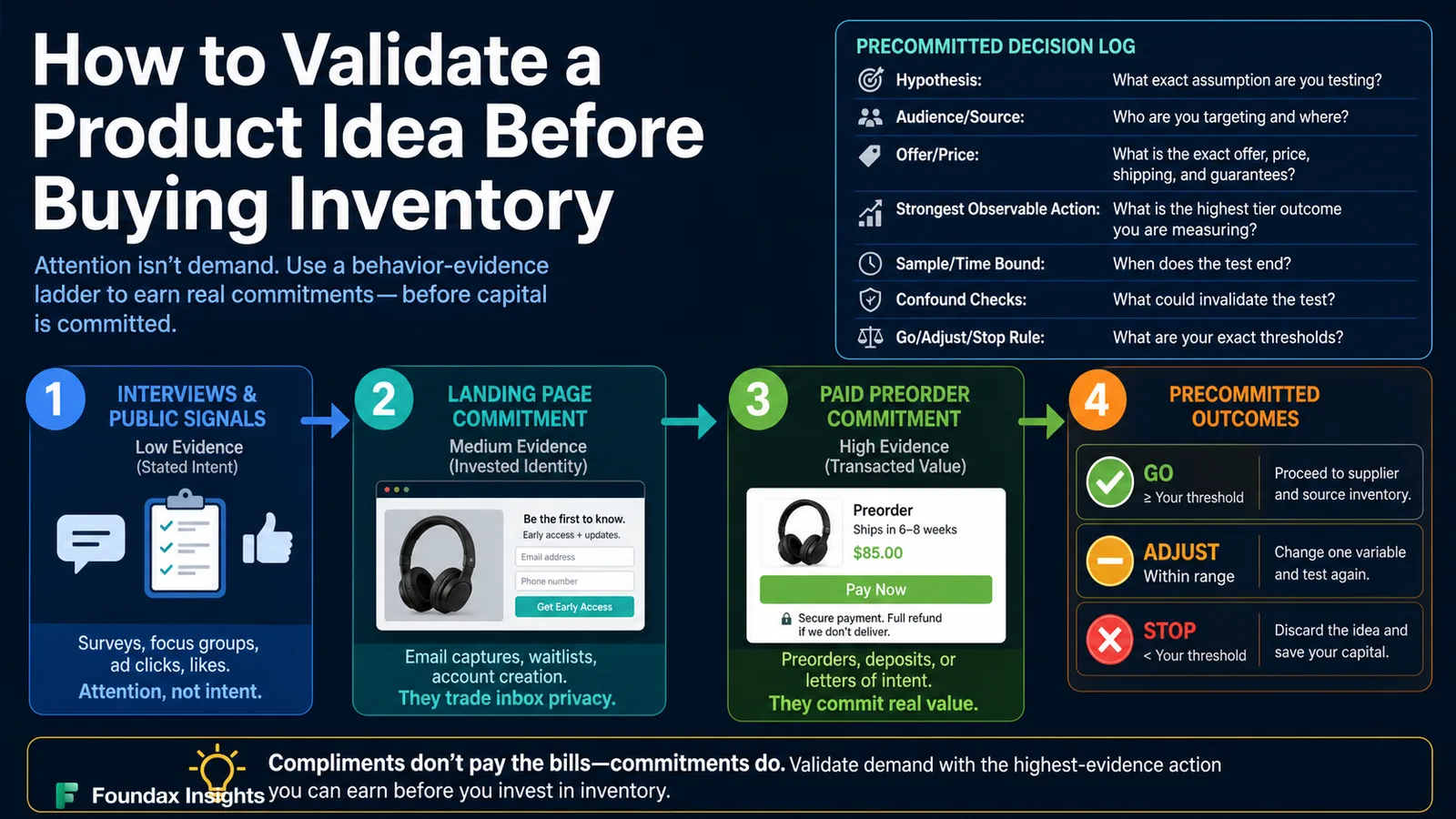
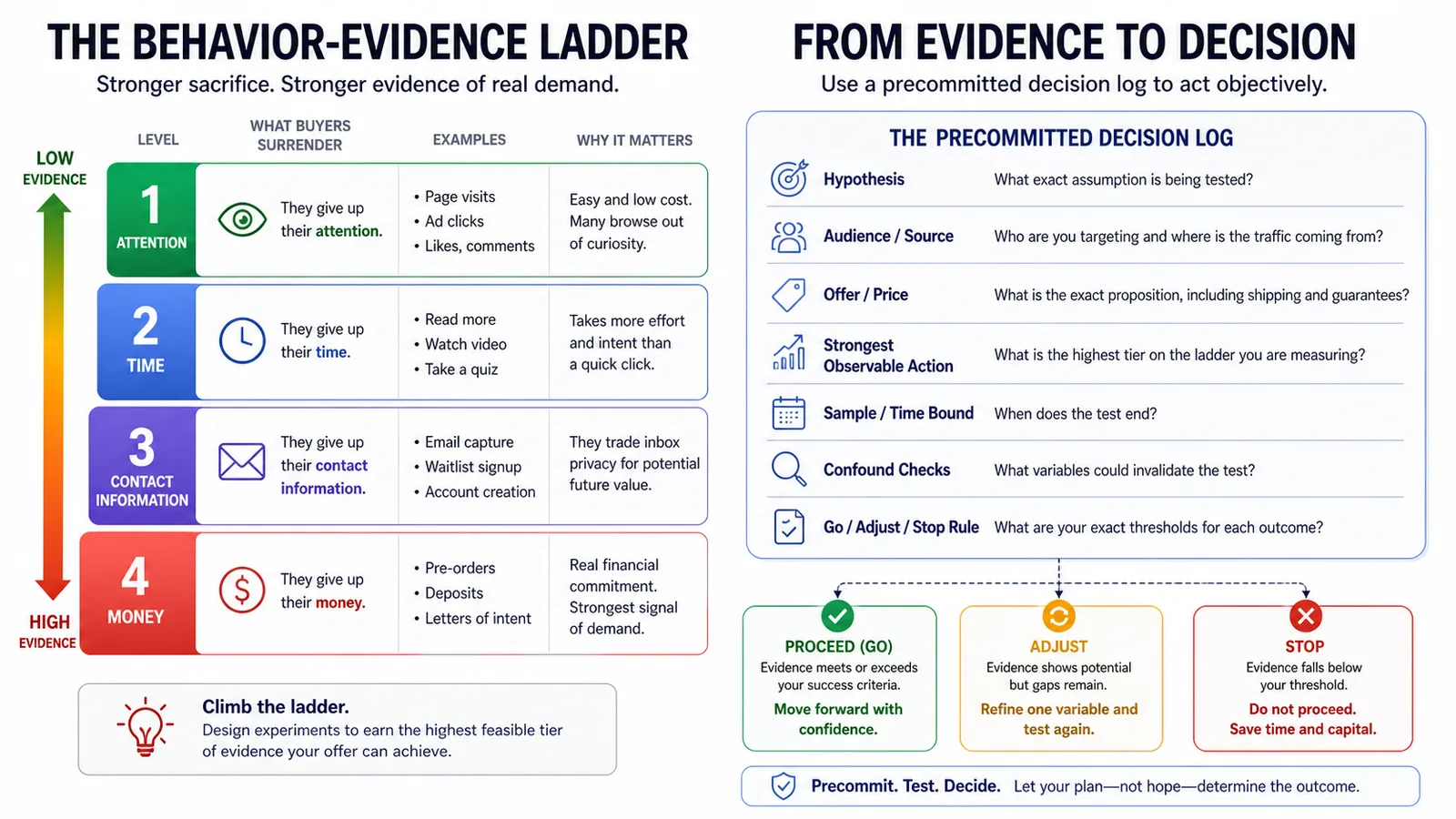
A common trap for new merchants is treating all engagement as proof of demand. Page visits, social media likes, and "I would buy this" survey responses measure attention and politeness, not intent. When you validate a product idea, you must grade your evidence based on what the user has to give up.
Rank your market signals using an evidence ladder:
Low Evidence (Stated Intent): Surveys, focus groups, and ad clicks. The Small Business Administration (SBA) correctly identifies direct research like focus groups as a way to shape your hypothesis, but what people say they will do rarely matches what they actually do when it is time to pay.
Medium Evidence (Invested Identity): Email captures, waitlist signups, and account creation. The buyer trades their contact information and inbox privacy for future access to the product.
High Evidence (Transacted Value): Pre-orders, B2B letters of intent, or crowdfunding deposits. The buyer commits actual dollars or makes a clear, documented business commitment. (Note: If you use pre-orders to validate demand, transparently disclose the test nature of the offer, the price, the estimated fulfillment timeline, and how refunds will be processed if the product does not launch. Avoid deceptive "fake checkouts" that collect payment data under the illusion of immediate availability.)
Setting Your Precommitted Decision Log
The fatal flaw of testing is rationalizing a mediocre result after the data comes in. To effectively test product demand before launch, you must define your thresholds for success and failure before you spend a single dollar on ads or outreach.
Use a precommitted decision log to outline your experiment. This acts as your objective standard when the test concludes.
Hypothesis: What exact assumption is being tested? (e.g., Home baristas will pay $85 for a custom-fitted espresso tamper.)
Audience/Source: Who are you targeting and where is the traffic coming from?
Offer/Price: What is the exact proposition, including shipping and guarantees?
Strongest Observable Action: What is the highest tier on the behavior-evidence ladder you are measuring? (e.g., Completing a form with an email and phone number to secure a $10 early-bird discount on launch day.)
Sample/Time Bound: When does the test end? (e.g., 1,000 unique landing page visitors or 14 days, whichever comes first.)
Confound Checks: What variables could invalidate the test? (e.g., Did the ad copy promise a feature the landing page didn't mention? Was the site load time too slow?)
Go/Adjust/Stop Rule: What are your exact thresholds? (Example purely for illustration: Proceed to supplier if >5% of visitors claim the discount code; Adjust the offer/price if 2–5%; Stop and discard the idea if <2%.)
Interpreting the Results
When your time bound is reached, evaluate the strongest observable action against your Go/Adjust/Stop rule.
If your test hit the "Stop" threshold, accept the result. High traffic with zero conversions means you successfully captured attention, but failed to uncover demand. You have saved yourself the cost of unsold inventory.
If your test lands in the "Adjust" range, your confound checks are critical. Did the test fail because the price was too high, or because the mobile checkout button was broken? Revise one variable—the price, the audience, or the offer—and run the experiment log again.
Structuring the Validated Product
Once a product clears your "Go" threshold and you commit to sourcing inventory, your operational focus shifts from testing hypotheses to structuring your product data for live commerce. Buyers can only purchase what platforms and storefronts can accurately read and display.
Foundax provides a canonical/listing contract that projects your structured product information consistently into your storefront and external growth surfaces. Before finalizing a listing, merchants can use Foundax to inspect how current product information is projected into Product Detail Page (PDP) metadata. You can also review Google Merchant Center (GMC) readiness to catch missing attributes—like GTINs, material specifications, or accurate weight data—before applying or submitting changes to external catalogs.
A successful validation test proves that a market wants your product, and accurate, structured product data ensures buyers can actually find and purchase it once you launch. Whether you are preparing to source your next item or pivoting away from a failed experiment, mastering how to find products to sell online will help you build a stronger hypothesis for your next decision log.
Frequently Asked Questions
How do I choose the best behavioral signal to test my product idea?
Select the signal that requires the highest level of commitment your setup allows. While email waitlists prove interest, they offer weaker evidence than transacted value. Whenever feasible, aim for high-evidence signals like pre-orders or B2B commitments, as capturing actual dollars or documented business intent provides the most reliable proof that your audience will pay for your solution.
Why do I need to set a go/adjust/stop rule before running a validation test?
Establishing decision thresholds before your test begins prevents confirmation bias. If you wait until after the data comes in, it is too easy to rationalize a mediocre result and proceed with a flawed idea. A precommitted rule forces you to respect the actual buyer behavior and objectively decide whether to source inventory, adjust your offer, or walk away.
What should I do if my landing page or pre-order test fails?
First, check for confounding variables: did the page load slowly, was the price unclear, or was the checkout broken? If the mechanics of the test were sound but conversions still missed your threshold, accept the result. You have successfully avoided spending capital on a product nobody wants. Cancel the project, promptly process transparent refunds for any pre-orders collected, and move on to your next hypothesis.
Does configuring my product in Foundax guarantee it will sell?
No. Foundax ensures your structured product data is accurately projected into storefront metadata and checks your readiness for external catalogs like Google Merchant Center. While precise listing data is essential for operational execution and visibility once you launch, a well-configured catalog record cannot generate market demand, validate your pricing, or guarantee sales. Demand must always be proven through buyer behavior.