A Framework for Finding and Validating Products to Sell Online
Evaluate ecommerce product ideas before committing your budget. This framework connects you to step-by-step methods for researching niches, screening market demand, and testing product viability so you can confidently decide what to sell.
Moving from "I do not know what to sell" to a defensible market entry requires two distinct phases: finding credible candidates based on market inefficiencies, and systematically disqualifying weak ideas before you commit capital. The goal is to identify your product's weakest assumption and run the cheapest possible test to either prove it or kill it.
Finding Credible Product Candidates
Most new merchants start by looking at trending product lists or massive marketplace bestsellers. This approach usually leads to saturated markets, margin compression, and expensive customer acquisition. Instead of looking for what is already popular, look for unserved needs and commercial inefficiencies using current US-native research surfaces.
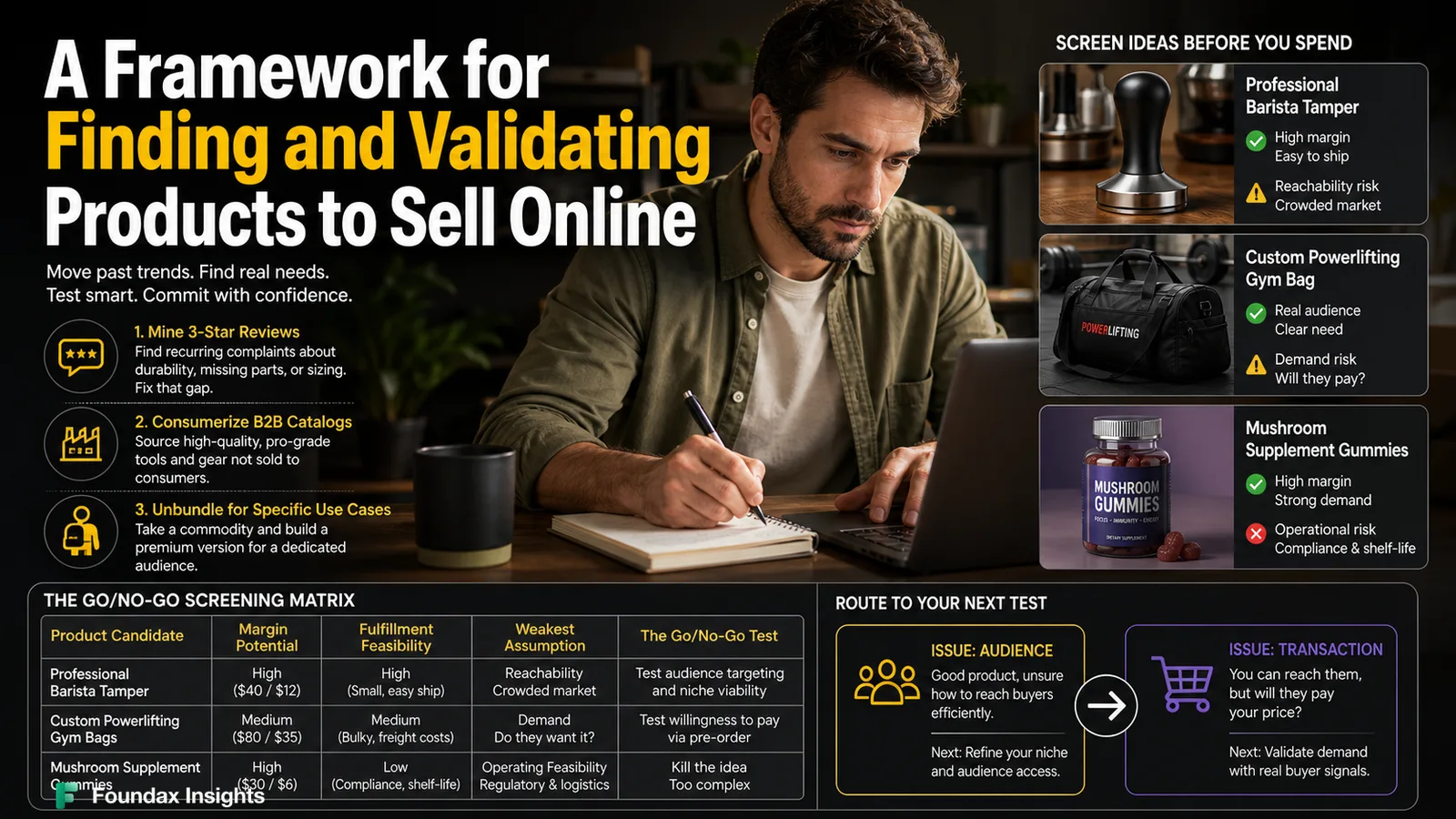
1. Mine 3-Star Reviews for Feature Gaps
Products with 5-star reviews are heavily defended; 1-star products are fundamentally broken. The 3-star reviews on major marketplaces reveal products that customers actively want, but that fail in execution. Look for recurring complaints about material durability, missing components, or poor sizing. A candidate emerges when you can source a modified version that solves that specific, documented frustration.
2. Consumerize B2B Catalogs
Industrial, medical, and hospitality suppliers often manufacture high-quality, durable goods that consumers cannot easily buy. By cross-referencing commercial sourcing directories like ThomasNet or wholesale networks like Faire, you can identify specialized gear—such as heavy-duty drafting chairs, high-grade organizational bins, or professional culinary tools—that can be repackaged and marketed to high-end hobbyists or home consumers.
3. Unbundle General Commodities
Identify a generic product category and build a highly specific version for a dedicated audience. A standard backpack is a commodity; a backpack explicitly designed and sized for competitive powerlifters' gear is a premium product.
The Go/No-Go Screening Matrix
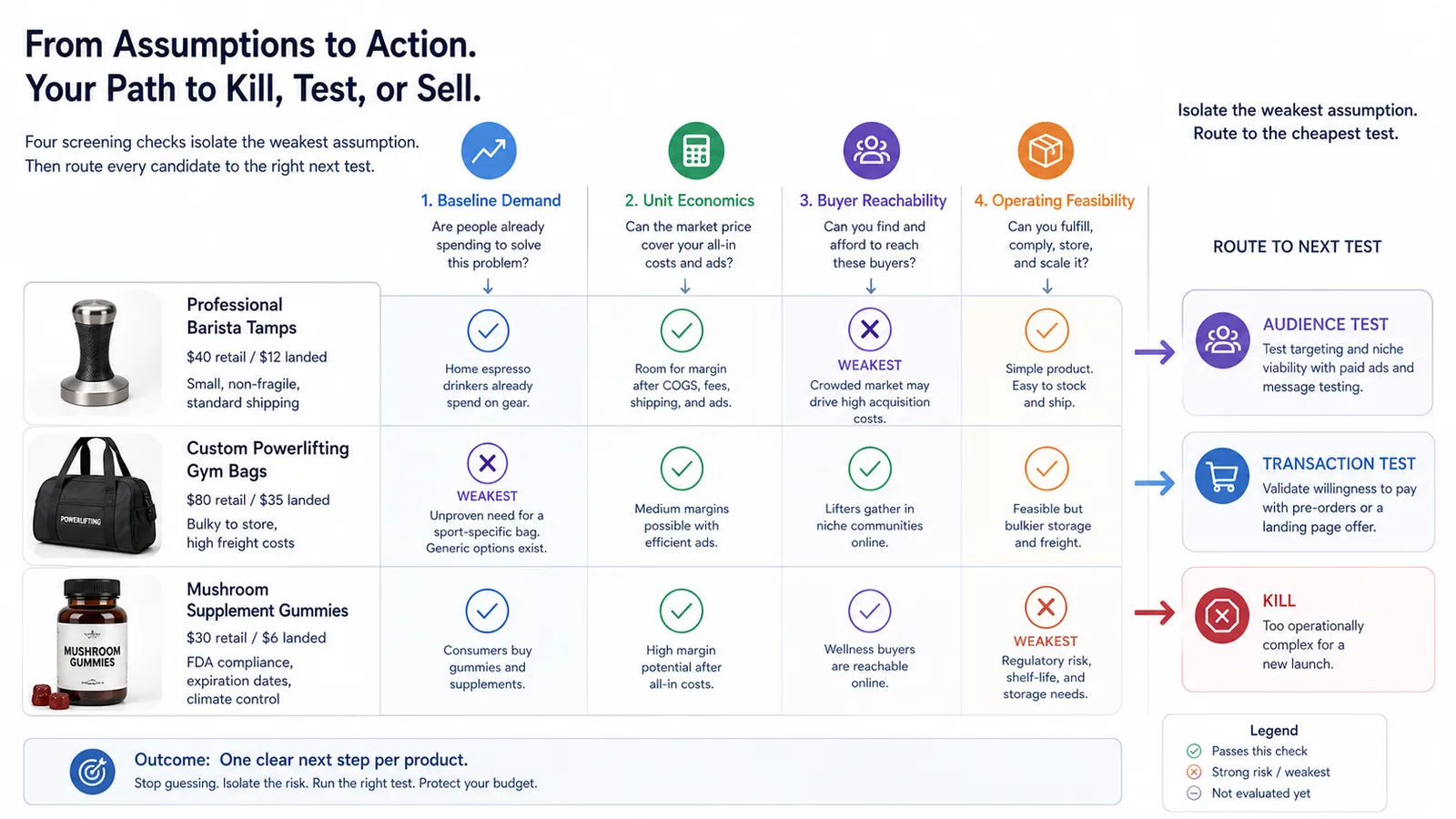
Once you have a shortlist of candidate products, do not try to validate them all at once. Screen them against four primary points of failure. If an idea cannot survive this desk-research phase, discard it before spending money on samples or domain names.
Baseline Demand: Is there established willingness to pay? Are consumers already spending money to solve this problem, even with inferior alternatives?
Unit Economics: Can the market-accepted price realistically cover your estimated cost of goods, fulfillment, shipping, and marketing overhead?
Buyer Reachability: Can you identify where these customers gather online, and can you afford to reach them?
Operating Feasibility: Does this product require specialized warehousing, prohibitive minimum order quantities (MOQs), complex regulatory compliance, or cold-chain logistics?
To force a decision, map your candidates using a simple screening matrix. The objective is to isolate the single highest risk for each surviving product.
Product Candidate
Margin Potential
Fulfillment Feasibility
Weakest Assumption
The Go/No-Go Test
Professional Barista Tamps
High ($40 retail / $12 landed)
High (Small, non-fragile, standard shipping)
Reachability: The home-espresso market is crowded; acquisition costs may ruin margins.
Test audience targeting and niche viability.
Custom Powerlifting Gym Bags
Medium ($80 retail / $35 landed)
Medium (Bulky to store, high freight costs)
Demand: Do lifters actually want a sport-specific bag, or are they happy with generic duffels?
Test willingness to pay via pre-order or landing page.
Operating Feasibility: Regulatory risk and strict inventory shelf-life.
Kill the idea. Too operationally complex for a new launch.
Routing to the Next Test
With your matrix complete, you are left with one or two strong candidates and a specific, isolated risk. Your next step is to choose the most critical remaining uncertainty and test it directly.
If your biggest uncertainty is the audience:
You have a viable product concept with good margins, but you are unsure how to position it against entrenched competitors or how to efficiently target buyers without exhausting your budget. Your next step is to refine your target market. Move to evaluating audience access and learn how to find a profitable niche where your operating strengths match an unserved segment's needs.
If your biggest uncertainty is the transaction:
You know exactly who the audience is and can reach them cheaply, but you do not know if they will actually pull out a credit card to pay your asking price. Your next step is to gather behavioral evidence. Move to demand validation to see how to validate a product idea using direct customer contact, waitlists, or tightly controlled early-market signals to prove actual willingness to pay.
Structuring Product Data for Market Exposure
When you are ready to move from internal research to market validation, your product-market hypothesis must be translated into storefront and catalog data. Whether you are running a limited traffic test or preparing an early listing, how you structure that information dictates how both customers and shopping platforms will read it.
Foundax provides a clear framework for this transition. As you prepare your listing, Foundax allows you to inspect exactly how your current product information projects into PDP metadata. You can also review your Google Merchant Center (GMC) readiness prior to submission. By surfacing potential dry-run blockers, these observable states make it easier to find missing or inconsistent data before you present the product to the market.
Frequently Asked Questions
What is the difference between screening a product idea and validating demand?
Screening is an internal desk-research filter designed to disqualify flawed concepts early based on unit economics, fulfillment feasibility, and reachability. Demand validation is an external behavioral test that measures whether real customers will commit attention, contact details, or money to your specific offer before you invest in inventory.
Why isn't strong aggregate market growth enough to justify a product launch?
Macro sales data reflects broad consumer spending across an entire industry, not demand for your specific item. High-growth categories often attract heavy competition and rising advertising costs, which compress margins. Market growth proves a sector is active, but only direct testing proves buyers prefer your offer over existing alternatives.
If a product concept has several weak assumptions, which one should be tested first?
Test the assumption that can disqualify the idea fastest and at the lowest cost. If fulfillment logistics or regulatory requirements make profitable delivery impossible, discard the idea immediately at zero marketing cost. If operational and margin feasibility hold, prioritize testing buyer demand and willingness to pay before spending on brand assets or inventory commitments.
How does Foundax assist once a product direction is chosen, and what are its boundaries?
Foundax helps translate your product-market hypothesis into structured catalog data, allowing you to inspect how information projects into PDP metadata and review Google Merchant Center readiness before publishing or submitting. It surfaces data inconsistencies and dry-run blockers early, but it does not evaluate market viability, automate product selection, or guarantee platform approvals and revenue.