Evaluating Ecommerce Niches: How to Find Your Target Market
A practical approach to choosing an ecommerce niche. Compare market segments by analyzing buyer pain points, willingness to pay, profit margins, and competitive alternatives, ensuring you target an audience you can actually reach and serve.
A common trap for prospective ecommerce operators is confusing a broad product category or a personal passion with a viable target market. Knowing you want to sell "home organization goods" or "outdoor gear" gives you an industry, but it does not tell you who is buying, how to reach them, or what they are willing to pay.
Learning how to find a profitable niche requires moving past demographic approximations and identifying a minimum viable target market. A demographic bucket like "millennial homeowners" is too broad; demographic size alone cannot outweigh reachability, willingness to pay, or your specific operator fit. To build a sustainable business, you must narrow a target audience to a group that shares a painful or repeated problem, can be identified and reached through existing channels, and has room for workable margins.
Moving Past the "Operator as Target Buyer" Trap
When figuring out how to choose a niche, it is tempting to build a customer profile based entirely on your own preferences. However, assuming the operator is representative of the target buyer often leads to systemic miscalculations in pricing and channel strategy.
Instead, rely on external verification. The US Small Business Administration (SBA) frames effective market research around measurable demand, market size, local saturation, and pricing behaviors. Furthermore, tools from the US Census Bureau offer powerful data for small businesses, allowing you to check population trends, location-based demographics, and consumer spending patterns. While this government data provides a baseline for market size and saturation, it only tells part of the story. You still need to determine if you can reach those buyers cost-effectively.
The Small-Operator Niche Decision Matrix
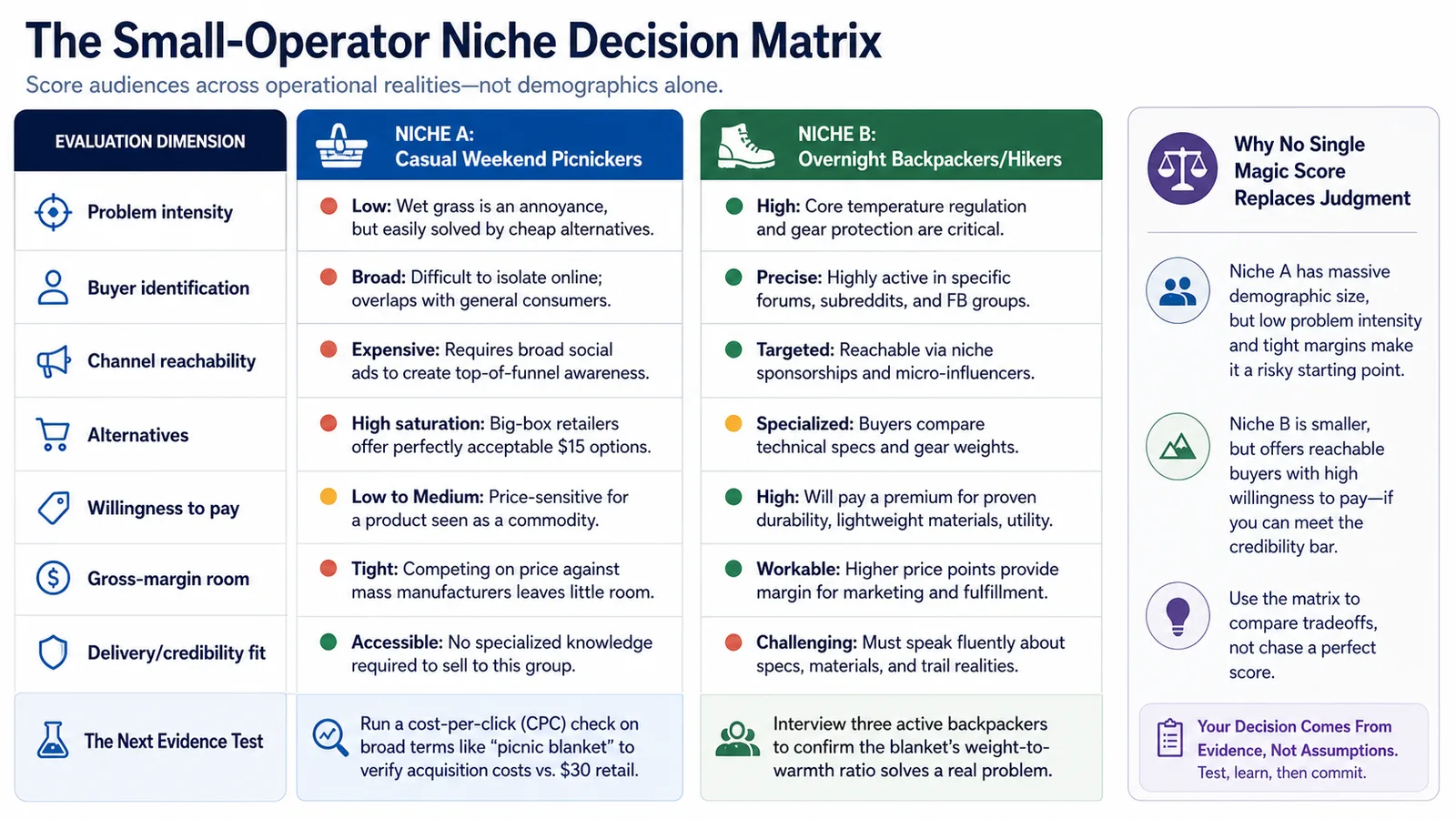
To evaluate how to identify a target market effectively, operators should score plausible audiences against specific operational realities. Rather than tallying up a single "magic score" that collapses important tradeoffs, use a decision matrix to preserve the distinct advantages and risks of each audience.
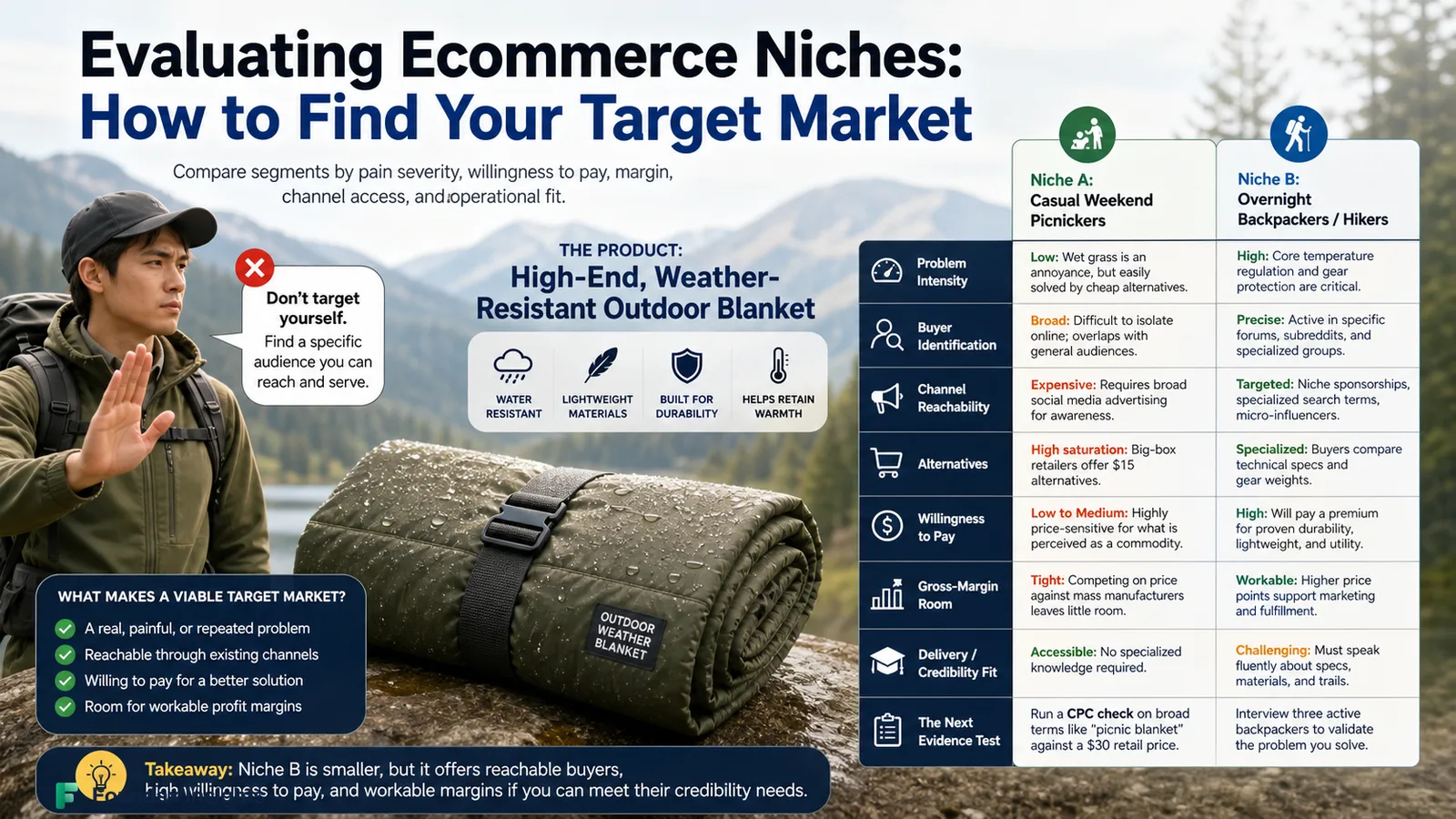
Below is an evaluation comparing two distinct audiences for a theoretical operator selling high-end, weather-resistant outdoor blankets.
Evaluation Dimension
Niche A: Casual Weekend Picnickers
Niche B: Overnight Backpackers/Hikers
Problem intensity
Low: Wet grass is an annoyance, but easily solved by cheap alternatives.
High: Core temperature regulation and gear protection are critical to the activity.
Buyer identification
Broad: Difficult to isolate online; overlaps with general consumer audiences.
Precise: Highly active in specific forums, subreddits, and specialized Facebook groups.
Channel reachability
Expensive: Requires broad social media advertising to generate top-of-funnel awareness.
Targeted: Reachable through niche sponsorships, specialized search terms, and micro-influencers.
Alternatives
High saturation: Big-box retailers offer perfectly acceptable $15 alternatives.
Specialized: Buyers are already accustomed to comparing technical specs and gear weights.
Willingness to pay
Low to Medium: Highly price-sensitive for what is perceived as a commodity.
High: Will pay a premium for proven durability, lightweight materials, and specific utility.
Gross-margin room
Tight: Competing on price against mass manufacturers leaves little room for acquisition costs.
Workable: Higher retail price points provide margin to absorb specialized marketing and fulfillment.
Delivery/credibility fit
Accessible: No specialized knowledge required to sell to this group.
Challenging: Requires the operator to speak fluently about technical specs, materials, and trail realities.
The Next Evidence Test
Run a cost-per-click (CPC) check on broad terms like "picnic blanket" to verify acquisition costs against a $30 retail price.
Interview three active backpackers to confirm if the blanket's weight-to-warmth ratio solves a real gear problem.
This matrix illustrates how to find a profitable niche market by weighing operational realities. Niche A has a massive demographic size, but the lack of problem intensity and tight margins make it a difficult starting point. Niche B is much smaller but offers reachable buyers with a high willingness to pay, provided the operator can meet the credibility requirements.
Preparing Your Product Data for Your Chosen Market
Once you have selected a target market and determined the product catalog required to serve them, you need to ensure your storefront and shopping channels accurately reflect what those buyers are looking for. You cannot afford a disconnect between the technical specifications your niche demands and the data presented on your product pages.
This is where Foundax supports your market strategy. Foundax uses a defined canonical/listing contract to project structured product information consistently into your storefront and growth surfaces. Merchants can inspect how their current product information is projected into Product Detail Page (PDP) metadata, ensuring that the specific attributes your target market cares about—like weight, material, or dimensions—are formatted correctly.
As you finalize your target audience and return to the broader strategy of how to find products to sell online, Foundax allows operators to review Google Merchant Center (GMC) readiness before applying or submitting changes. While having structured product data does not guarantee ranking, autonomous approval, or automatic demand, accurately projecting your product facts is the necessary final step to ensure the buyers you have carefully targeted actually find what they need when they arrive.
Frequently Asked Questions
What makes a niche reachable rather than merely large?
A massive demographic only offers potential volume; a reachable niche means you can pinpoint exactly where those buyers gather and affordably place your product in front of them. Reachability relies on identifiable behaviors—such as using highly specific search terms, participating in dedicated forums, or buying through specialized channels—rather than just sharing a broad age or location bracket.
How should I use the decision matrix without treating the final result as a magic score?
The matrix is designed to expose operational tradeoffs, not to calculate a guaranteed winner. Instead of adding up a total score, use the dimensions to visualize risks. It helps you decide whether you are better equipped to handle a niche with high margins but intense technical credibility requirements, or an accessible audience that requires competing aggressively on acquisition costs.
What is the best approach if two target markets look equally viable in the evaluation?
When two niches present similar opportunities on paper, execute the cheapest next evidence test for each. This might involve running a low-budget keyword test to compare actual cost-per-click rates or interviewing a few buyers from both groups to determine which audience has a more urgent, painful problem that your product can solve.
How does Foundax support my store after I select a niche?
Once your target market is defined and your catalog is set, Foundax helps you project your structured product information consistently into your storefront and growth surfaces. Merchants can use Foundax to inspect how their product data appears in page metadata and review Google Merchant Center (GMC) readiness before applying or submitting changes, ensuring your carefully formatted facts are accurately presented to buyers.