Cross-Border Ecommerce#productized service#how to productize a service#productized consulting#fixed scope service package#standardize freelance services
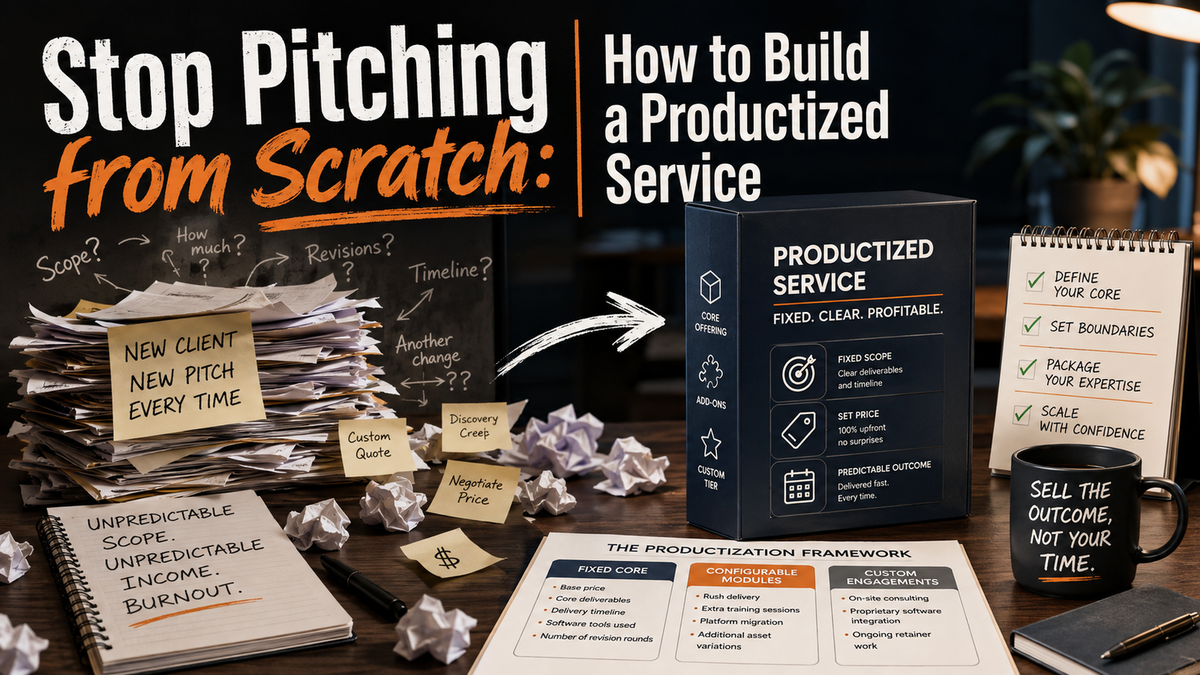
Stop Pitching from Scratch: How to Build a Productized Service
Custom client work often leads to scope creep and burnout. Discover how to identify your core offerings, set rigid service boundaries, and create standard packages that scale your expertise.
Custom consulting is exhausting when every new client requires a unique proposal, a fresh scope of work, and a negotiated price. You spend hours pitching before a single invoice is paid, and the resulting delivery process is entirely unpredictable.
A productized service solves this by packaging your expertise into a standardized offering. By defining a fixed scope, set price, and predictable timeline, you shift from selling your time to selling a specific outcome. You make your service as easy to buy as a product off a shelf.
Productizing does not mean forcing every client need into a rigid, one-size-fits-all box. Instead, it involves standardizing the core work you do 80% of the time, allowing you to deliver faster, protect your margins, and eliminate scope creep.
Designing Your Productization Framework
To standardize freelance services, you must separate the predictable elements of your work from the highly variable ones. Review your last five successful projects and isolate the recurring tasks, deliverables, and roadblocks.
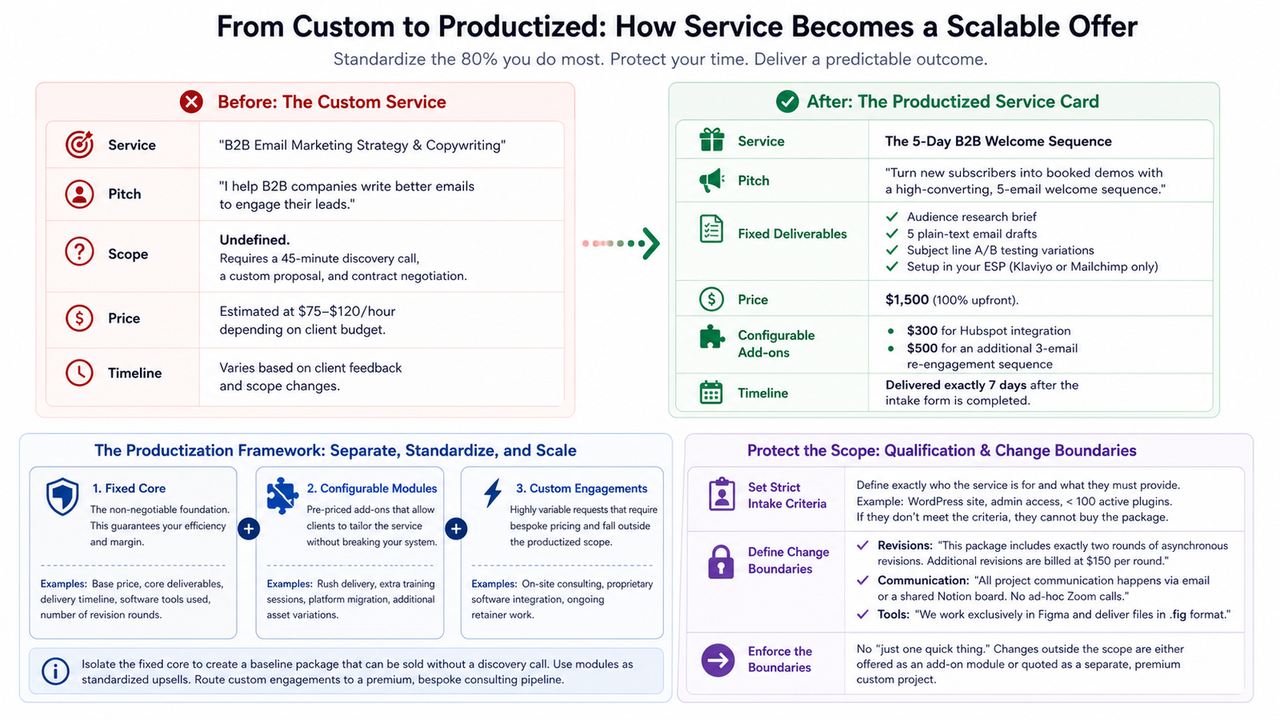
Once you identify the patterns, divide your offering into three categories: what stays fixed, what can be configured, and what remains custom.
Element
Definition
Examples
Fixed Core
The non-negotiable foundation of the service. This guarantees your efficiency and margin.
Base price, core deliverables, delivery timeline, software tools used, number of revision rounds.
Configurable Modules
Pre-priced add-ons that allow clients to tailor the service without breaking your system.
Rush delivery, extra training sessions, platform migration, additional asset variations.
Custom Engagements
Highly variable requests that require bespoke pricing and fall outside the productized scope.
By isolating the fixed core, you create a baseline package that can be sold without a discovery call. Configurable modules act as standardized upsells. If a client demands custom engagements, you route them away from the productized service and into a premium, bespoke consulting pipeline.
The Before-and-After Service Card
Moving from custom quotes to a fixed scope service package requires a drastic change in how you present your offer. You must replace vague capabilities with concrete deliverables.
Here is how a solo operator offering B2B email marketing might transform a custom service into a productized service card:
Pitch: "I help B2B companies write better emails to engage their leads."
Scope: Undefined. Requires a 45-minute discovery call, a custom proposal, and contract negotiation.
Price: Estimated at $75–$120/hour depending on client budget.
Timeline: Varies based on client feedback and scope changes.
After: The Productized Service Card
Service: The 5-Day B2B Welcome Sequence
Pitch: "Turn new subscribers into booked demos with a high-converting, 5-email welcome sequence."
Fixed Deliverables: Audience research brief, 5 plain-text email drafts, subject line A/B testing variations, setup in your ESP (Klaviyo or Mailchimp only).
Price: $1,500 (100% upfront).
Configurable Add-ons: $300 for Hubspot integration; $500 for an additional 3-email re-engagement sequence.
Timeline: Delivered exactly 7 days after the intake form is completed.
Qualification Rules and Change Boundaries
A productized service is only profitable if you fiercely protect the scope. If you allow clients to dictate the terms, you are simply doing custom work at a flat rate—a recipe for working below minimum wage.
Set Strict Intake Criteria
Define exactly who the service is for and what they must provide before work begins. For example, a website speed optimization service might require the client to be on WordPress, have administrative access ready, and have less than 100 active plugins. If they do not meet these criteria, they cannot buy the package.
Define Change Boundaries
Clients will inevitably ask for "just one quick thing." Your productized offering must explicitly state the boundaries of the engagement:
Revisions: "This package includes exactly two rounds of asynchronous revisions. Additional revisions are billed at $150 per round."
Communication: "All project communication happens via email or a shared Notion board. No ad-hoc Zoom calls."
Tools: "We work exclusively in Figma and deliver files in .fig format."
Transitioning Current Clients
Switching to a productized model can feel risky when you rely on revenue from existing bespoke clients. You do not need to fire your current roster to make the shift. Instead, use a phased transition plan that protects your cash flow while setting new boundaries.
Ring-Fence Active Projects: Do not change the terms of active contracts. Deliver on your current custom obligations exactly as promised.
Productize Your Next Lead: Route all net-new inquiries to your productized service. If a prospect asks for custom work, explain that your agency model has shifted to focus entirely on delivering specialized, fixed-scope packages.
Offer a Standardized Renewal: As current client projects wrap up, introduce the new model. Frame it as a benefit: "To deliver faster and keep costs predictable, I’ve standardized my services. Moving forward, instead of estimating hours, you can book my 'Monthly SEO Audit Package' for a flat $1,000."
Enforce the Cut-Off: Set a firm date (e.g., 90 days out) where all hourly or legacy custom work ceases. Clients who refuse to transition to the productized model or your premium custom tier must be offboarded.
Frequently Asked Questions
What if a client needs something slightly outside the fixed package?
If the request is small and repeatable, turn it into a priced, configurable add-on module for future clients. If the request is complex or highly specific to that one client, decline it, refer them to another specialist, or quote it entirely separately as a premium custom project distinct from your productized offering.
How do I price a productized service compared to my hourly rate?
Price based on the value of the outcome, not the hours it takes to complete. If a custom project previously took you 20 hours at $100/hour ($2,000), but you optimize your process to complete it in 5 hours, you should still charge $2,000. The client is paying for the guaranteed result and the speed, while you are rewarded for your efficiency.
Can I offer productized services and still take custom projects?
Yes, but they must be managed distinctly. Many operators use a productized service as their primary lead generator and bread-and-butter income, reserving custom consulting only for high-budget enterprise clients. The key is ensuring custom work is priced high enough to justify stepping outside your optimized, productized workflow.