Cross-Border Ecommerce#website vs social media for business#social media vs website#owned media strategy#build an owned audience#move social followers to website
Beyond the Feed: Transitioning from Social Followers to Owned Assets
Relying purely on platform algorithms puts your connection to customers at risk. Find out how to strategically introduce an owned website, capture direct contacts, and encourage repeat purchases.
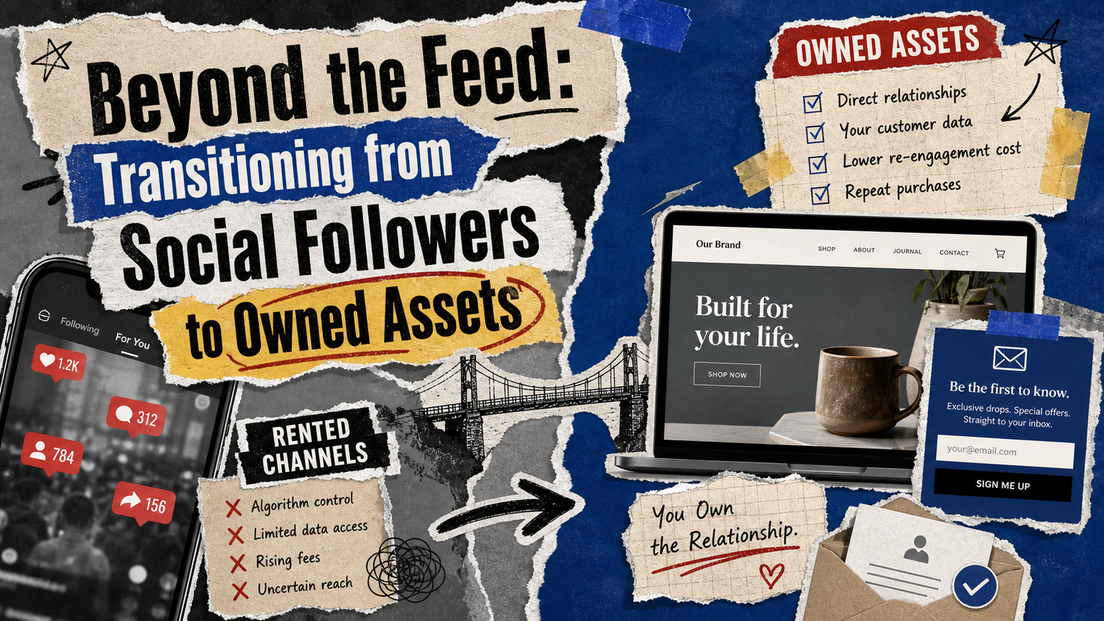
Building a business on the back of a social media platform or a third-party marketplace is a proven way to find your first customers. These platforms offer unmatched tools for discovery, built-in trust, and vast pools of active buyers. However, running a business entirely on "rented land" carries a foundational risk: you do not control the algorithm, you do not set the rules, and most importantly, you do not own the relationship with your customers.
When a platform changes its visibility metrics or a marketplace increases its fees, businesses without independent assets often scramble. The solution is not to abandon the networks that currently drive your sales. Instead, the most resilient small businesses add an owned website and a permission-based contact list as a durable relationship layer.
This strategy allows you to keep utilizing platforms for what they do best—discovery and audience building—while systematically moving those engaged users to channels you control.
Understanding the Balance: Rented vs. Owned Channels
Before making structural changes to your marketing, it helps to map exactly what rented platforms and owned assets bring to your business. You need both, but they serve entirely different functions in the customer lifecycle.
Feature
Rented Channels (Social Media, Marketplaces)
Owned Assets (Website, Email/SMS Lists)
Audience Access
Filtered by algorithms; visibility must be earned repeatedly or paid for.
Direct; messages reach the inbox or phone of every subscriber.
Data Ownership
Platform retains customer data; merchant sees limited demographic data.
Merchant owns customer contact info, purchase history, and behavior data.
Cost Dynamics
Organic reach is "free" but declining; paid reach requires continuous ad spend.
High upfront effort, but low marginal cost to re-engage past buyers.
Primary Strength
Discovery, viral reach, community engagement, and initial trust-building.
Durability, repeat purchases, upselling, and long-term brand equity.
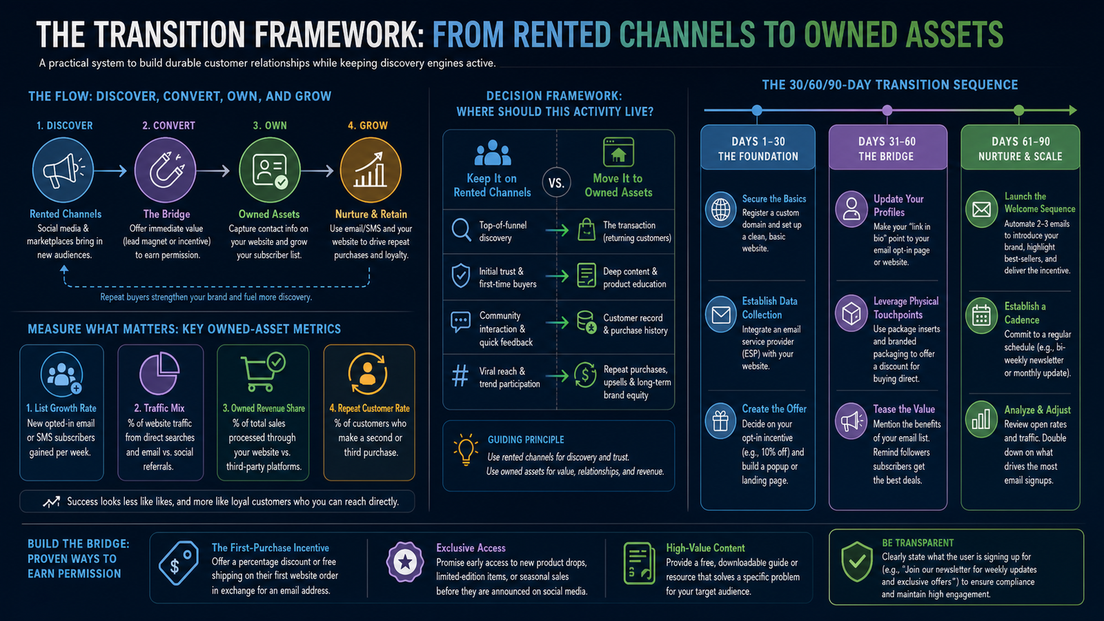
Mapping the Transition: What Stays and What Moves
Transitioning to an owned-asset model does not mean shutting down your Etsy shop or abandoning your TikTok account. It means realigning their purpose.
What remains on rented channels:
Top-of-Funnel Discovery: Use social media to cast a wide net, leveraging trends and hashtags to find new eyes.
Initial Trust: Marketplaces provide a sense of security for first-time buyers who might be hesitant to input their credit card on an unknown website.
Community Interaction: Casual conversations, polls, and immediate feedback loops are still best suited for social feeds.
What moves to owned assets:
The Transaction: Whenever possible, direct returning customers to purchase through your own domain to avoid marketplace commission fees.
Deep Content and Education: Long-form product guides, sizing details, and brand storytelling live permanently on your website.
The Customer Record: Every transaction on your site captures a name, email address, and purchase history, allowing you to build a valuable customer database.
Earning Permission: The Bridge to Your Owned Assets
You cannot simply export your followers from a social platform and email them. Moving an audience requires earning explicit permission. To get users to leave a highly engaging social feed and hand over their contact information, you must offer immediate, tangible value.
This is commonly done through a "lead magnet" or an opt-in incentive. Effective strategies include:
The First-Purchase Incentive: Offering a percentage discount or free shipping on their first website order in exchange for an email address.
Exclusive Access: Promising subscribers early access to new product drops, limited-edition items, or seasonal sales before they are announced on social media.
High-Value Content: Providing a free, downloadable guide or resource that solves a specific problem for your target audience.
When collecting this information, transparency is critical. Clearly state what the user is signing up for (e.g., "Join our newsletter for weekly updates and exclusive offers") to ensure compliance with privacy expectations and maintain high engagement rates.
Measuring Success in the Transition
As you build out your website and contact lists, your metrics for success will shift away from likes, comments, and follower counts. To gauge the health of your owned assets, track these indicators:
List Growth Rate: The number of new, opted-in email or SMS subscribers gained per week.
Traffic Mix: The percentage of your website traffic coming from direct searches and email links versus social media referrals.
Owned Revenue Share: The percentage of total sales processed through your website compared to third-party marketplaces.
Repeat Customer Rate: Since owned assets excel at retention, a successful transition should result in a higher percentage of customers buying a second or third time.
The 30/60/90-Day Transition Sequence
Building an owned audience takes time. Rather than attempting to launch everything at once, use a staged approach to establish your assets, build the bridge from your social channels, and begin nurturing your new list.
Days 1–30: The Foundation
Secure the Basics: Register a custom domain name and set up a basic, visually clean website. Even a simple, one-page site is enough to start.
Establish Data Collection: Integrate an email service provider (ESP) with your website.
Create the Offer: Decide on your opt-in incentive (e.g., 10% off) and build a simple popup or dedicated landing page to collect email addresses.
Days 31–60: The Bridge
Update Your Profiles: Change the "link in bio" on all social media profiles to direct users to your email opt-in page or your new website.
Leverage Physical Touchpoints: If you ship physical products through a marketplace, design package inserts thanking the customer for their order and offering a discount on their next purchase if they buy directly from your website.
Tease the Value: Begin mentioning the benefits of your email list in your social media content. Remind followers that subscribers get the best deals.
Days 61–90: Nurture and Scale
Launch the Welcome Sequence: Automate a short series of 2-3 emails that deploy immediately after someone subscribes. Introduce your brand story, highlight your best-selling products, and deliver the promised incentive.
Establish a Cadence: Commit to a regular communication schedule, whether that is a bi-weekly newsletter or a monthly product update.
Analyze and Adjust: Review your open rates and website traffic. Identify which social posts or marketplace inserts are driving the most email signups and double down on those efforts.
Frequently Asked Questions
Do I need to stop selling on marketplaces once my website is live?
No. Marketplaces are excellent engines for acquiring first-time buyers. The most profitable strategy is to keep the marketplace active for discovery, but use package inserts and branded packaging to encourage those first-time buyers to make their next purchase directly on your website.
How do I get social media followers to visit my website without hurting my reach?
Social algorithms generally prefer to keep users on their platforms, so posts with external links can sometimes see lower reach. To bypass this, focus on building curiosity. Share highly engaging, native content on the platform, and instruct users to visit the link in your bio or reply with a specific keyword to receive a direct message with the link to your site.
Is an email list still an effective business asset?
Yes. Email marketing consistently delivers one of the highest returns on investment for small businesses. Unlike a social media post, which might be seen by a small fraction of your followers, an email lands directly in the inbox of a customer who explicitly asked to hear from you, making it a highly reliable channel for driving repeat sales.