Cross-Border Ecommerce#side hustle business#turn side hustle into business#solopreneur business#side hustle systems#sustainable side hustle
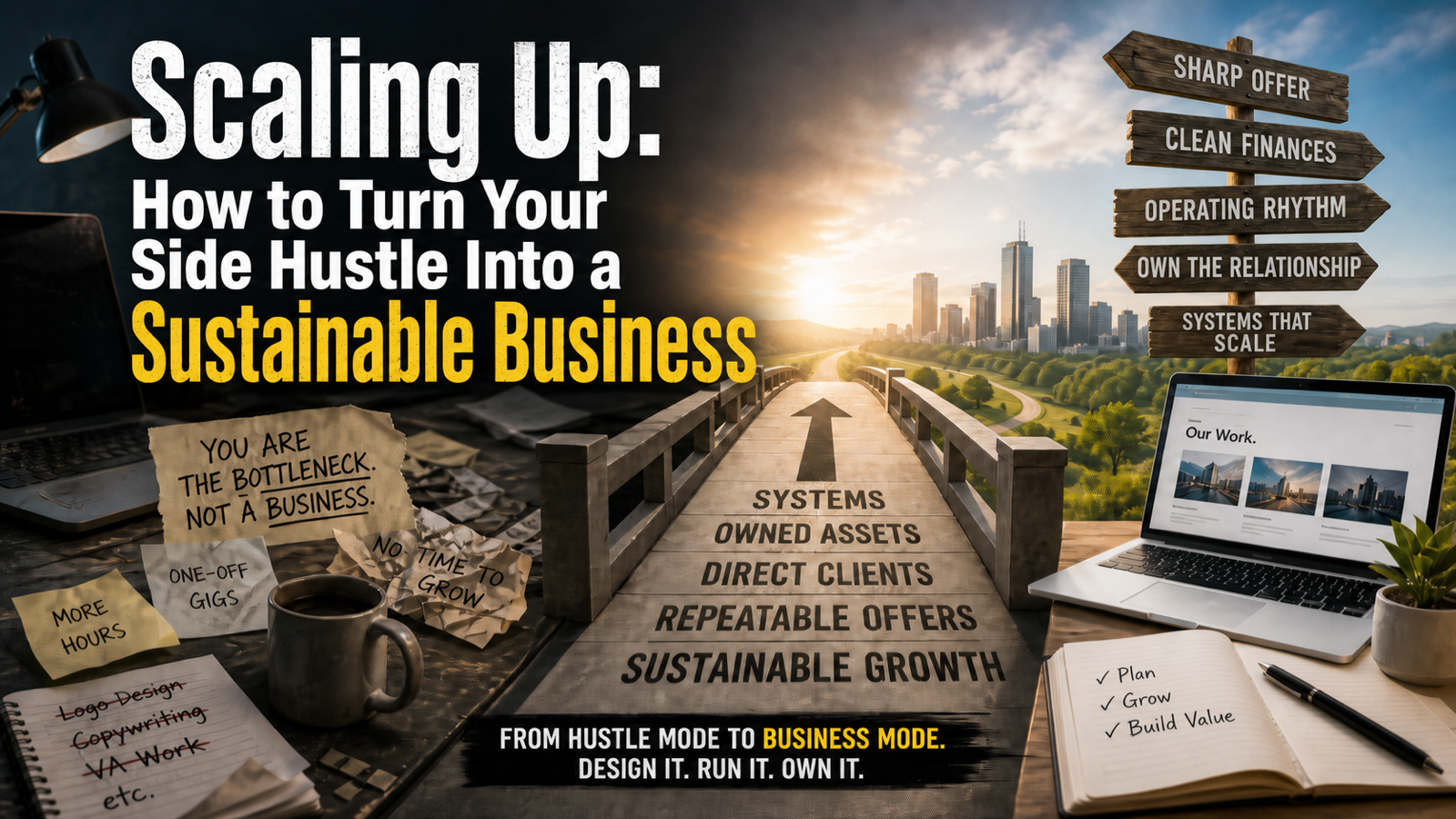
Scaling Up: How to Turn Your Side Hustle Into a Sustainable Business
Moving beyond random gigs requires structure. Learn how to evaluate your current setup, streamline daily operations, and build a sustainable side hustle that scales without burning you out.
Most side hustles start as a desperate trade: you swap your nights and weekends for a little extra cash. It feels great at first. You land a client, you finish a project, you get paid. But eventually, the thrill wears off. You hit an invisible ceiling where you simply cannot work any more hours. You haven’t built a business; you’ve built a second job where you are the most demanding, unreasonable boss you’ve ever had.
Transitioning from repeated gigs to a durable business requires a fundamental shift in how you operate. A hustle relies entirely on your immediate sweat equity. A business relies on systems, repeatable offers, and owned assets that allow you to grow without burning out.
Getting there doesn’t happen by accident, and it isn't triggered by hitting a magical revenue number or filling out a single piece of paperwork. It happens by intentionally staging your transition across your operations, your finances, and your customer relationships.
Here is how to make the leap.
1. Sharpen Your Offer
When you are hustling, your implicit pitch is, "I will do whatever you need for money." You take on a logo design one day, a copywriting gig the next, and maybe some virtual assistant work on the weekend. This is exhausting and impossible to scale.
To build a business, you must productize your service. Identify the one or two things you do best, that clients consistently value, and that you can deliver efficiently. Package them into a specific offer with a clear outcome and a set price. Instead of selling "marketing consulting by the hour," sell a "comprehensive monthly email marketing teardown." When your offer is sharp and repeatable, your delivery becomes faster, and your profit margins grow.
2. Separate Your Records and Finances
If you are buying groceries and paying for business software out of the same checking account, you are running a hobby, not a business.
Proper financial hygiene is non-negotiable. Open a dedicated business checking account and run every single business transaction through it. Under the guidelines of IRS Publication 334 (Tax Guide for Small Business) and the instructions for Schedule C (Form 1040), sole proprietors must keep accurate, permanent books and records to determine their business income and deductible expenses.
You do not need a complex corporate structure to do this. You just need a clear, unbroken trail of money coming in and money going out. When tax season arrives, a dedicated ledger turns a nightmare into a straightforward afternoon of data entry.
3. Establish a Sustainable Operating Rhythm
Gig workers react. Business owners plan. If you are constantly putting out fires and responding to client emails at midnight, you have no time to steer the ship.
You need an operating rhythm. Timebox your week to separate "working in the business" (delivering client work) from "working on the business" (marketing, accounting, strategic planning). Dedicate a specific half-day every week purely to CEO-level tasks. If you do not forcefully carve out this time, urgent client demands will swallow it whole.
4. Own the Customer Relationship
Gig platforms and freelance marketplaces are great for getting your first few reps in. They supply the demand, process the payments, and handle the infrastructure. But they also own the customer, control your visibility, and take a heavy cut of your earnings.
To be a durable business, you must build direct relationships. Once your core offer is sharp and your path to acquiring customers is stable, you need a digital home that you fully control. Using a platform like Foundax gives you an editable website and content surface to showcase your portfolio, capture leads, and control your own narrative. Moving clients off rented marketplace platforms and onto your own direct roster is how you build long-term enterprise value.
5. Build Systems to Remove the Bottleneck (You)
As long as every decision, template, and process lives exclusively in your head, the business cannot grow past your personal capacity.
Start writing down how you do what you do. Create standard operating procedures (SOPs) for client onboarding, invoice generation, and project kickoff. Automate your intake forms and meeting scheduling. The goal is to build a machine where the routine steps happen automatically, leaving your brain free to focus on the high-value work that actually moves the needle.
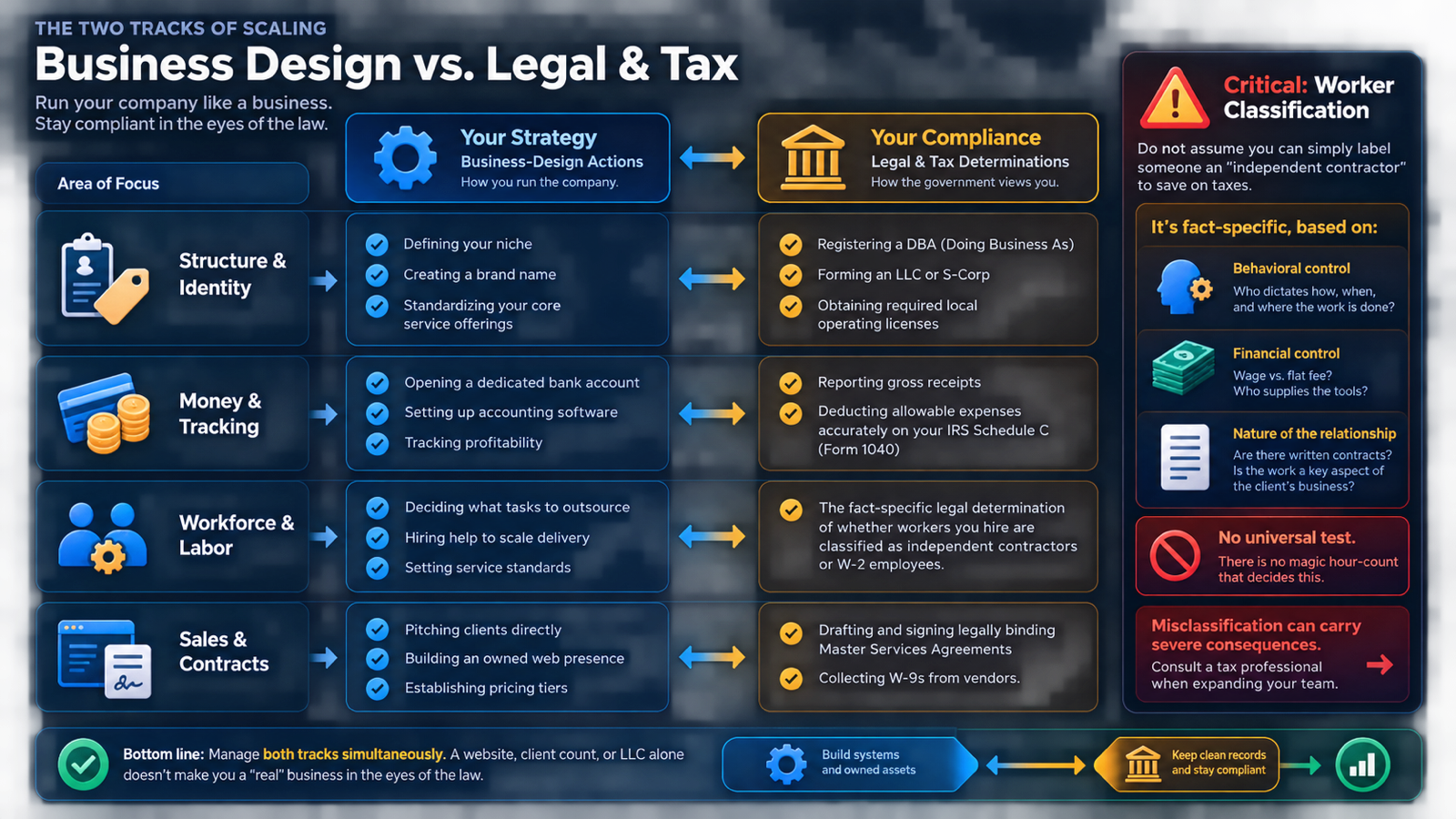
The Two Tracks of Scaling
It is incredibly common for new operators to confuse business design (how you run the company) with legal and tax compliance (how the government views you). Keep in mind that no single website, client count, or LLC automatically turns you into a "real" business in the eyes of the law. You must manage both tracks simultaneously.
Transition Table: Business Design vs. Legal & Tax
Area of Focus
Business-Design Actions (Your Strategy)
Legal & Tax Determinations (Your Compliance)
Structure & Identity
Defining your niche, creating a brand name, and standardizing your core service offerings.
Registering a DBA (Doing Business As), forming an LLC or S-Corp, and obtaining required local operating licenses.
Money & Tracking
Opening a dedicated bank account, setting up accounting software, and tracking profitability.
Reporting gross receipts and deducting allowable expenses accurately on your IRS Schedule C (Form 1040).
Workforce & Labor
Deciding what tasks to outsource, hiring help to scale delivery, and setting service standards.
The fact-specific legal determination of whether workers you hire are classified as independent contractors or W-2 employees.
Sales & Contracts
Pitching clients directly, building an owned web presence, and establishing pricing tiers.
Drafting and signing legally binding Master Services Agreements and collecting W-9s from vendors.
A vital note on worker classification: As you scale and bring on help, do not assume you can simply label someone an "independent contractor" to save on taxes. Worker classification is a highly fact-specific legal and tax determination based on behavioral control, financial control, and the nature of the relationship. There is no universal test or magic hour-count that decides this; misclassification can carry severe consequences, so consult a tax professional when expanding your team.
Frequently Asked Questions
Do I have to form an LLC to be considered a real business?
No. An LLC (Limited Liability Company) is a legal entity structure primarily used to separate your personal assets from your business liabilities. It is not a universal requirement to operate or to make money. Many successful solo operators run as sole proprietors and report their business income and expenses on IRS Schedule C. The decision to form an LLC should be based on your specific risk profile, industry, and state regulations, ideally in consultation with a legal professional.
How do I know if I am legally acting as an employee or an independent contractor for my clients?
There is no single rule or exact number of hours that universally determines your status. Under IRS guidelines, it is a fact-specific determination that hinges on control. Generally, the courts and the IRS look at behavioral control (does the client dictate exactly how, when, and where you do the work?), financial control (are you paid a regular wage vs. a flat fee, and do you supply your own tools?), and the type of relationship (are there written contracts, and is the work a key aspect of the client's regular business?).
When is the right time to build my own website?
Do not use building a website as a way to procrastinate on actually getting clients. In the very beginning, a simple professional social profile or a gig marketplace profile is enough to validate that people will pay for your services. The right time to launch an owned website is after you have validated your core offer, established a stable customer path, and are ready to own your audience directly rather than renting space on third-party platforms.