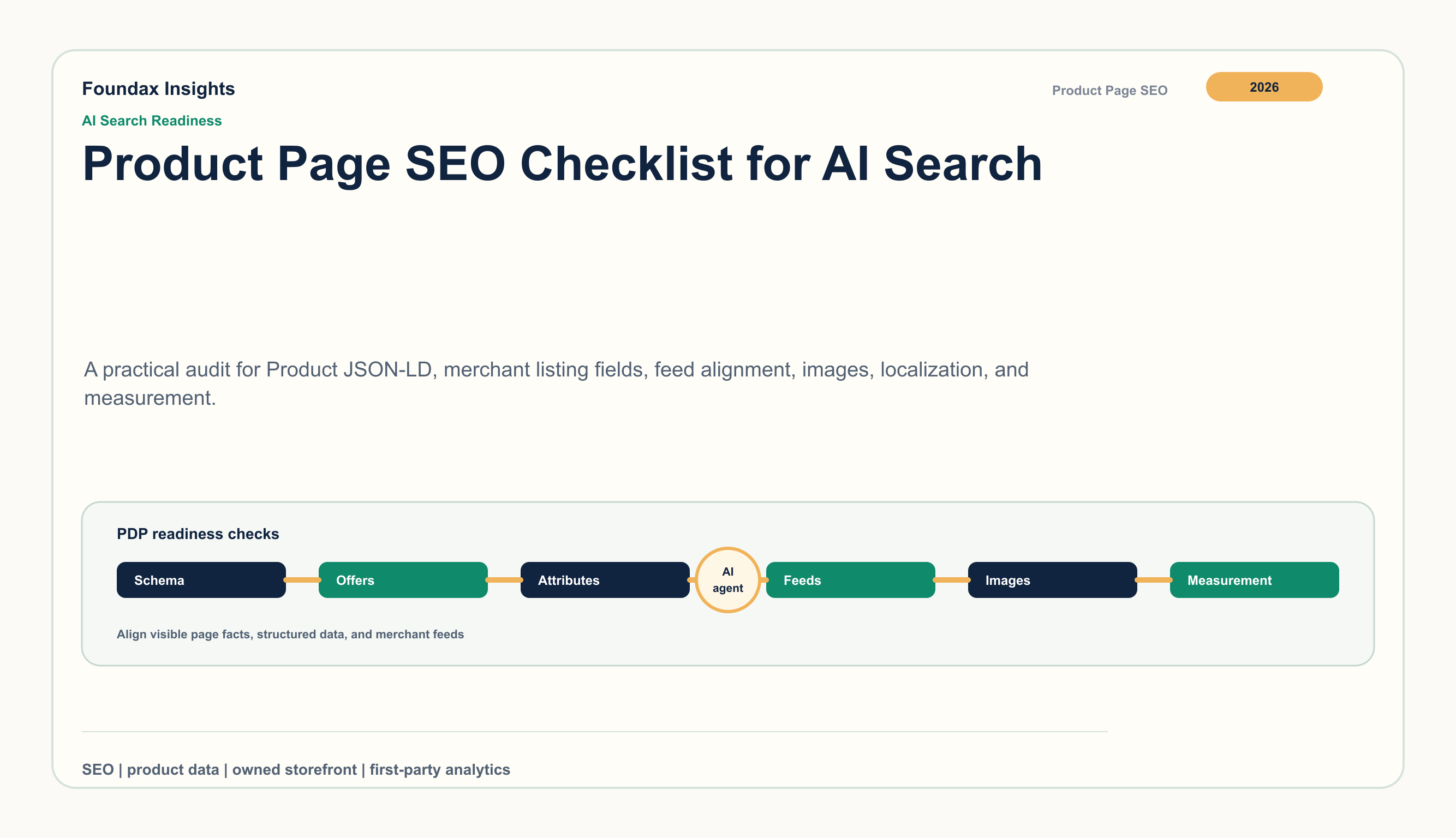
AI search does not remove the need for classic product page SEO. It makes the weak spots easier to expose. A product page still needs a clear title, crawlable content, a fast mobile experience, and a canonical URL. But ecommerce teams now also need to keep the visible page, Product JSON-LD, variant attributes, images, policies, and Merchant Center feed aligned.
The workflow below is built for DTC teams that already have product pages but want them to be easier for Google Search, Google Shopping, AI Mode-style shopping experiences, and other product discovery systems to understand. The practical goal is to remove avoidable ambiguity so crawlers, feeds, and reporting tools can read the same product facts: page content, Product JSON-LD, Merchant Center data, images, variants, shipping, returns, and analytics labels.
What changed for product page SEO
Google's Product structured data documentation separates product snippets from merchant listings. Product snippets can show details such as ratings, price, and availability. Merchant listings apply to pages where shoppers can buy from you and support more product-specific information such as shipping, sizing, returns, and variants. Google also recommends combining page-level structured data with Merchant Center feeds because the two sources help Google understand and verify product data.
AI shopping raises the bar for attribute completeness. Google's May 20, 2025 AI Mode shopping update says AI Mode combines Gemini capabilities with the Shopping Graph, which includes product listings with details like reviews, prices, colors, and availability. On May 27, 2026, Google Merchant Center announced upcoming AI performance insights, including product attribute insights and an attribute completeness score for missing structured product attributes.
That does not mean every Product schema field is an AI ranking factor. It means PDP SEO now has to be operated as a data-quality workflow, not only a copywriting workflow.
Checklist 1: make the page crawlable and canonical
Before touching schema, verify the basics:
- The product page returns a stable 200 status for the canonical URL.
- The canonical URL matches the URL used in structured data, sitemap entries, and Merchant Center feed links.
- Robots rules, noindex tags, login walls, and region redirects do not block the product page.
- Localized product pages have consistent alternate links and do not mix languages inside the same page.
- Variant URLs are intentional: either each variant has a canonical page or variants are represented under a parent product pattern.
If these basics are wrong, structured data only makes the inconsistency easier to detect.
Checklist 2: align visible facts with Product JSON-LD
The Product JSON-LD on a PDP should describe what shoppers can see on that same page. Audit the core fields first:
- Product name and description.
- Product image URLs that are crawlable and relevant to the product.
- SKU, MPN, GTIN, and brand when available.
- Offer data such as price, currency, URL, availability, and condition.
- Aggregate rating only when real review count and rating data exist.
Do not mark up hidden claims, fake reviews, or business policies that are not represented on the page. Google's structured data guidelines require structured data to be a true representation of the page content and warn that misleading markup can prevent rich results from showing.
Checklist 3: separate Product schema from merchant listing depth
Product schema is not one giant checkbox. Google distinguishes product snippets, merchant listings, variants, shipping, returns, loyalty, and policies. A PDP audit should therefore ask two questions:
- What can the page-level Product JSON-LD express reliably today?
- What should live in Merchant Center feed fields or merchant listing markup instead?
For example, price and availability may appear in both page markup and the feed. Shipping and returns may come from Merchant Center, product-level merchant listing markup, or organization-level policy markup. Google documents an order of precedence for shipping and return configurations, so teams should avoid maintaining conflicting values in multiple places.
Checklist 4: keep page, feed, and inventory facts consistent
AI search and shopping surfaces are sensitive to stale product facts. Check these fields across PDP, feed, and backend records:
- Price, sale price, and sale price effective date.
- Availability, preorder/backorder state, and availability date.
- Primary image and additional images.
- Brand, GTIN, MPN, and identifier exists.
- Google product category and item group ID.
- Size, color, material, pattern, gender, age group, and size system.
- Shipping weight/dimensions and product dimensions when they matter.
The practical rule is simple: the shopper-facing page, schema, and feed should not disagree about what the product is, whether it is available, or what it costs.
Checklist 5: audit attributes like a discovery system would
Attribute completeness matters because users ask product questions in natural language. Instead of only optimizing a title for one keyword, audit whether the page can answer common buying filters:
- What is it made of?
- Which size or fit does it support?
- Which color or finish is shown?
- Which model, bundle, multipack, or variant does this SKU represent?
- Which market, language, and currency is this page for?
- What policy applies to shipping, returns, and availability?
The May 27, 2026 Merchant Center AI insights announcement is a useful signal here: Google specifically calls out product attribute insights and an attribute completeness score for products missing structured attributes.
Checklist 6: make images machine-readable and indexable
Product images should not be treated as decoration. Check that:
- Main product images are accessible from crawlable URLs.
- Structured data image URLs point to relevant product images.
- Image alt text describes the product plainly rather than stuffing keywords.
- Variant images match the selected variant where possible.
- CDN transformations do not block Googlebot or produce temporary URLs.
Google's structured data guidelines state that image URLs used in structured data must be crawlable and indexable. If the image cannot be accessed, it cannot support richer product presentation.
Checklist 7: measure with Search Console and Merchant Center
After deployment, use reporting rather than assumptions:
- Search Console Product snippets and Merchant listings reports for warnings and errors.
- Search Console Performance report for impressions, clicks, click-through rate, and rich result appearance.
- Merchant Center diagnostics and feed issue reports for product data problems.
- Merchant Center AI performance insights when available in your market.
- Storefront analytics for downstream behavior after product page visits.
Treat this as an operating loop: fix invalid items, inspect live URLs, request validation, and compare performance after template or feed changes.
How Foundax supports this workflow
Foundax supports this work as an operating workflow for keeping product facts consistent across public pages, structured data, Search Console, Merchant Center, and analytics:
- Published PDP runtime can emit Product JSON-LD with Product, Offer, and AggregateRating fields when the underlying data exists.
- The SEO workspace supports metadata, canonical, sitemap, Search Console verification, and sitemap submission flows.
- GMC preflight and sync use a strict alignment model: required fields must pass checks before submission, and merchant-provided facts remain the source of truth.
- Product import templates and structured product records help teams maintain SKU, attribute, image, pricing, and GMC fields in one operational model.
- Multi-locale storefront and content workflows make it easier to keep localized pages and hreflang-style discovery consistent.
This is the right framing for AI search: fewer data mismatches and a clearer path from product record to public page to merchant feed.
A practical 30-minute PDP audit
Use this sequence when reviewing a high-priority product page:
- Open the live product page and confirm canonical, language, title, description, image, price, and availability.
- Inspect the rendered Product JSON-LD and compare it with visible page content.
- Check Merchant Center feed fields for the same SKU or item group.
- Review Search Console Product structured data reports for warnings and invalid items.
- Check whether missing attributes map to real buyer filters.
- Fix source product records first, then regenerate page/schema/feed outputs.
- Re-test the live URL and monitor Search Console and Merchant Center after recrawl.
FAQ
What role should Product schema play?
Product schema should express real page facts in a machine-readable format: identity, images, offers, ratings when present, shipping, returns, and variant context. Treat schema as a data-quality foundation that keeps the visible PDP, structured markup, and merchant feed easier to compare.
Which fields should I audit first?
Start with title, description, images, SKU or identifiers, brand, price, currency, availability, canonical URL, and variant attributes. These fields are the easiest to compare across the visible page, Product JSON-LD, and Merchant Center feed.
What is the difference between product snippets and merchant listings?
Product snippets are product-related search results that can include information such as ratings, price, and availability. Merchant listings apply to pages where customers can buy from you and support more commerce-specific details such as shipping, returns, sizing, and variants.
Should every product page include FAQ schema?
Only if the page actually has shopper-facing FAQ content and your implementation supports that markup. Do not add FAQ markup just because a checklist says so. Misleading or invisible structured data is a quality risk.
How often should product page SEO be rechecked?
Recheck after template changes, feed changes, pricing or availability automation changes, major localization updates, and any Search Console or Merchant Center warning. High-volume SKUs should be reviewed on a recurring cadence.
How does Foundax support this workflow?
Foundax helps teams keep product records, PDP metadata, Product JSON-LD, sitemap/Google workflows, and GMC preflight/sync in one operating path. That reduces mismatch risk across page, schema, and feed, while still leaving business facts under merchant control.
References
Related reading
For the broader discovery model, read Product Data Is Becoming the SEO Layer for AI Commerce Discovery, then use the agentic commerce product data guide to prioritize fields across catalog, feed, and storefront.