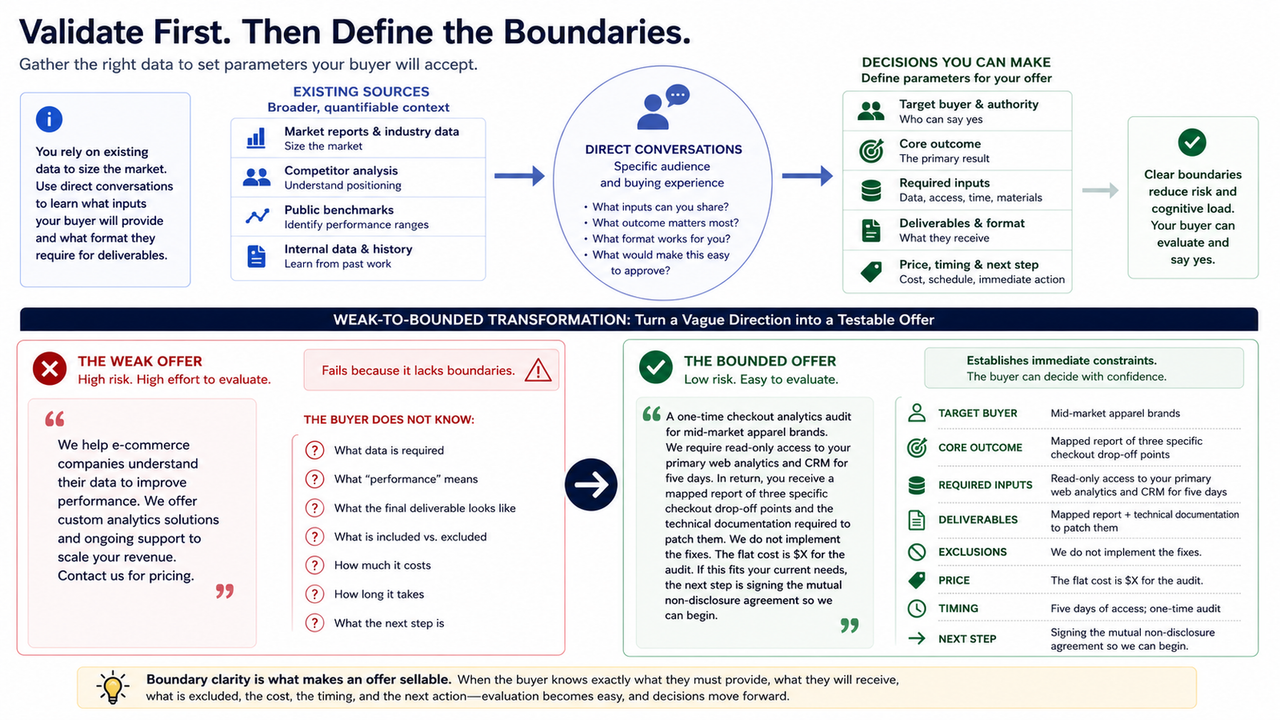
Transform your broad business idea into a specific, bounded offer. Discover how to clearly define your target buyer, map out the expected outcome, and establish firm exclusions and pricing to test your concept.
Most new products and services stall not because the underlying concept is flawed, but because the offer itself is too ambiguous for a buyer to evaluate. A sellable offer is not a persuasion tactic, a countdown timer to force scarcity, or an "irresistible" marketing formula. It is a defined boundary. It converts by reducing delivery risk and cognitive load, allowing a specific buyer to understand exactly what they must provide, what they will receive, and how the transaction concludes.
The Weak-to-Bounded Transformation
Broad service and product directions create high perceived risk for the buyer. Consider a hypothetical transformation of a vague B2B service into a testable offer.
The Weak Offer
"We help e-commerce companies understand their data to improve performance. We offer custom analytics solutions and ongoing support to scale your revenue. Contact us for pricing."
This fails because it lacks boundaries. The buyer does not know what data is required, what "performance" means, what the final deliverable looks like, or how much it costs. Evaluating it requires a high degree of effort.
The Bounded Offer
"A one-time checkout analytics audit for mid-market apparel brands. We require read-only access to your primary web analytics and CRM for five days. In return, you receive a mapped report of three specific checkout drop-off points and the technical documentation required to patch them. We do not implement the fixes. The flat cost is $X for the audit. If this fits your current needs, the next step is signing the mutual non-disclosure agreement so we can begin."
This offer is sellable because it establishes immediate constraints. The buyer knows exactly what is expected of them, what they will get, what is explicitly excluded, the timing, the cost, and the immediate next action.
To determine the right parameters for your specific audience, you must gather validation data. According to the US Small Business Administration's “Market research and competitive analysis”, updated March 24, 2026, direct customer research can answer specific audience and buying-experience questions, while existing sources serve broader quantifiable context. You rely on existing data to size the market, but you must use direct conversations to learn exactly what inputs your specific buyer is willing to provide and what format they require for deliverables.
The Copyable One-Page Offer Card
To move a product or service direction into the market, draft your boundaries using the following template. Do not pitch; simply state the mechanics of the exchange.
TARGET BUYER: [Specific individual or role with the authority to accept]
CORE OUTCOME: [The primary, objective result of the transaction]

REQUIRED INPUTS: [Exactly what time, materials, data, or access the buyer must provide]
DELIVERABLES: [The specific format, quantity, and nature of what is handed over]
EXCLUSIONS: [What is explicitly NOT included or supported]
EVIDENCE/METHODOLOGY: [The factual process or mechanism used to deliver the work]

PRICE / TEST COMMITMENT: [The exact financial cost or initial pilot commitment]
TIMING: [The schedule from acceptance to final delivery]
ACCEPTANCE CONDITIONS: [The specific criteria that dictate the work is complete]
NEXT STEP: [The single immediate action required to initiate the offer]
The Red-Team Test
Once you have drafted your offer card, apply a red-team test to expose missing boundaries before presenting it to a buyer. Review your draft against these failure points:
The "Discovery Call" Trap: Can the buyer evaluate the fundamental structure of this offer without needing to schedule a meeting to uncover the price or scope?
The Input Ambiguity: If the buyer delays sending you materials, does the timeline break? Your offer must clearly define the buyer's required inputs as a condition of your timing.
The Scope Creep Vulnerability: Are the exclusions aggressive enough? If a buyer assumes you will implement a strategy rather than just delivering a report, your exclusions have failed.
The Acceptance Dispute: Is the definition of "done" objective? If acceptance relies on the buyer being "satisfied" rather than a specific deliverable being handed over, the offer carries too much delivery risk.
Defining these constraints prevents you from selling a concept that cannot be delivered. Mastering this transition from a broad idea to a bounded transaction is a necessary step in how to start an online business, moving you away from endless planning and into actual market evaluation.
Frequently Asked Questions
What separates a bounded offer from a standard sales pitch?
A bounded offer relies on defined constraints rather than persuasion tactics or artificial scarcity. Instead of using broad claims, it reduces a buyer's cognitive load and delivery risk by immediately stating the exact inputs required, the specific deliverables provided, the exclusions, the timeline, and the price.
How do I determine which specific constraints my target buyer needs?
While existing data sources are useful for broad market sizing and quantifiable context, they do not reveal the exact boundaries your buyers expect. You must conduct direct customer research to learn the exact inputs your specific audience is willing to provide and the deliverable formats they require to accept the offer.
Why should acceptance conditions avoid relying on buyer satisfaction?
If an offer's definition of "done" relies on the buyer being subjectively satisfied rather than an objective deliverable being handed over, it carries too much delivery risk. Objective acceptance conditions, combined with explicitly stated exclusions, prevent scope creep and ensure the transaction can be clearly evaluated and concluded without dispute.