Early Acquisition Tactics: Finding Initial Traction
Once your offer is ready, it is time to start the conversation. Learn practical methods for leveraging existing relationships, niche communities, and direct outreach to test your proposition without an advertising budget.
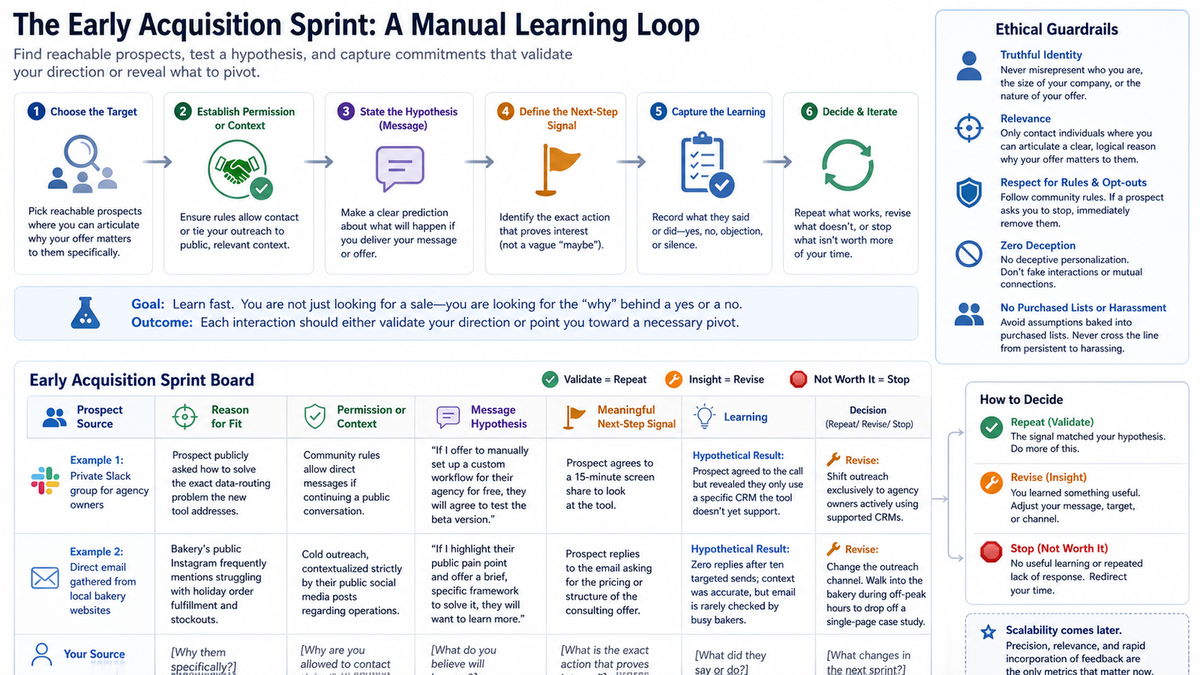
When you have a new offer but no existing audience and zero advertising budget, the priority is not building a scalable revenue channel. The central judgment of early acquisition is that it must operate as a manual learning loop. Your immediate goal is to find reachable prospects, present a hypothesis, and capture commitments that either validate your direction or point you toward a necessary pivot.
Navigating this phase is a fundamental part of how to start an online business. Rather than blasting the internet with automated messages, early operators must carefully choose among warm relationships, active niche communities, adjacent partnerships, and highly targeted direct outreach.
The strategy is to select prospects based on their reachability and the specific question you need each interaction to answer. According to the US Small Business Administration's “Market research and competitive analysis” guide (updated March 24, 2026), direct research such as interviews can produce nuanced, audience-specific understanding (https://www.sba.gov/business-guide/plan-your-business/market-research-competitive-analysis). You are not just looking for a sale; you are looking for the "why" behind a yes or a no.
The Ethical Imperative of Manual Outreach
Because early outreach is manual and often uninvited, it requires strict adherence to ethical boundaries.
Truthful Identity: Never misrepresent who you are, the size of your company, or the nature of your offer.
Relevance: Only contact individuals where you can articulate a clear, logical reason why your offer matters to them specifically.
Respect for Rules and Opt-outs: If a community forbids self-promotion, do not post. If a prospect asks you to stop contacting them, immediately remove them from your workflow.
Zero Deception: Do not use deceptive personalization (e.g., faking a previous interaction or claiming a mutual connection that does not exist).
No Purchased Lists or Harassment: Avoid relying on the assumptions baked into purchased lead lists, and never cross the line from persistent to harassing.
The Early Acquisition Sprint Board
To formalize your learning loop, use a sprint board. This framework forces you to document the rationale behind your outreach, define what success looks like for that specific interaction, and establish a clear loop for iterating on your approach.
Below is a copyable sprint board structure, populated with two clearly hypothetical examples operating under different constraints.
Hypothetical Example 1 Constraint: Niche Community Access
The operator is a software developer who built a workflow tool for digital marketing agencies, leveraging an existing professional community.
Hypothetical Example 2 Constraint: Cold Direct Local Outreach
The operator offers specialized inventory consulting for local, independent bakeries and has no shared community, relying strictly on direct public contact information.
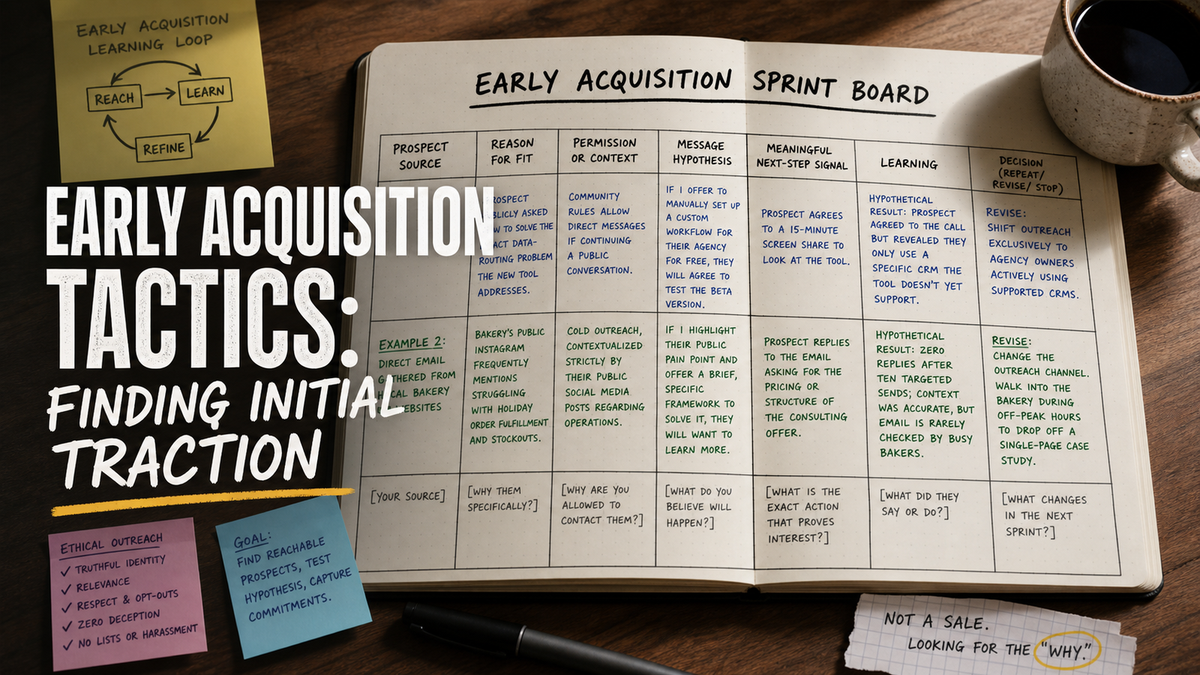
Prospect Source
Reason for Fit
Permission or Context
Message Hypothesis
Meaningful Next-Step Signal
Learning
Decision (Repeat/ Revise/ Stop)
Example 1: Private Slack group for agency owners
Prospect publicly asked how to solve the exact data-routing problem the new tool addresses.
Community rules allow direct messages if continuing a public conversation.
"If I offer to manually set up a custom workflow for their agency for free, they will agree to test the beta version."
Prospect agrees to a 15-minute screen share to look at the tool.
Hypothetical Result: Prospect agreed to the call but revealed they only use a specific CRM the tool doesn't yet support.
Revise: Shift outreach exclusively to agency owners actively using supported CRMs.
Example 2: Direct email gathered from local bakery websites
Bakery's public Instagram frequently mentions struggling with holiday order fulfillment and stockouts.
Cold outreach, contextualized strictly by their public social media posts regarding operations.
"If I highlight their public pain point and offer a brief, specific framework to solve it, they will want to learn more."
Prospect replies to the email asking for the pricing or structure of the consulting offer.
Hypothetical Result: Zero replies after ten targeted sends; context was accurate, but email is rarely checked by busy bakers.
Revise: Change the outreach channel. Walk into the bakery during off-peak hours to drop off a single-page case study.
[Your Source]
[Why them specifically?]
[Why are you allowed to contact them?]
[What do you believe will happen?]
[What is the exact action that proves interest?]
[What did they say or do?]
[What changes in the next sprint?]
Running the Loop
Your acquisition sprint is designed to break down assumptions. Start by filling out the bottom row with a handful of highly targeted prospects. Execute the outreach, record the exact learning (whether it is a hard rejection, a technical objection, or an enthusiastic yes), and make a decisive call to repeat the process, revise the message or target, or stop using that channel entirely.
Scalability comes later. In the beginning, precision, relevance, and the rapid incorporation of direct feedback are the only metrics that matter.
Frequently Asked Questions
Why should I avoid using automated messages or purchased lead lists for my initial outreach?
Early acquisition is designed as a manual learning loop rather than a scalable revenue channel. Relying on automated blasts or the assumptions baked into purchased lists prevents you from carefully selecting prospects based on strict relevance. Manual outreach ensures you operate ethically and allows you to gather the nuanced, audience-specific feedback necessary to validate or pivot your offer.
What defines a successful interaction if the prospect does not immediately buy?
A successful interaction provides a clear learning opportunity that answers the "why" behind a yes or a no. Success at this stage is often defined by capturing a meaningful next-step signal, such as a prospect agreeing to a brief screen share, replying to ask about the structure of your offer, or providing specific feedback about the tools they currently use.
What is the best course of action when prospects completely ignore my outreach?
When outreach is ignored, record the lack of response as a specific learning outcome on your sprint board. You must then make a decisive call to revise your approach. Often, a lack of response means you need to change your outreach channel entirely—such as shifting from emails that go unread to dropping off materials in person during off-peak hours.