Website Maintenance Cost for DTC Brands
A practical budget model for DTC teams that need to maintain product data, SEO, Google readiness, content, localization, policies, performance, and analytics after launch.
Read more
A practical guide for DTC teams to reduce fragile app stacks by moving product data, SEO, content, feed readiness and analytics into core workflows.
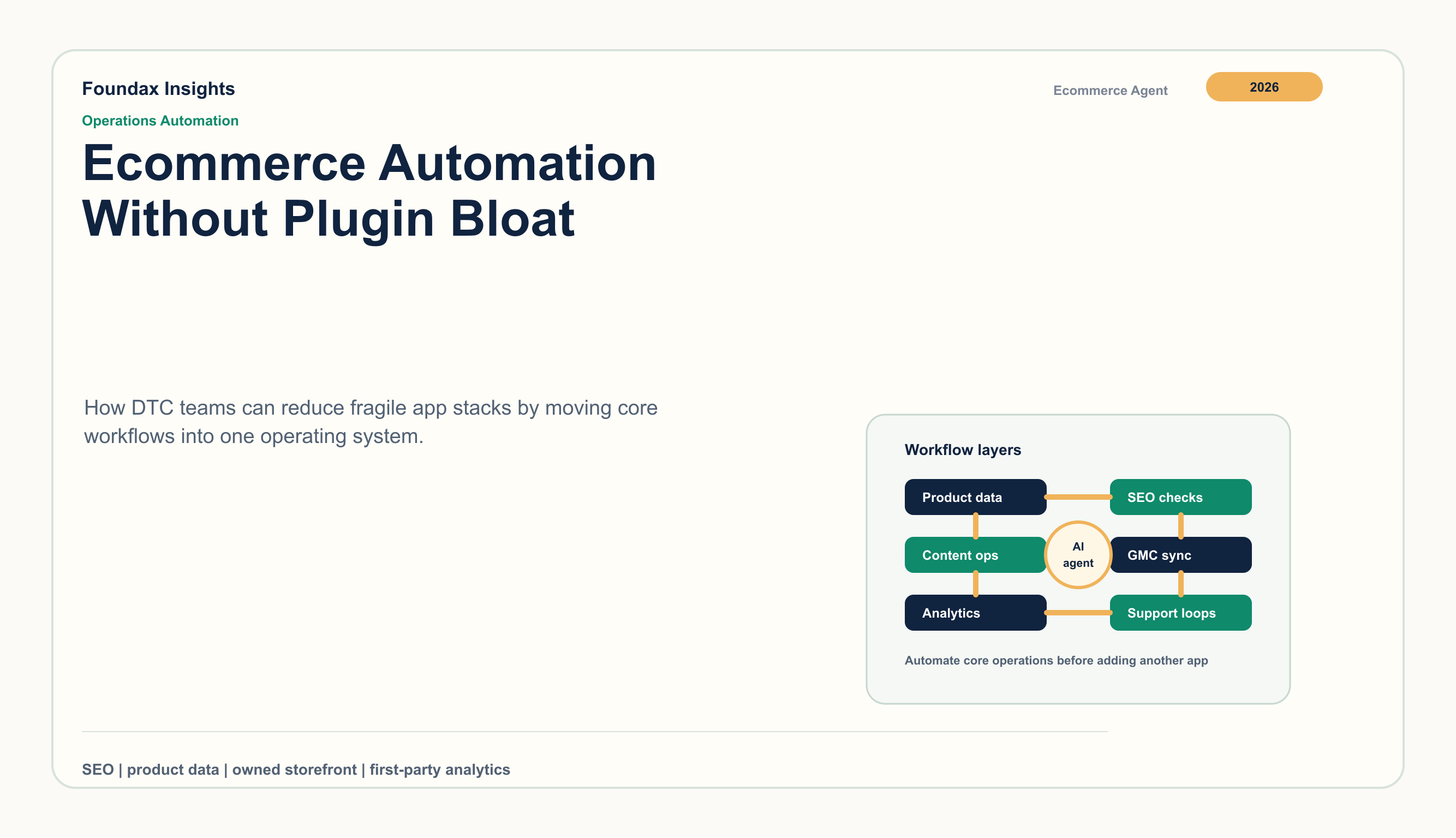
Plugins are not the enemy. They are often the fastest way to test a specialized feature, connect a niche system, or fill a platform gap. The problem starts when core operations become a stack of disconnected apps: one for SEO, one for reviews, one for product feeds, one for analytics, one for localization, one for support, and another for every exception.
Shopify's own performance guidance lists apps and third-party code among the biggest factors that can affect store performance. web.dev explains that third-party JavaScript can add network requests, main-thread work, duplicate frameworks and rendering delays. Shopify billing docs also show that app subscriptions and usage charges can run on independent billing cycles. None of this means merchants should never use apps. It means every added dependency should earn its place.
Plugin bloat is not a specific number of apps. It is a pattern:
For founders, the hidden cost is not only subscription spend. It is the coordination tax: more places to configure, more places for data to disagree, and more vendors involved when something breaks.
A healthier ecommerce stack separates core workflows from edge experiments.
| Workflow | Better default | When an app still makes sense |
|---|---|---|
| Product data | Keep names, variants, identifiers, media, price and availability in one owned source of truth. | Specialized PIM, ERP or supplier integration. |
| SEO and structured data | Generate core metadata, sitemap, hreflang and Product JSON-LD from the same product and page data. | Advanced experimentation or market-specific tooling. |
| Content operations | Publish content, FAQ, policy and localization through a governed content workflow. | A specialized content syndication or review platform. |
| Merchant feed readiness | Use preflight checks before sending product data to Merchant Center or similar channels. | A channel with unique feed rules or marketplace-specific operations. |
| Analytics | Keep first-party session, source, product and funnel signals close to the commerce system. | Supplemental tools such as GA4, ads pixels or BI warehouses. |
| Support and operations | Keep customer, product and order context accessible to support workflows. | A dedicated helpdesk when volume or SLA requirements justify it. |
The rule is simple: if a workflow affects product truth, buyer trust, SEO visibility or checkout confidence, it should be close to the operating system. If it is experimental, specialized or channel-specific, an app may be the right answer.
List every app, script, tag manager container and embedded widget. Record what it owns, what data it reads, what it writes, how it bills, and which page types it affects. Do not start by deleting things. Start by knowing what exists.
Look for duplicate analytics tools, overlapping SEO fields, multiple review widgets, several pop-up or discount tools, and feed apps that each maintain their own product assumptions. Duplicate responsibility is usually more dangerous than the app count itself.
Product identifiers, titles, variant facts, price, availability, canonical URLs, page metadata and policy facts should not depend on a fragile chain of manual copies. Move these facts into the core commerce system or a governed source that the storefront can read.
Keep apps that do a specialized job, have a clear owner, and do not duplicate a core workflow. Remove or replace apps that only exist because the core system has not been configured properly. For retained apps, define a review date and performance budget.
Foundax is designed around the operating-system side of the stack. Current product capabilities support product records, published pages, Content Studio, multilingual publishing, SEO metadata, core Product JSON-LD on PDPs, sitemap and hreflang output, Google Search Console and Merchant Center readiness workflows, GMC dry-run and sync paths, official content publishing, and first-party analytics.
That means Foundax can reduce the need for separate tools around product truth, SEO readiness, content publishing, localization and channel QA. The Foundax position is pragmatic: automate the core workflows that should stay connected, then integrate selectively where specialization creates real value. Email service providers, advanced review networks, niche ERPs, warehouse systems, helpdesks and marketplace connectors can still be valid when they are the right tool for a specialized job.
No. Plugins are useful when they solve a specialized problem. They become risky when core product, SEO, content, analytics or policy workflows depend on many disconnected tools without a clear owner.
There is no universal threshold. The better question is whether each app has a clear job, a clear data owner, a clear performance cost and a review date. Five overlapping apps can be worse than ten well-governed ones.
No. Some scripts are necessary for analytics, advertising, payments, reviews or support. The goal is to audit, budget and remove redundancy, not to pretend every third-party service is avoidable.
Product data, page publishing, SEO metadata, structured product data, sitemap, hreflang, localization, feed readiness and first-party analytics should be close to the core system because they affect discovery and buyer trust.
No. Foundax reduces fragmentation around core commerce and growth workflows. Specialized tools can still make sense when they have clear ownership, data boundaries and measurable value.