Cross-Border Ecommerce#AI consulting#small business AI#AI automation services#service offers
Designing an AI Consulting Offer for Small Businesses
Transition from generic tool knowledge to solving targeted client problems. Learn to package AI consulting services by defining strict boundaries, integration steps, and clear human oversight for a paid pilot.
Most small business owners do not want to learn how to write system prompts, connect API endpoints, or troubleshoot webhooks. When they search for AI automation, they are looking for relief from tedious, error-prone daily tasks. To build a defensible AI consulting offer, you cannot simply resell access to tools the client could license themselves. You must sell the transfer of responsibility for a specific, bounded workflow.
Your service is not the underlying AI model. Your service is the discovery, the architectural boundaries, the error handling, and the ongoing maintenance that allows a business to trust the automation.
Evaluating Workflows for Automation Viability
The fastest way to fail an AI consulting engagement is choosing a workflow that requires perfect subjective judgment or operates in a zero-tolerance environment. A successful paid pilot targets a high-frequency, low-stakes bottleneck where human review is already built into the final step.
Use this matrix to qualify a client's workflow before offering a pilot:
Workflow Characteristic
Viable for AI Pilot
Poor Fit for AI Pilot
Task Frequency
Daily, repetitive data handling (e.g., intake routing, invoice parsing)
Text-based, semi-structured (emails, web forms, standard PDFs)
Undigitized, purely physical, or complex emotional contexts
Error Tolerance
Errors are easily caught before deployment (drafting a response)
Errors cause immediate financial or legal damage (autonomous trading, unreviewed payroll)
Success Measurement
Binary and objective (fields extracted correctly, tagged accurately)
Subjective and stylistic (creative branding, nuanced PR responses)
Structuring the Bounded Pilot: Maintenance Request Triage
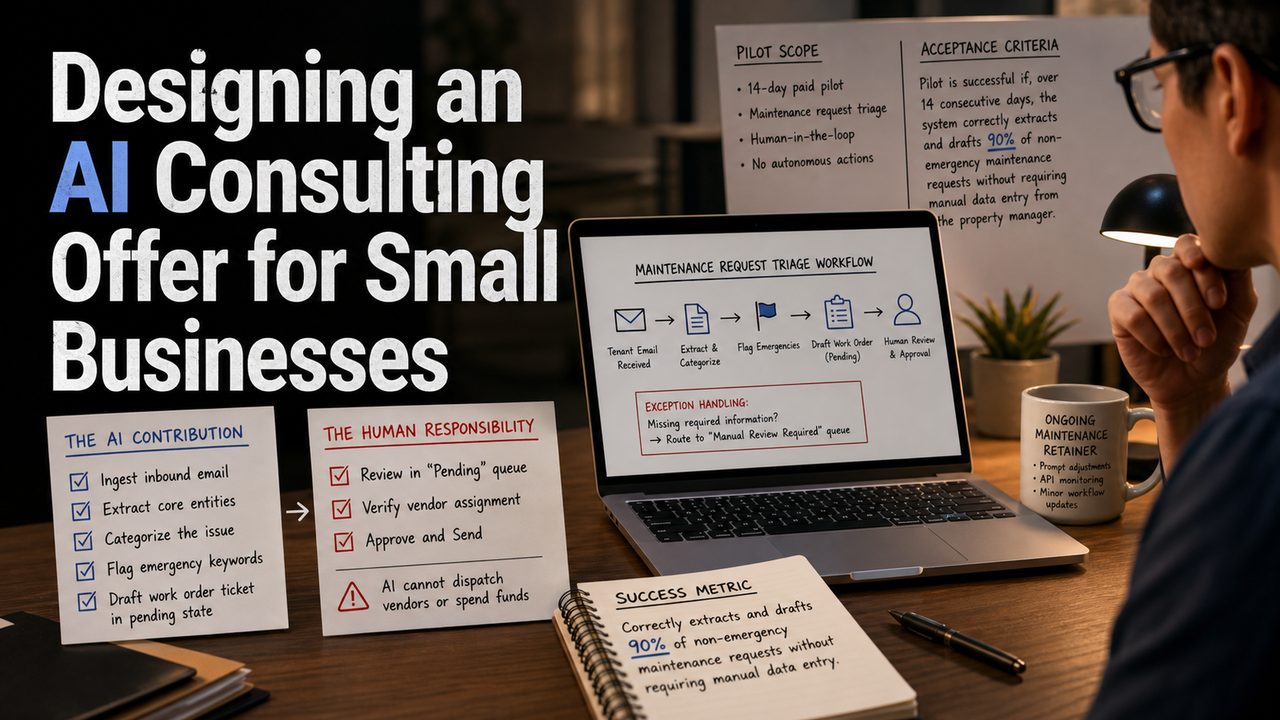
To demonstrate how to package an offer, consider a hypothetical pilot for a local property management company. The owner spends early mornings reading through overnight tenant emails, categorizing maintenance issues, and manually copying data into their property management software to request vendor quotes.
The offer is a 14-day paid pilot to automate the triage and drafting of these work orders.
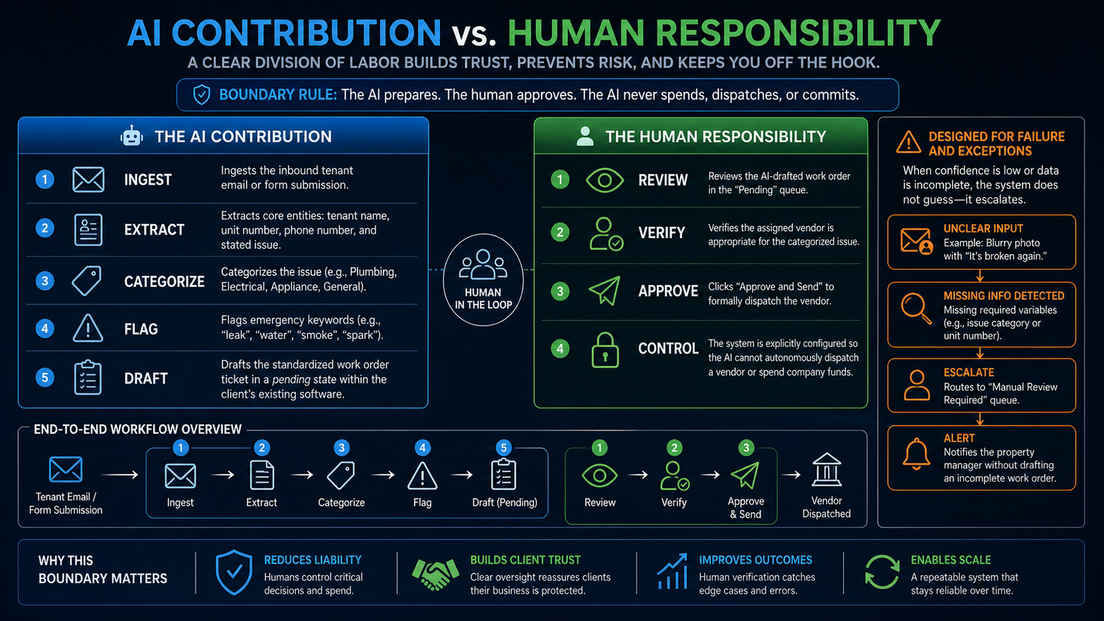
Defining Roles: The AI Contribution vs. Human Responsibility
A professional offer clearly demarcates what the machine executes and what the human finalizes. Blurring this line introduces liability and client anxiety.
The AI Contribution:
Ingests the inbound tenant email or form submission.
Extracts core entities: tenant name, unit number, phone number, and stated issue.
Categorizes the issue (e.g., Plumbing, Electrical, Appliance, General).
Drafts the standardized work order ticket in a pending state within the client's existing software.
The Human Responsibility:
Reviews the AI-drafted work order in the "Pending" queue.
Verifies the assigned vendor is appropriate for the categorized issue.
Clicks "Approve and Send" to formally dispatch the vendor.
The system is explicitly configured so the AI cannot autonomously dispatch a vendor or spend company funds.
Designing for Failure and Exception Handling
AI models will occasionally hallucinate, encounter edge-case inputs, or fail to parse messy data. Your offer must include the exact routing protocol for when the system lacks confidence.
If a tenant submits an email containing only a blurry photo and the text "It's broken again," the AI should not guess the context. The automation must be built to recognize missing required variables (like issue category or unit number) and immediately route the ticket to a "Manual Review Required" queue, alerting the property manager without drafting an incomplete work order. Selling this exception-handling mechanism proves to the client that you are implementing a robust business system, not just a fragile script.
Establishing Acceptance Criteria
A paid pilot requires an objective finish line. If you do not define what success looks like, the pilot can stretch indefinitely without converting to a long-term maintenance contract.
For the property management pilot, the acceptance criteria might state: The pilot is successful if, over 14 consecutive days, the system correctly extracts and drafts 90% of non-emergency maintenance requests without requiring manual data entry from the property manager.
Transitioning to Ongoing Maintenance and Support
Software decays. Underlying AI models are deprecated, third-party software APIs update their endpoints, and user behavior changes. A one-time setup fee leaves both you and the client vulnerable to future breakages.
Position the initial pilot fee as the cost of discovery and initial build, and require a monthly maintenance retainer for production deployment. This ongoing agreement should cover a fixed number of hours dedicated to adjusting prompts when data drifts, monitoring API health, and managing minor workflow adjustments. Make it clear that paying for maintenance is how they ensure the workflow remains off their plate permanently.
Frequently Asked Questions
How do I prevent an AI pilot from disrupting a client’s daily operations?
Keep the pilot tightly bounded by selecting a single, low-risk process with strictly defined data inputs. Always build a "human-in-the-loop" step into the workflow where the client’s team reviews and approves all AI-generated outputs before they are used. Establish clear failure handling protocols—such as immediately reverting to their standard manual process—if the AI produces inaccurate results or unexpected formats.
Should I price an initial AI pilot based on hours worked or value delivered?
Price the pilot using a fixed flat fee tied directly to specific acceptance criteria. Small businesses often hesitate at open-ended hourly consulting for emerging technology due to budget unpredictability. By defining exactly what constitutes a successful pilot—such as generating 20 approved email templates or accurately categorizing a set batch of inventory data—you provide cost certainty and focus the engagement on a tangible, measurable outcome.
How do I transition a client from a limited pilot to an ongoing AI expansion?
Build expansion rules directly into your initial pilot agreement. Once the pilot meets its pre-defined acceptance criteria, use that success as the trigger to review a scaling proposal. Present a phased rollout plan that either applies the validated AI workflow to a larger volume of data or introduces it to another department, framing the expansion as a logical next step backed by proven operational metrics.