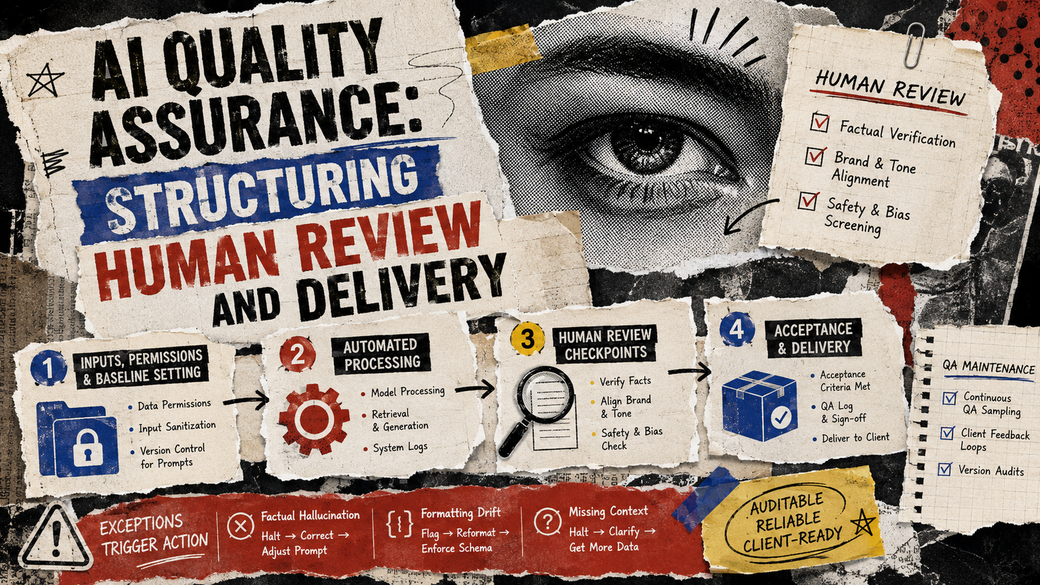
AI Quality Assurance: Structuring Human Review and Delivery
Establish reliable delivery pipelines for AI services. Map out precise steps for client input limitations, automated processing, objective human review, and handling exceptions before handing over the final product.
Delivering an AI-enabled service means managing probabilistic outcomes. Unlike traditional software, where a specific input reliably produces an identical output, generative models can introduce variations, hallucinations, and formatting drifts over time. When businesses purchase an AI automation or consulting service, they are not paying for raw AI generation—they are paying for the quality assurance, human review, and operational certainty that wraps around it.
Quality assurance must be built into the core delivery workflow. A reliable service requires auditable inputs, explicit human-in-the-loop (HITL) checkpoints, clear escalation paths, and defined acceptance criteria.
Architecting the Auditable Delivery Workflow
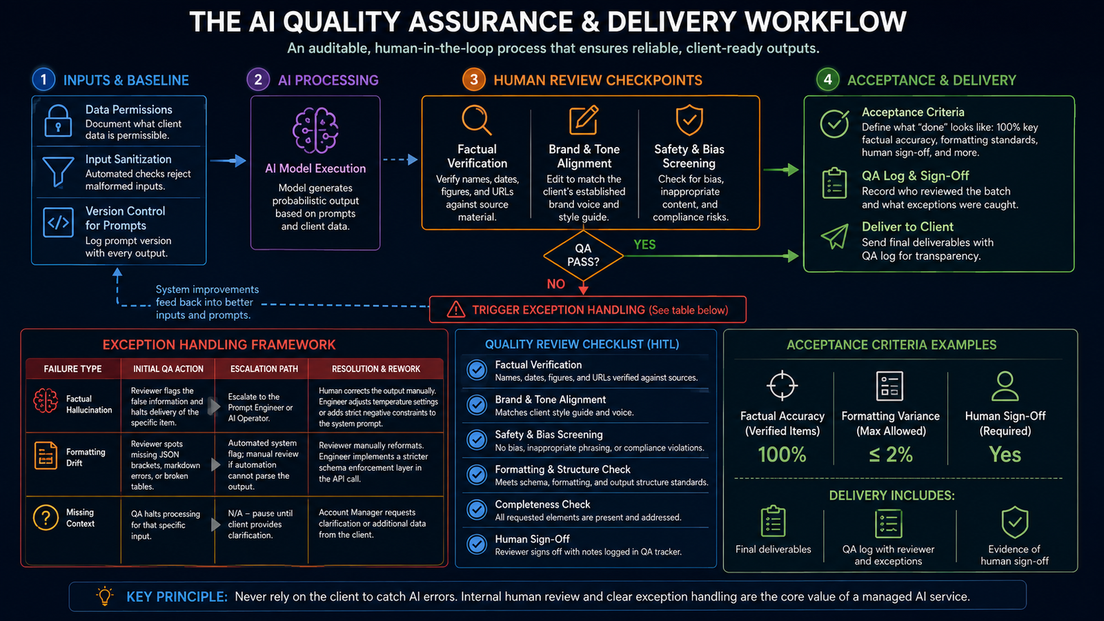
An effective AI service delivery model makes responsibility visible at every stage. You must define exactly how client data is handled, where a human decides if an output is usable, and what happens when the system fails.
1. Inputs, Permissions, and Baseline Setting
Before the AI processes anything, establish strict gates for data entry.
Data Permissions: Document exactly what client data is permissible for use. If you operate in a regulated environment, do not assume that removing obvious identifiers makes data safe to send to a model. Define permitted data, review provider retention and training terms, assess re-identification risk, and obtain qualified privacy or compliance guidance before processing sensitive information.
Input Sanitization: Institute automated checks to ensure the client’s input meets the required format. If an input is malformed, the system should reject it back to the client rather than allowing the AI to guess the intent.
Version Control for Prompts: Treat the system prompts and context windows as production code. Log which version of the prompt generated which output so that degradation can be traced back to specific changes.
2. The Human Review Checkpoints
Do not rely on the client to catch AI errors. Internal human review is the primary value-add of a managed AI service.
Factual Verification: Human reviewers must verify names, dates, financial figures, and URLs against the source material.
Brand and Tone Alignment: AI often defaults to recognizable linguistic patterns (e.g., overly formal or highly enthusiastic phrasing). Reviewers must actively edit outputs to match the client's established brand voice.
Safety and Bias Screening: Reviewers must check for unintended bias, inappropriate phrasing, or compliance violations before the output is passed to the client.
3. Acceptance Criteria and Delivery
Clients need to know what "done" looks like. Define specific acceptance criteria for the final deliverables. This might include a maximum allowed variance in formatting, a verified factual accuracy rate of 100% on key metrics, and evidence of human sign-off. Deliverables should be accompanied by a lightweight QA log indicating who reviewed the batch and what exceptions were caught.
Structuring Rework, Exceptions, and Escalation
When an AI output fails your internal QA standards, it must trigger a standardized exception handling process rather than an ad-hoc fix.
Failure Type
Initial QA Action
Escalation Path
Resolution and Rework
Factual Hallucination
Reviewer flags the false information and halts delivery of the specific item.
Escalate to the Prompt Engineer or AI Operator.
Human corrects the output manually. Engineer adjusts temperature settings or adds strict negative constraints to the system prompt.
Formatting Drift
Reviewer spots missing JSON brackets, markdown errors, or broken tables.
Automated system flag; manual review if automation cannot parse the output.
Reviewer manually reformats. Engineer implements a stricter schema enforcement layer in the API call.
Missing Context
AI outputs a generic response because the client input lacked necessary detail.
QA halts processing for that specific input.
Account Manager requests clarification or additional data from the client.
Worked Scenario: Failure and Recovery
To understand how this workflow operates in practice, consider a hypothetical AI service that generates personalized B2B executive briefing documents based on weekly client CRM updates and public news feeds.
The Failure:
During the Tuesday generation run, the AI processes a briefing for a target executive. The model ingests a poorly dated press release from three years ago and confidently hallucinates that the target company has just launched a discontinued product line.
Detection:
The output enters the human review queue. The human reviewer, following the mandatory "Factual Verification" checklist, searches the target company's current product page. They discover the product was sunsetted two years prior.
Recovery and Rework:
Immediate Fix: The reviewer manually deletes the hallucinated paragraph, writes a correct summary of the company's actual recent earnings call, and marks the document as "Human Corrected." The client receives a flawless briefing on time.
Root Cause Logging: The reviewer logs the error in the QA tracker as a "Temporal Hallucination."
System Adjustment: The AI Operator reviews the log and realizes the model is not properly weighing the publication dates of scraped URLs. The operator updates the retrieval-augmented generation (RAG) system to strictly filter out any news sources older than six months.
Auditing: The updated prompt is version-controlled, and the next batch of briefings is heavily monitored to ensure the date-filtering constraint works.
Because the QA process was structured, the client never saw the failure, and the underlying service became permanently more reliable.
Maintenance and Long-Term Support
AI models are not static. Underlying APIs receive silent updates, client needs evolve, and data structures shift. A professional AI delivery service requires ongoing maintenance.
Continuous QA Sampling: Even if an automated workflow proves highly reliable over time, maintain a baseline of random human sampling. Reviewing 10% of all automated outputs prevents silent degradation.
Client Feedback Loops: Establish a formal mechanism for clients to flag outputs they feel missed the mark, even if those outputs passed internal QA. Use this feedback to update the client's specific style guide and tuning parameters.
Version Audits: Schedule quarterly reviews of all system prompts, RAG databases, and API versions to ensure the infrastructure supporting the service remains optimal and secure.
Frequently Asked Questions
How should I decide which AI-generated deliverables require full human review versus a quick spot check?
Evaluate the complexity and potential operational impact of each deliverable to determine the necessary review depth. Route high-stakes materials—such as strategic project plans or complex data analysis—through a full, manual human review to catch nuanced errors or contextual misunderstandings. Assign low-risk, repetitive outputs to a faster spot-check queue, and ensure your team clearly documents the criteria used to assign these different review levels.
What steps should I take if a client finds an error in a deliverable that already passed our internal human review?
Acknowledge the issue immediately and trigger your recovery process to correct the work manually without relying on further AI generation. Next, check your internal evidence of review logs to identify where the breakdown occurred—whether it was a flawed initial AI prompt, an undetected hallucination, or an oversight by the human reviewer. Use this failure analysis to update your internal review checklists so your team catches similar errors before future deliveries.
How do I structure the client acceptance check to ensure they actively validate the final AI-assisted work?
Require the client to complete a formal feedback loop, such as a targeted approval form, rather than passively receiving the file. Deliver the work alongside a summary of the specific elements your team already verified during the human-in-the-loop phase, and ask the client to explicitly sign off on business-specific details or proprietary nuances that only they can accurately judge. If the client rejects any portion, route their feedback directly into your designated escalation queue for immediate manual revision.