Cross-Border Ecommerce#AI side hustle#make money with AI#AI services to sell#AI consulting
Evaluating a Realistic AI Side Hustle: From Skills to Paid Services
Map out the steps to build a sustainable AI side hustle. Learn to move past tool hype by defining clear client workflows, human oversight requirements, and measurable outcomes before launching your service.
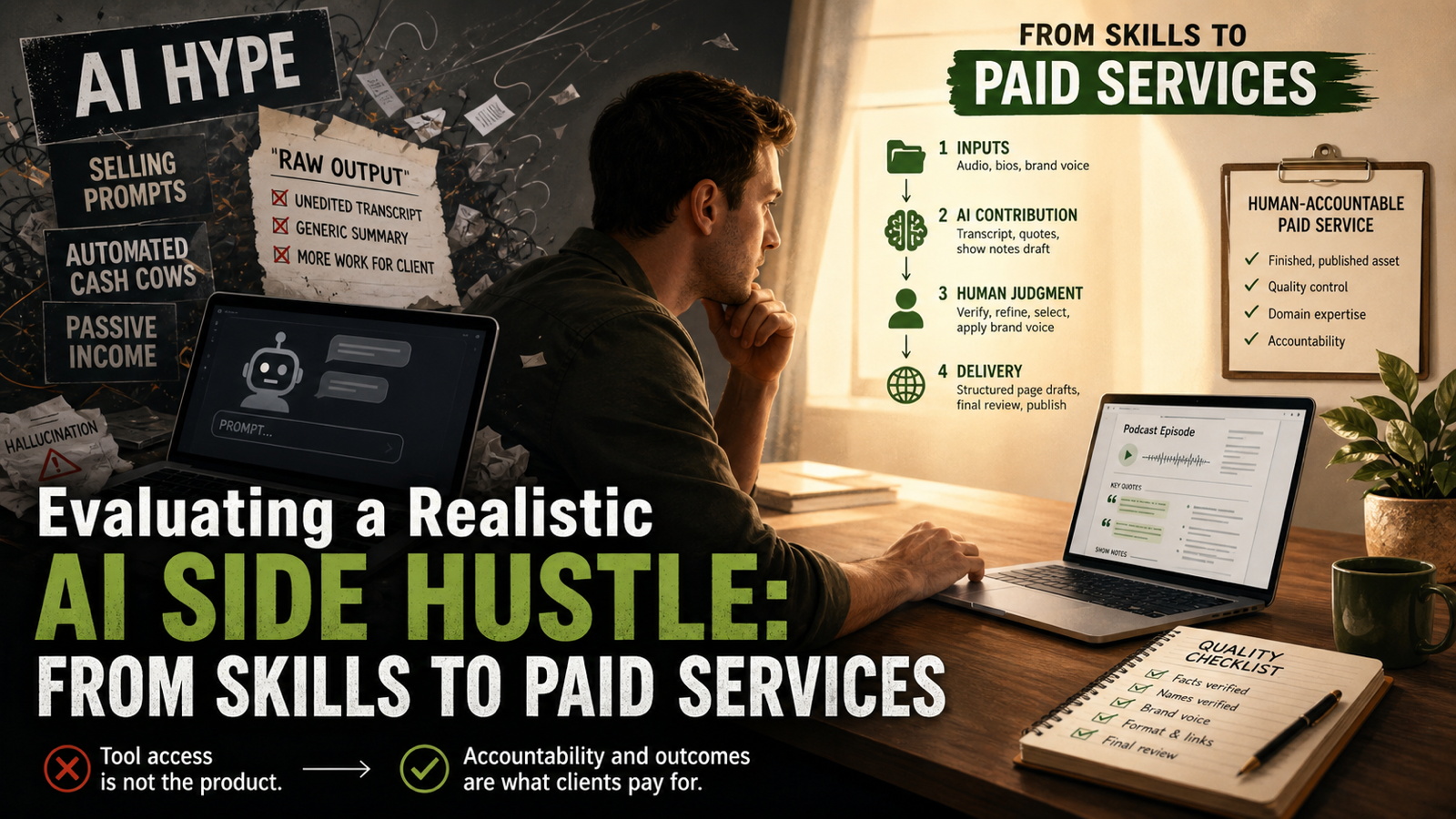
The internet is saturated with promises of automated cash cows and passive income generated by artificial intelligence. However, building a sustainable AI side hustle requires moving past the hype of "selling prompts" or setting up autonomous systems. Real clients do not pay for your fluency in a specific tool; they pay for a dependable, finished outcome.
To turn AI capabilities into a profitable service, you must separate raw AI output from a human-accountable deliverable. Your value lies in the workflow: gathering the right inputs, utilizing AI for heavy lifting, applying human judgment to catch errors, and taking responsibility for the final result.
Shifting from Tool Operation to Client Outcomes
A common mistake new side hustlers make is trying to sell access to AI. Pitching services like "I will use AI to write your blog posts" immediately devalues the work. If the only step between the client's problem and the solution is writing a prompt, the client will simply do it themselves.
A realistic side hustle wraps AI in a service layer. You are not selling the technology; you are selling the time savings, the quality control, and the domain expertise required to guarantee a specific result. The client is paying you to absorb the friction of the process, including handling exceptions, fixing hallucinations, and ensuring the final product aligns with their brand standard.
Worked Example: Raw Output vs. Paid Service
To understand the difference between operating a tool and running a side hustle, consider a service aimed at podcasters: converting raw episodes into published web content and social media assets.
The Raw AI Output (Low to No Value):
You take the client's audio file, run it through an AI transcription tool, and use a chatbot to summarize the text. You email the unedited transcript and a generic, robotic-sounding summary back to the client. The client still has to read it, fix the spelling of guest names, format it for their website, and write their own social media posts. You have not solved their problem; you have only given them a different type of work.
The Human-Accountable Paid Service (High Value):
You define a strict, end-to-end workflow where AI is the engine, but you are the driver.
Inputs: You collect the raw audio, guest bios, and the client's brand voice guidelines.
AI Contribution: You use AI to generate the initial transcript, extract key quotes, and draft foundational show notes.
Human Judgment: You manually listen to the audio to verify complex technical terms or names the AI missed. You rewrite the AI-generated show notes to match the host's specific tone and humor. You select the most engaging quotes, discarding the AI's weaker suggestions.
Delivery: You use a platform like Foundax as an editable content workspace to generate the structured page drafts for the podcast's website. You conduct a final human review of the layout and text, separate the drafting process from the live environment, and only hit publish when the page meets your quality standards.
In the second scenario, the client pays for a finished, published asset. If a link is broken or a quote is misattributed, you are the one responsible for fixing it. That accountability is what makes it a viable business.
Anatomy of a Dependable AI Service Workflow
Before launching a side hustle, map out exactly how your service will function. A professional offering requires distinct boundaries and protocols for when things go wrong.
Input Standardization: What exact assets do you need from the client before you begin? (e.g., historical sales data, brand style guides, specific file formats). If a client provides incomplete inputs, how do you handle it?
The AI Mandate: Define exactly what the AI will do. Is it structuring messy data? Generating variations of ad copy for you to choose from? Drafting initial code snippets? Keep the AI's role tightly scoped.
Exception Handling: AI models are unpredictable. What is your process when the AI generates unusable output, hallucinates facts, or completely misses the required tone? Your service must include the time and ability to manually rewrite or restructure the work when the tool fails.
Quality Controls: Establish a checklist that every deliverable must pass before the client sees it. This should include fact-checking, plagiarism scans (if dealing with public content), and brand compliance reviews.
Maintenance Burden: Are you delivering a one-time asset, or does this require ongoing support? If you use AI to build a custom dashboard for a client, clarify who is responsible if the underlying API breaks six months later.
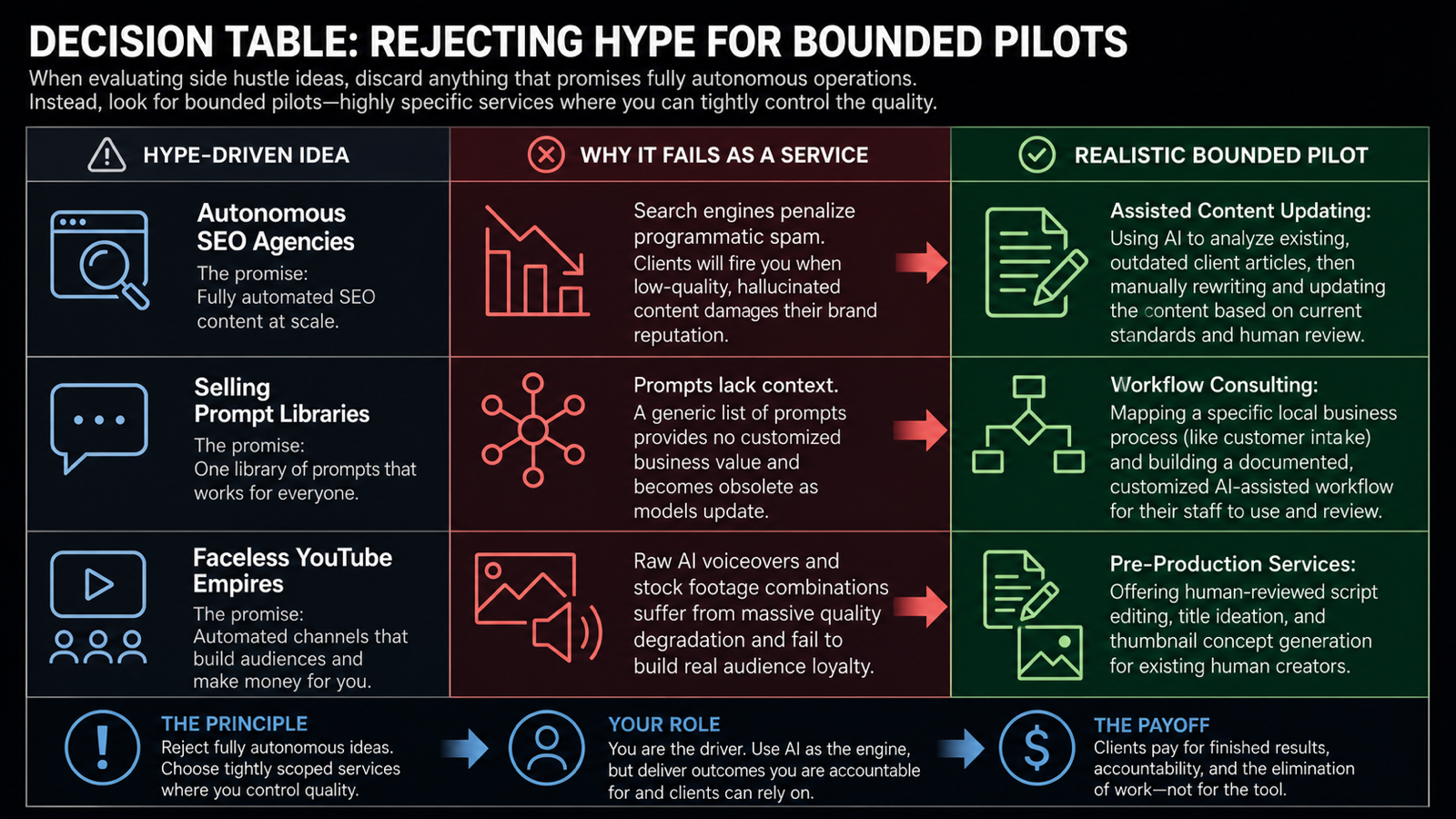
Decision Table: Rejecting Hype for Bounded Pilots
When evaluating side hustle ideas, discard anything that promises fully autonomous operations. Instead, look for bounded pilots—highly specific services where you can tightly control the quality.
Hype-Driven Idea
Why It Fails as a Service
Realistic Bounded Pilot
Autonomous SEO Agencies
Search engines penalize programmatic spam. Clients will fire you when low-quality, hallucinated content damages their brand reputation.
Assisted Content Updating: Using AI to analyze existing, outdated client articles, then manually rewriting and updating the content based on current standards and human review.
Selling Prompt Libraries
Prompts lack context. A generic list of prompts provides no customized business value and becomes obsolete as models update.
Workflow Consulting: Mapping a specific local business process (like customer intake) and building a documented, customized AI-assisted workflow for their staff to use and review.
Faceless YouTube Empires
Raw AI voiceovers and stock footage combinations suffer from massive quality degradation and fail to build real audience loyalty.
Pre-Production Services: Offering human-reviewed script editing, title ideation, and thumbnail concept generation for existing human creators.
Launching Your Side Hustle
Start with a single, highly defined deliverable. Do not offer broad "AI consulting" until you have proven you can reliably execute a specific task, such as formatting weekly newsletters, cleaning messy CRM data, or generating localized marketing assets.
Test your workflow on yourself or a single pilot client. Pay close attention to the review layer—track how long it actually takes you to fix the AI's mistakes and polish the output to a professional standard. Your pricing and your reputation will ultimately depend not on how fast the AI generates a first draft, but on the quality and reliability of the final result you deliver.
Frequently Asked Questions
How should I price an AI-assisted service when faster generation makes hourly billing counterproductive?
Price your service with flat, value-based project rates rather than hourly billing. When AI accelerates the initial drafting phase, traditional hourly billing penalizes your efficiency while ignoring the most critical stage of the process: manual fact-checking, domain-specific refinement, and quality assurance. Calculate your project rate by estimating the total human review time, a buffer for client revisions, software overhead costs, and the commercial value of the final deliverable to the client.
Should I disclose to clients that generative AI is part of my production workflow?
Yes. Transparently addressing your use of AI builds trust and establishes clear legal boundaries regarding intellectual property and data privacy. Outline in your service agreements that AI serves solely as an internal research and drafting assistant, that all deliverables undergo comprehensive human verification, and that confidential client data is never input into public training models. Clients pay for accountability, domain expertise, and liability protection—not the raw mechanism used to generate a first draft.
What is the most reliable way to validate market demand before paying for specialized software subscriptions?
Secure one to three paid pilot projects using manual processes or free baseline tools before investing in premium software tiers or complex automations. Pitch the specific operational outcome—such as structuring unstructured data, localizing marketing copy, or formatting technical documentation—directly to prospective clients who already have an active budget for that problem. If a client is unwilling to pay a human to solve the issue, adding automated tools will not turn it into a viable business.