Cross-Border Ecommerce#how to start dropshipping#dropshipping for beginners#no inventory ecommerce#business model
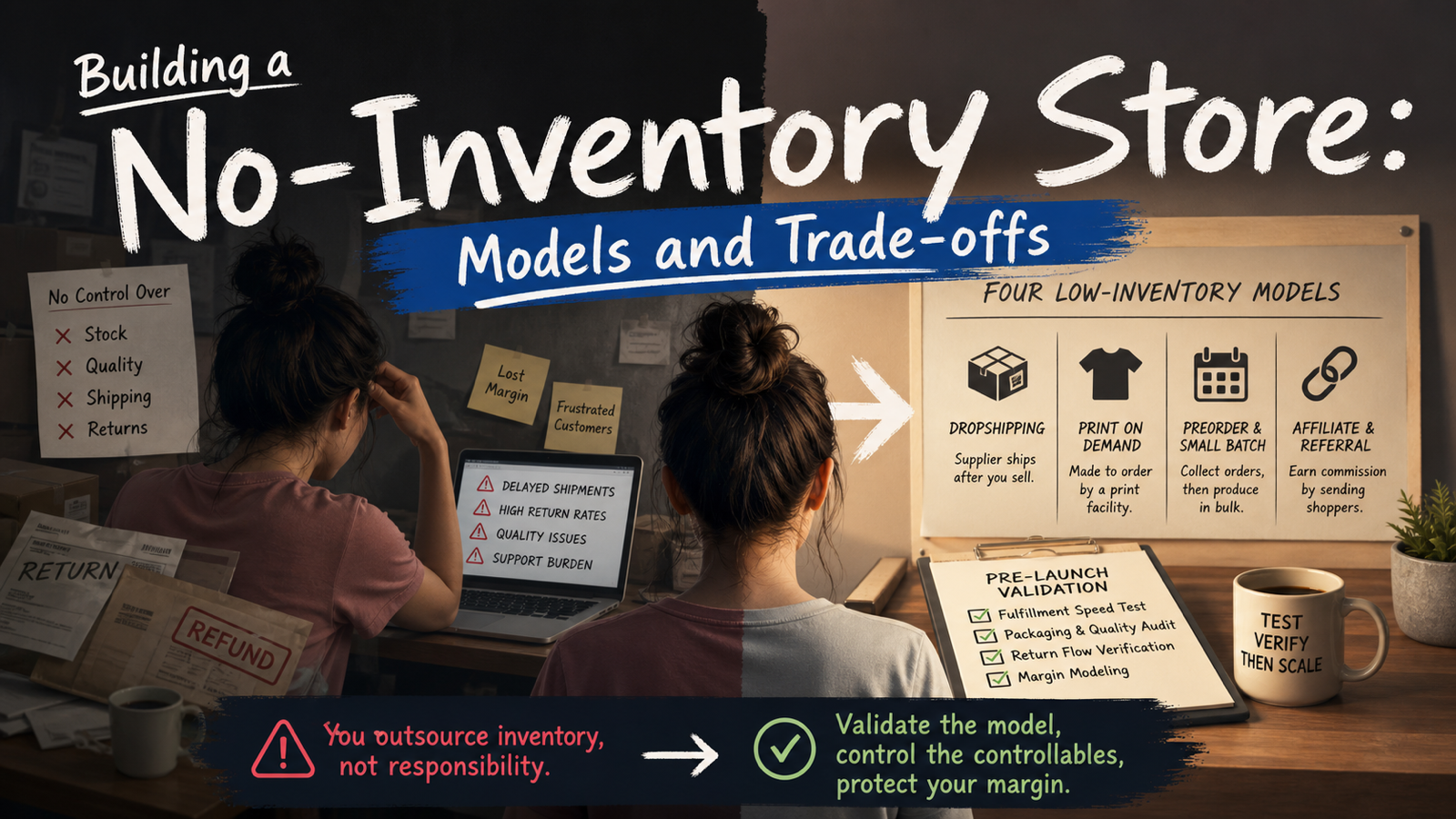
Building a No-Inventory Store: Models and Trade-offs
Explore the reality of zero-inventory fulfillment. This breakdown covers dropshipping and print-on-demand mechanics, helping you weigh upfront cost savings against added customer support and quality control responsibilities.
The appeal of selling online without holding physical inventory is straightforward: test market demand and launch a catalog without buying warehouse stock upfront. However, removing physical inventory from your balance sheet does not remove your operational workload. Outsourcing storage and packing does not automatically outsource your customer service obligations, quality control responsibilities, or financial exposure when shipments go wrong. Choosing a low-inventory model requires matching your available capital, time, and tolerance for customer support with a fulfillment system whose specific failure points you can realistically manage.
The Four Low-Inventory Models
Before committing resources to a storefront, evaluate how each model shifts operational responsibility.
Classic Dropshipping: You list products held by a third-party supplier. When a customer orders, you purchase the item from the supplier, who ships it to the buyer. You rarely see the physical item, making you entirely dependent on the supplier's stock levels and fulfillment speed.
Print on Demand (POD): You apply digital designs to blank physical goods (apparel, mugs, prints). The item is printed and shipped by a third-party facility only after an order is placed. Quality is generally more consistent than broad dropshipping, but base item costs are higher.
Preorder and Small Batch: You collect orders over a set campaign period before manufacturing begins. Once the window closes, you trigger a bulk production run. This offers high quality control but requires you to manage strict delivery deadlines and communicate actively with waiting buyers.
Affiliate and Referral: You publish content or curated links that route shoppers to an established brand or marketplace. You trade control over pricing and customer data for a model that typically avoids direct fulfillment and customer support, earning revenue through negotiated commission structures.
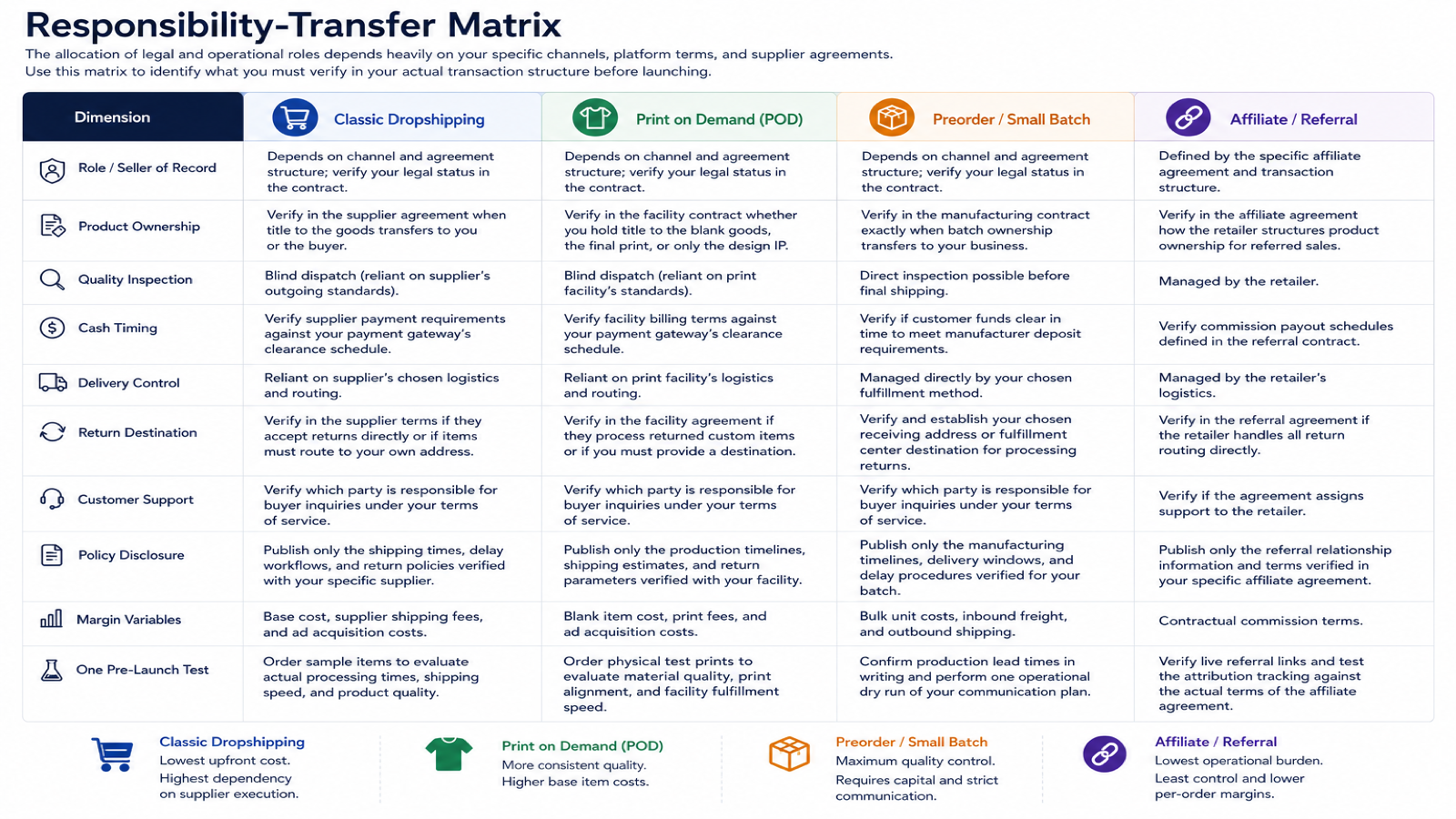
Responsibility-Transfer Matrix
The allocation of legal and operational roles depends heavily on your specific channels, platform terms, and supplier agreements. Rather than assuming responsibilities are automatically outsourced, use the matrix below to identify what you must verify in your actual transaction structure before launching.
Dimension
Classic Dropshipping
Print on Demand (POD)
Preorder / Small Batch
Affiliate / Referral
Role / Seller of Record
Depends on channel and agreement structure; verify your legal status in the contract.
Depends on channel and agreement structure; verify your legal status in the contract.
Depends on channel and agreement structure; verify your legal status in the contract.
Defined by the specific affiliate agreement and transaction structure.
Product Ownership
Verify in the supplier agreement when title to the goods transfers to you or the buyer.
Verify in the facility contract whether you hold title to the blank goods, the final print, or only the design IP.
Verify in the manufacturing contract exactly when batch ownership transfers to your business.
Verify in the affiliate agreement how the retailer structures product ownership for referred sales.
Quality Inspection
Blind dispatch (reliant on supplier's outgoing standards).
Blind dispatch (reliant on print facility's standards).
Direct inspection possible before final shipping.
Managed by the retailer.
Cash Timing
Verify supplier payment requirements against your payment gateway's clearance schedule.
Verify facility billing terms against your payment gateway's clearance schedule.
Verify if customer funds clear in time to meet manufacturer deposit requirements.
Verify commission payout schedules defined in the referral contract.
Delivery Control
Reliant on supplier's chosen logistics and routing.
Reliant on print facility's logistics and routing.
Managed directly by your chosen fulfillment method.
Managed by the retailer's logistics.
Return Destination
Verify in the supplier terms if they accept returns directly or if items must route to your own address.
Verify in the facility agreement if they process returned custom items or if you must provide a destination.
Verify and establish your chosen receiving address or fulfillment center destination for processing returns.
Verify in the referral agreement if the retailer handles all return routing directly.
Customer Support
Verify which party is responsible for buyer inquiries under your terms of service.
Verify which party is responsible for buyer inquiries under your terms of service.
Verify which party is responsible for buyer inquiries under your terms of service.
Verify if the agreement assigns support to the retailer.
Policy Disclosure
Publish only the shipping times, delay workflows, and return policies verified with your specific supplier.
Publish only the production timelines, shipping estimates, and return parameters verified with your facility.
Publish only the manufacturing timelines, delivery windows, and delay procedures verified for your batch.
Publish only the referral relationship information and terms verified in your specific affiliate agreement.
Margin Variables
Base cost, supplier shipping fees, and ad acquisition costs.
Blank item cost, print fees, and ad acquisition costs.
Bulk unit costs, inbound freight, and outbound shipping.
Contractual commission terms.
One Pre-Launch Test
Order sample items to evaluate actual processing times, shipping speed, and product quality.
Order physical test prints to evaluate material quality, print alignment, and facility fulfillment speed.
Confirm production lead times in writing and perform one operational dry run of your communication plan.
Verify live referral links and test the attribution tracking against the actual terms of the affiliate agreement.
Critical Operational Pressure Points
1. Delivery Promises and Federal Shipping Baselines
Under general US federal consumer-protection guidance, sellers generally must honor their advertised shipping times. If no specific shipping time is stated, the baseline expectation is generally 30 days. When a shipment is delayed beyond these timeframes, general federal guidance states the seller should notify the buyer and offer a choice: consent to the delay or cancel the order for a full refund. (Note: This is general federal guidance outlining operational boundaries, not personalized legal advice.) Selling items through distant suppliers requires you to align your site’s delivery promises with what the supplier can actually achieve to navigate these boundary expectations.
2. The Material Cost of Returns
Online returns are a material operating and cost variable that must be modeled into your pricing. A 2025 release from the National Retail Federation estimated that 19.3% of US online sales would be returned in 2025. While this figure is retail-wide and not specific to dropshipping, it highlights an inherent cost of distance selling that you must account for. Consider this illustrative math for a single theoretical returned order where the item cannot be sent back to the supplier:
If your supplier agreement does not allow for returns, you may have to absorb the wholesale cost of the refunded transaction.
Customer Revenue: +$40.00
Illustrative Supplier Base Cost: -$15.00
Illustrative Ad Acquisition Cost: -$12.00
Refund Issued to Customer: -$40.00
Illustrative Net Loss on Return: -$27.00 (Assuming the supplier base cost and ad spend are unrecoverable)
3. Marketplace Rules vs. Independent Storefronts
Platform rules dictating your role in a transaction vary drastically and cannot be generalized. For example, under Amazon's specific dropshipping policy, the operator must act as the seller of record on all invoices, packing slips, and external packaging. Operators must review the current official terms of any marketplace before launching to confirm their required role. If you build an independent storefront, your obligations depend on your specific service contracts and payment gateways. You might use software like Foundax to visually edit and preview product, site-page, and blog SEO information, with important fields sourced from product facts. However, creating an independent site means your actual responsibilities for customer acquisition, payments, and transaction outcomes are dictated by your third-party service agreements, as the storefront software itself merely provides the content and visual layer.
The Pre-Launch Validation Protocol
Before directing paid traffic to a no-inventory store, verify your supplier network and operating assumptions through an active pressure test:
Fulfillment Speed Test: Place sample orders to various geographic regions. Measure the exact gap between order placement and the first valid carrier scan to verify if the supplier's advertised processing times are accurate.
Packaging and Quality Audit: Inspect the delivered test items for material quality, print alignment, and the absence of third-party promotional materials or competitor invoices in the packaging.
Return Flow Verification: Attempt to initiate a return with your supplier on a test order. Document the exact workflow, the return destination address, and any required postage costs to understand what your actual customers will experience.
Margin Modeling: Map an illustrative unit economics breakdown. Factor in realistic baseline item costs, packaging, shipping, anticipated ad spend, transaction costs, and a buffer for expected industry return rates to ensure the remaining margin justifies the operational effort.
Frequently Asked Questions
If I use a dropshipping supplier, am I legally responsible for delayed shipments or customer support?
Outsourcing physical storage and packing to a supplier does not automatically outsource your customer service obligations, quality control responsibilities, or legal exposure. Under general US federal consumer-protection guidance, sellers generally must honor advertised shipping times or notify buyers with options if delays occur, and your specific role is ultimately determined by your agreements. Review your supplier terms of service and marketplace agreements to verify exactly which party is assigned responsibility for buyer inquiries, and align your site’s delivery promises with what your supplier can actually achieve.
How do customer returns impact the profit margins of a no-inventory business?
Online returns are a material operating expense that can quickly destroy your margins, especially if your supplier agreement does not allow items to be sent back. If you are forced to issue a full refund to the customer but cannot recover the wholesale base cost of the item or your ad acquisition spend, you will absorb a direct net loss on the transaction. Map an illustrative unit economics breakdown that factors in baseline costs, ad spend, and a buffer for expected industry return rates to ensure your remaining margin can survive inevitable refunds.
What should I do before sending paid traffic to my new print-on-demand store?
Before committing marketing capital, you must run an active pressure test to verify your supplier network and operating assumptions rather than relying solely on their advertised claims. This involves testing fulfillment speed, inspecting packaging quality, and understanding the return workflow. Place sample orders to various geographic regions to audit the material quality, measure the exact gap between order placement and the first valid carrier scan, and attempt a test return to document the actual customer experience.