Cross-Border Ecommerce#print on demand vs dropshipping#POD vs dropshipping#sell without inventory
Comparing Fulfillment Without Inventory: Which Fits You?
Low inventory doesn't mean low responsibility. Compare the distinct cash flow, lead time, and customer service demands of different fulfillment options to figure out which setup makes sense for your product type.
Selling without holding physical inventory shifts upfront capital requirements and bulk storage costs to a supplier or partner, but it does not erase the operational burdens of customer acquisition, support, or legal compliance. Choosing an inventory-free model requires identifying exactly which responsibilities you are willing to outsource and which risks—such as extended lead times, rigid quality control limits, or complex refund obligations—you are prepared to manage.
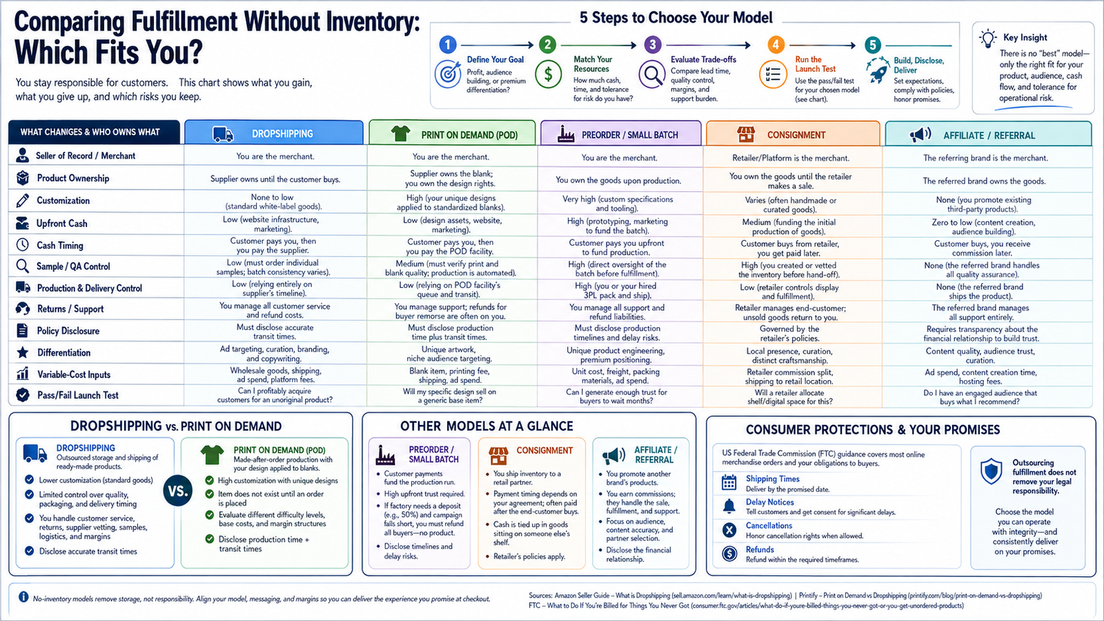
Responsibility-Transfer Comparison Matrix
The following matrix identifies how control, costs, and obligations shift across the five primary inventory-free models.
Criteria
Dropshipping
Print on Demand (POD)
Preorder / Small Batch
Consignment
Affiliate / Referral
Seller of Record / Merchant
You are the merchant.
You are the merchant.
You are the merchant.
Retailer/Platform is the merchant.
The referring brand is the merchant.
Product Ownership
Supplier owns until the customer buys.
Supplier owns the blank; you own the design rights.
You own the goods upon production.
You own the goods until the retailer makes a sale.
The referred brand owns the goods.
Customization
None to low (standard white-label goods).
High (your unique designs applied to standardized blanks).
Very high (custom specifications and tooling).
Varies (often handmade or curated goods).
None (you promote existing third-party products).
Upfront Cash
Low (website infrastructure, marketing).
Low (design assets, website, marketing).
High (prototyping, marketing to fund the batch).
Medium (funding the initial production of goods).
Zero to low (content creation, audience building).
Cash Timing
Customer pays you, then you pay the supplier.
Customer pays you, then you pay the POD facility.
Customer pays you upfront to fund production.
Customer buys from retailer, you get paid later.
Customer buys, you receive commission later.
Sample / QA Control
Low (must order individual samples; batch consistency varies).
Medium (must verify print and blank quality; production is automated).
High (direct oversight of the batch before fulfillment).
High (you created or vetted the inventory before hand-off).
None (the referred brand handles all quality assurance).
Production & Delivery Control
Low (relying entirely on supplier's timeline).
Low (relying on POD facility's queue and transit).
High (you or your hired 3PL pack and ship).
Low (retailer controls display and fulfillment).
None (the referred brand ships the product).
Returns / Support
You manage all customer service and refund costs.
You manage support; refunds for buyer remorse are often on you.
You manage all support and refund liabilities.
Retailer manages end-customer; unsold goods return to you.
The referred brand manages all support entirely.
Policy Disclosure
Must disclose accurate transit times.
Must disclose production time plus transit times.
Must disclose production timelines and delay risks.
Governed by the retailer's policies.
Requires transparency about the financial relationship to build audience trust.
Differentiation
Ad targeting, curation, branding, and copywriting.
Unique artwork, niche audience targeting.
Unique product engineering, premium positioning.
Local presence, curation, distinct craftsmanship.
Content quality, audience trust, curation.
Variable-Cost Inputs
Wholesale goods, shipping, ad spend, platform fees.
Blank item, printing fee, shipping, ad spend.
Unit cost, freight, packing materials, ad spend.
Retailer commission split, shipping to retail location.
Ad spend, content creation time, hosting fees.
Pass/Fail Launch Test
Can I profitably acquire customers for an unoriginal product?
Will my specific design sell on a generic base item?
Can I generate enough trust for buyers to wait months?
Will a retailer allocate shelf/digital space for this?
Do I have an engaged audience that buys what I recommend?
Dropshipping vs. Print on Demand
While dropshipping and print on demand both remove the need to store products, they differ fundamentally in production timing and customization.
Amazon's current seller guide defines dropshipping as outsourced storage and shipping, noting that this model provides limited control over product quality, packaging, and delivery timing. Even without physical inventory, seller-side work can include managing customer service, returns, supplier vetting, samples, logistics, and margins (https://sell.amazon.com/learn/what-is-dropshipping). Note that Amazon's seller-of-record rule is platform-specific.
Print on demand introduces a made-after-order production layer. According to first-party POD provider Printify, POD is distinct from resale-oriented dropshipping because of its customization element; the item does not exist until an order is placed. This requires evaluating different difficulty levels, base costs, and margin structures compared to sourcing pre-manufactured goods (https://printify.com/blog/print-on-demand-vs-dropshipping/).
Preorder, Consignment, and Affiliate Trade-offs
Moving beyond supplier-fulfilled models, preorders, consignment, and affiliate marketing alter cash flow timing and operational focus.
In a preorder or small-batch model, the customer's payment funds the manufacturing run. Hypothetically, if a seller launches a preorder campaign for a specialized hiking backpack, the buyers provide the upfront cash. However, if the factory requires a 50% minimum deposit before tooling begins and the campaign falls short of that threshold, the seller fails the launch test and must refund all buyers rather than producing the bags.
Consignment shifts physical storage to a retail partner, though exact payment timing and operational ownership depend strictly on your specific agreement with the retailer. Often, you do not receive capital until the end-customer completes a purchase, tying up your cash in physical goods sitting on someone else's shelf.
In a typical affiliate or referral model, the referred brand handles the direct sale and product fulfillment. You trade product margins and pricing control for commission economics. Rather than managing physical returns or transaction support, your operational focus shifts to owning the audience relationship, maintaining content accuracy, and doing the ongoing work of partner selection.
Outsourcing fulfillment does not erase your responsibility to the buyer. Choosing the right inventory-free model means aligning your marketing claims with the actual capabilities of your supply chain, ensuring you can consistently honor the delivery promises you make at checkout.
Frequently Asked Questions
What is the main operational difference between dropshipping and print on demand?
While both models avoid upfront inventory storage, dropshipping focuses on reselling pre-manufactured white-label products, whereas print on demand creates custom goods only after an order is placed. In print on demand, your designs are printed onto base items per order, which requires accounting for manufacturing and production lead times alongside standard transit times.
Who is responsible for customer service and returns when selling without inventory?
If you are the merchant of record—as in dropshipping, print on demand, and preorder models—you are fully responsible for customer support, delivery inquiries, and refund liabilities, even if the supplier makes a fulfillment error. In consignment, customer support depends on your specific retailer agreement, while in a typical affiliate model, the referred brand handles the sale, delivery, and post-purchase support directly.
How does cash timing differ between dropshipping and a preorder model?
In dropshipping, a customer pays you for an individual item, and you immediately use those funds to purchase the product from your supplier for fulfillment. In a preorder model, upfront customer payments are pooled to finance a future production run or batch order, meaning manufacturing only proceeds once your campaign goals or minimum order thresholds are met.