Cross-Border Ecommerce#Service Business Ideas#Low Cost Side Hustles#Skill Based Business
Stop Brainstorming: A Filter for Finding Your Low-Cost Service Side Hustle
Struggling to choose a work-from-home service business? This guide offers a practical decision framework to filter low-cost service side hustles based on your actual constraints. Evaluate your available time, existing skills, and startup budget to identify viable business ideas and target real customer demand without falling for get-rich-quick schemes.
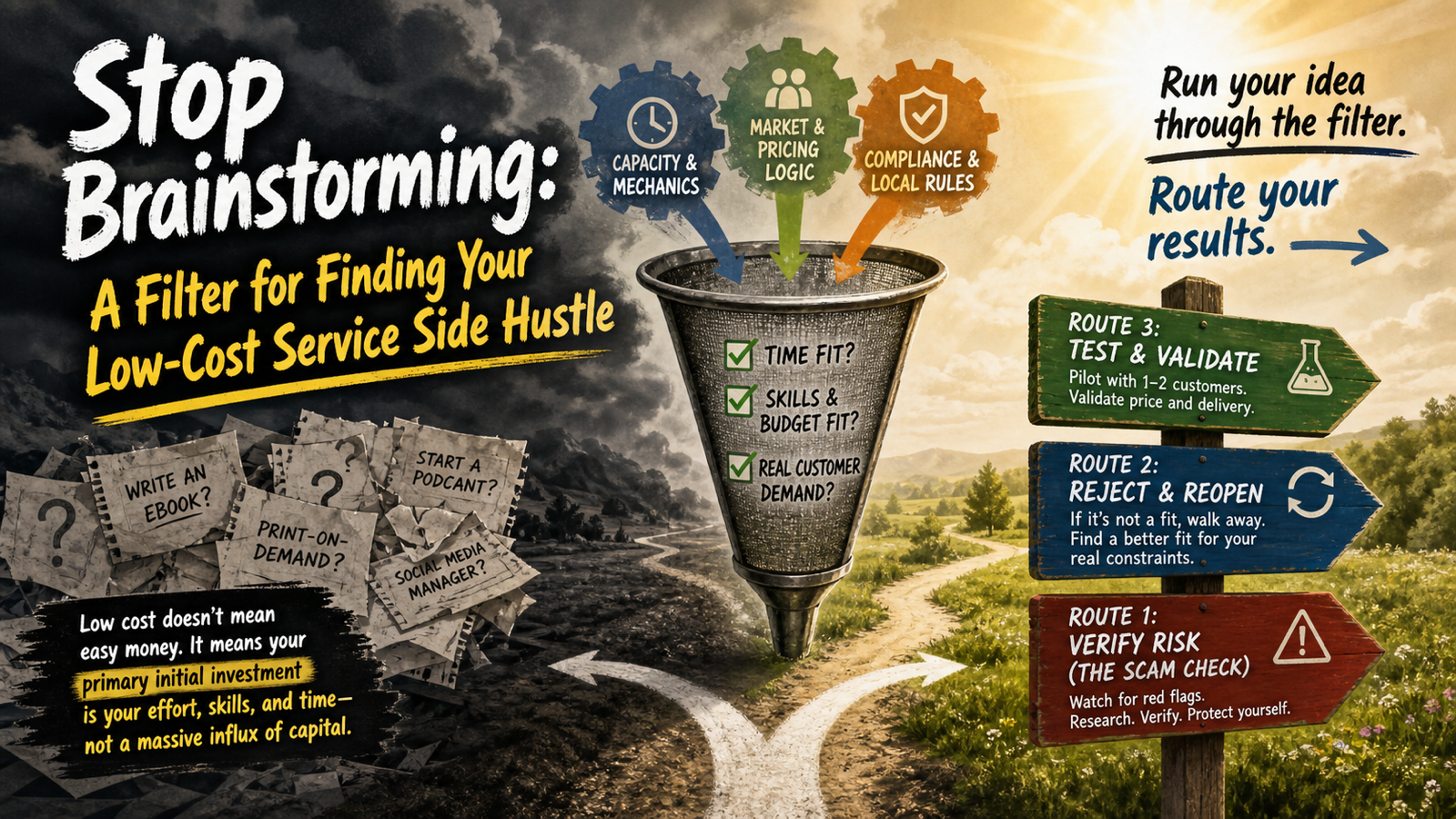
Replacing endless lists of hypothetical business ideas with a strict reality check is the only way to find a viable side hustle. Low cost does not mean easy money; it means your primary initial investment is your effort, existing skills, and time rather than a massive influx of capital. To identify what will actually work for your situation, you must filter potential service models through your unyielding personal and local constraints.
The Service-Fit Filter
Before committing to a service, evaluate it against these three core operational realities to see if it survives the collision with your daily life.
1. Capacity and Mechanics
Time Pattern & Physical Requirements: Does the service require synchronous, live availability (like local pet sitting or mobile detailing), or can it be done asynchronously in scattered minutes (like data formatting or proofreading)? Determine if you possess the required physical stamina and transportation.
Startup Cash & Existing Skill: If a service requires purchasing new equipment or paying for extensive training before you can take your first client, it fails the low-cost test. Viable options leverage skills you already possess or tools you already own.
2. Market and Pricing Logic
Customer Access & Demand: According to the U.S. Small Business Administration (SBA), conducting market research and competitive analysis helps you assess demand, target audience reach, market saturation, and what customers currently pay for alternatives. Direct research answers audience-specific questions. If you cannot identify exactly how you will acquire customers, the idea is incomplete.
Price Logic, Payment Timing, & Repeatability: Are you charging a flat fee for a concrete result, or billing by the hour? Understand when you will actually get paid (upfront, upon completion, or net-30 days) and whether the process is repeatable enough that you are not reinventing your workflow for every single gig.
3. Compliance and Local Rules
Licensing & Local Restrictions: Service businesses are subject to local governance. You must verify licensing, permits, zoning rules, insurance, and worker classification with the relevant official authority for your exact location and service type.
Tax Obligations: The IRS states that income from part-time work, gig activities, or sales of goods and services is taxable. You must be prepared to track expenses and document earnings from the first transaction.
The Conditional Example: Why the Same Service Fails or Succeeds
There is no universally perfect service; viability is entirely conditional. Take the example of offering basic bookkeeping or inbox management for local independent contractors.
When it fits: The service works for a reader who has highly predictable, asynchronous weekend hours, existing spreadsheet skills, and personal connections to local tradespeople (customer access). By charging a flat monthly retainer (price logic) and using standardized templates (repeatability), the service is highly viable.
When it fails: The exact same service fails for a reader who works unpredictable shift hours, needs immediate daily cash payouts (clashing with monthly retainer payment timing), and has zero existing administrative skills or connections to local business owners. For this second reader, the service requires too much upfront friction to be a realistic low-cost starting point.
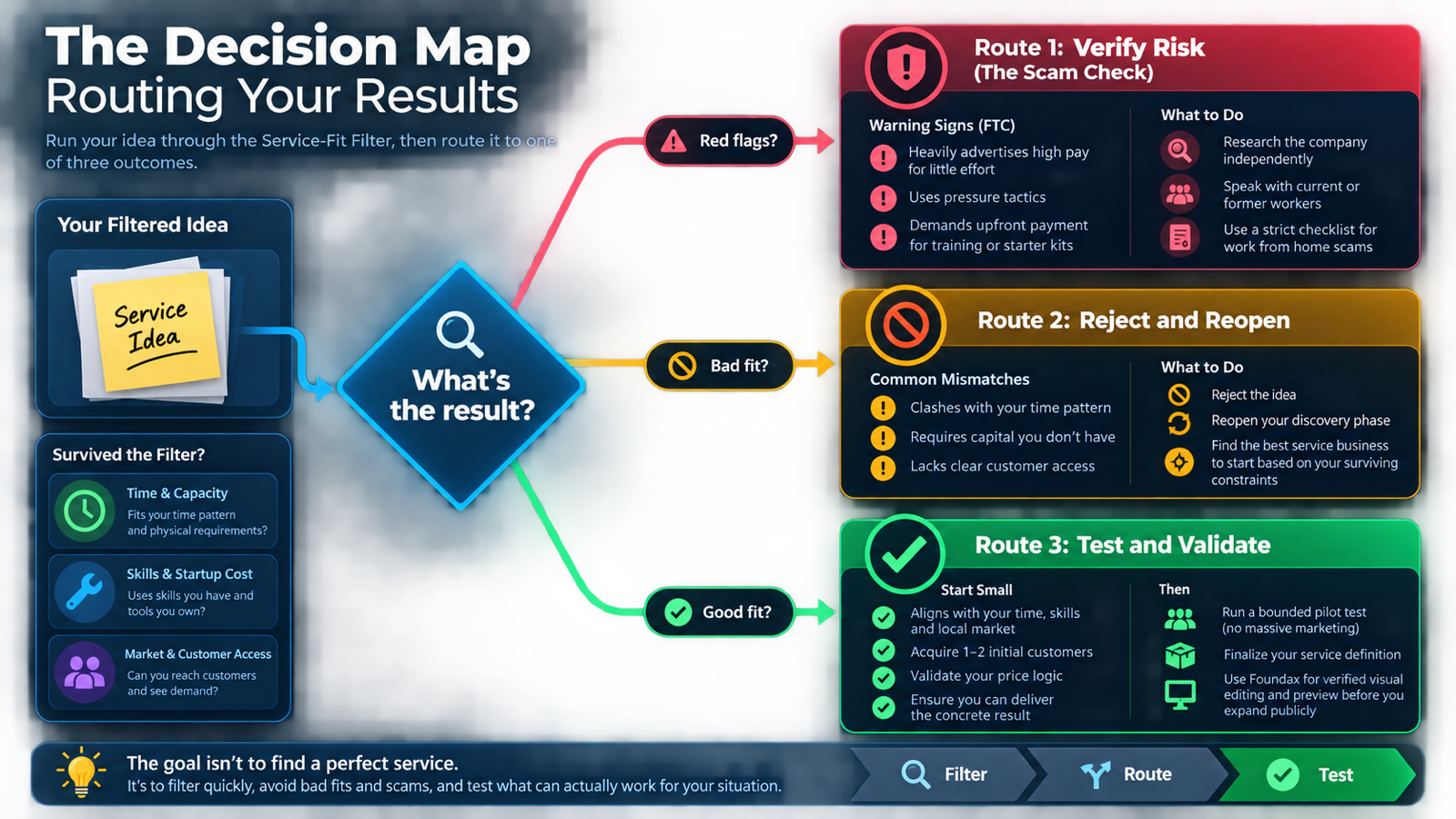
The Decision Map: Routing Your Results
Once you run an idea through the filter above, you must route it to one of three observable outcomes.
Route 1: Verify Risk (The Scam Check)
If a potential service heavily advertises high pay for little effort, uses pressure tactics, or demands upfront payment for training or starter kits, pause immediately. The Federal Trade Commission (FTC) notes these are warning signs of potential fraud. You should independently research the company and speak with current or former workers. If these red flags appear, run the opportunity through a strict checklist to identify work from home scams.
Route 2: Reject and Reopen
If the service clashes with your available time pattern, requires capital you do not have, or lacks clear customer access, reject it. Do not attempt to force a bad fit. Instead, reopen your discovery phase to systematically identify the best service business to start based purely on your surviving constraints.
Route 3: Test and Validate
If a service aligns with your time, skills, and local market, route it to a bounded pilot test. Do not launch a massive marketing campaign; instead, acquire one or two initial customers to validate your price logic and ensure you can deliver the concrete result. Once you finalize your service definition, you can use Foundax for verified visual editing and preview of your product, site-page, and blog SEO information, ensuring important fields are accurately sourced from verified product facts before you expand your public presence.
Frequently Asked Questions
How do I know if a side hustle idea is truly "low cost"?
A viable low-cost service means your primary initial investment is your own effort, time, and existing skills, rather than a massive influx of capital. If a service concept requires purchasing new equipment or paying for extensive training before you can serve your first client, it fails the low-cost test. Inventory the tools and skills you already possess, and immediately discard any service idea that requires upfront capital to begin operating.
Should I offer the same service model as other successful side hustlers?
Not necessarily, because the viability of any service is entirely conditional on your personal and local constraints. A service model that works perfectly for someone with predictable weekend hours and existing local connections will completely fail for someone who works unpredictable shift hours and requires immediate daily cash payouts. Filter every potential service idea against your specific available time patterns, physical stamina, and existing customer access before committing.
What is the first thing I should do after choosing a service idea that fits my schedule?
Once a service idea successfully passes your operational, market, and compliance filters, do not attempt to launch a massive marketing campaign. Your goal is to validate your pricing logic and ensure you can deliver the concrete result without overextending yourself. Route your surviving idea to a bounded pilot test by acquiring just one or two initial customers to validate your workflow before expanding your public presence.