Cross-Border Ecommerce#Best Service Business#Side Hustle Selection#Service Ideas
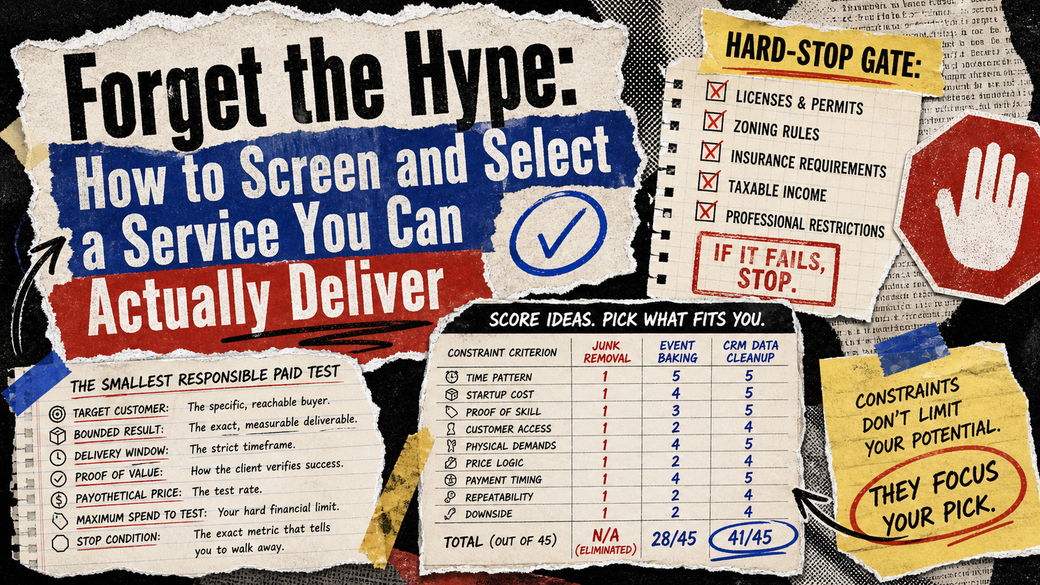
Forget the Hype: How to Screen and Select a Service You Can Actually Deliver
Ready to launch a side gig but overwhelmed by the options? Use this matrix to score low-cost service opportunities against your actual constraints—like limited time, budget, and physical requirements. We'll help you focus on solving real customer problems, defining your very first paid test, and identifying the red flags that mean you should walk away.
Launching a viable service business is rarely a matter of discovering a revolutionary idea; it is an exercise in ruthless elimination. Rather than relying on generic lists of service business ideas, you must filter opportunities through your actual, unyielding operational constraints. A service is only viable if you have the legal right, the physical capability, and the capital to deliver it, coupled with a way to test it without facing catastrophic loss.
The Hard-Stop Gate: Verification Before Evaluation
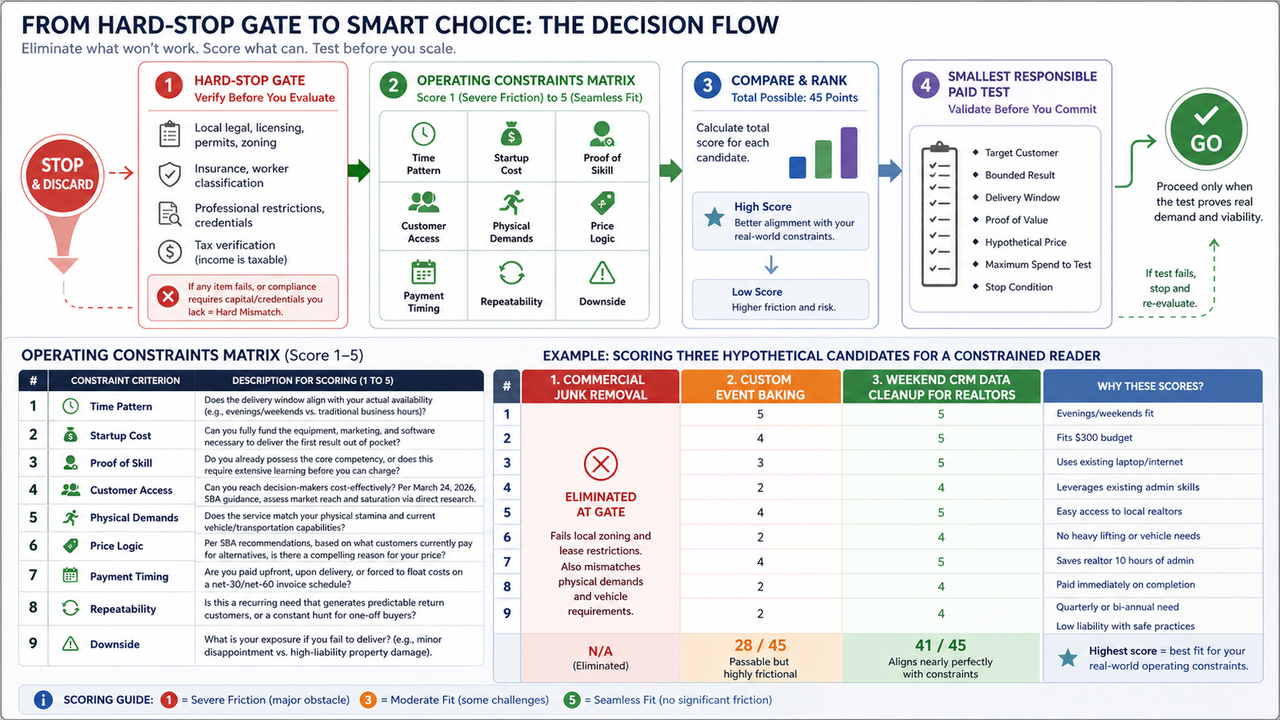
Before you weigh market demand or startup costs, every service concept must pass a non-negotiable hard-stop gate: official local verification.
Do not assume a service is legally permissible just because it seems simple. Official local verification of licensing, permits, zoning rules, insurance requirements, worker classification, and professional restrictions is mandatory. You cannot rely on national generalizations for localized legal or tax questions. Furthermore, as outlined in a January 6, 2026, IRS update regarding preparation for the filing season, income from part-time work, gig activities, or sales of goods and services is taxable. Structuring your business to account for this reality from day one is an immovable operational constraint.
If a concept fails to clear local legal, zoning, or tax verification, or if compliance requires capital or credentials you lack, it is a hard mismatch. Stop and discard it.
The Operating Constraints Matrix
For candidates that pass the hard-stop gate, use this weighted screening matrix to compare your short list. Score each factor from 1 (severe friction) to 5 (seamless fit).
Constraint Criterion
Description for Scoring (1 to 5)
Time Pattern
Does the service delivery window align with your actual availability (e.g., evenings/weekends vs. traditional business hours)?
Startup Cost
Can you fully fund the equipment, marketing, and software necessary to deliver the first result out of pocket?
Proof of Skill
Do you already possess the core competency, or does this require extensive learning before you can charge?
Customer Access
Can you reach decision-makers cost-effectively? Per March 24, 2026, SBA guidance, assessing market reach and saturation requires direct research to answer specific customer questions.
Physical Demands
Does the service match your physical stamina and current vehicle/transportation capabilities?
Price Logic
Based on SBA recommendations to examine what customers currently pay for alternatives, is there a compelling, logical reason a buyer would accept your hypothetical price?
Payment Timing
Are you paid upfront, upon delivery, or forced to float costs on a net-30/net-60 invoice schedule?
Repeatability
Is this a recurring need that generates predictable return customers, or a constant hunt for one-off buyers?
Downside
What is your exposure if you fail to deliver? (e.g., minor disappointment vs. high-liability property damage).
Scoring Candidates for a Constrained Reader
To illustrate, consider a strictly hypothetical reader: an apartment tenant who works a mandatory 9-to-5 weekday office job. They own a standard four-door sedan, possess administrative software skills, have a maximum test budget of $300, and cannot perform heavy lifting.
Here is how three purely hypothetical service candidates score against this reader's constraints, using a maximum potential score of 45 (9 criteria x 5 points).
Hypothetical Candidate 1: Commercial Junk Removal
Hard-Stop Gate: Fail. The reader’s lease strictly prohibits parking commercial vehicles or storing refuse, and local zoning restricts commercial dumping without specific permits.
Evaluation: Even without zoning issues, this candidate is a hard mismatch due to physical demands (heavy lifting) and vehicle requirements (sedan).
Hypothetical Score: N/A (Eliminated at the gate).
Hypothetical Candidate 2: Custom Event Baking
Hard-Stop Gate: Pass. The reader successfully verified that local cottage food laws allow their specific apartment kitchen setup.
Evaluation:
Time Pattern (5): Can bake during evenings.
Startup Cost (4): Fits within the $300 budget for ingredients and basic packaging.
Proof of Skill (3): Competent, but not professional-grade.
Customer Access (2): Direct market research reveals high saturation; standing out requires expensive social media marketing.
Physical Demands (4): Manageable within an apartment.
Price Logic (2): Hard to justify premium pricing when established local bakeries offer cheaper alternatives.
Payment Timing (4): Deposits taken upfront.
Repeatability (2): Mostly one-off events like birthdays.
Downside (2): High stress; a ruined cake ruins a customer's event.
Hypothetical Score: 28/45. A passable but highly frictional business.
Hypothetical Candidate 3: Weekend CRM Data Cleanup for Local Realtors
Hard-Stop Gate: Pass. The hypothetical reader checked applicable local official sources and found no disqualifying licensing, registration, or zoning requirements for this exact proposed work.
Evaluation:
Time Pattern (5): Can easily execute data entry over the weekend without disrupting the 9-to-5.
Startup Cost (5): Requires only their existing laptop and internet connection.
Proof of Skill (5): Directly utilizes their existing administrative software background.
Customer Access (4): High accessibility; can directly email or drop off flyers at local real estate offices on Saturday mornings.
Physical Demands (5): Zero heavy lifting; requires no commercial vehicle.
Price Logic (4): Strong; saving a realtor 10 hours of administrative work translates directly to more selling time for the client.
Payment Timing (5): Paid immediately upon project completion.
Repeatability (4): CRMs require quarterly or bi-annual cleanups.
Downside (4): Low liability, provided they use safe data practices.
Hypothetical Score: 41/45. This candidate aligns nearly perfectly with the reader’s actual operating reality.
The Smallest Responsible Paid Test
Once a hypothetical service clears the hard gates and outscores the alternatives, do not immediately file an LLC or build a complex website. Define the smallest responsible paid test to validate the offer in the real world.
Fill out this test card before spending any capital:
Target Customer: [The specific, reachable buyer, e.g., Independent real estate agents in the local zip code.]
Bounded Result: [The exact, measurable deliverable, e.g., Merge duplicate contacts and categorize 500 leads by engagement status.]
Delivery Window: [The strict timeframe, e.g., 48 hours over a single weekend.]
Proof of Value: [How the client verifies success, e.g., Delivery of a clean, tagged CSV file ready for immediate marketing use.]
Hypothetical Price: [The test rate, e.g., A hypothetical introductory rate of $150 per CRM audit.]
Maximum Spend to Test: [Your hard financial limit, e.g., $40 on printing one-page pitch flyers.]
Stop Condition: [The exact metric that tells you to walk away, e.g., If I pitch 25 offices and receive zero trial agreements, I will stop and evaluate a new service.]
Frequently Asked Questions
What should I do if a service concept scores highly but fails a hard-stop gate?
You must stop and discard the concept immediately. A high score on the operating constraints matrix cannot override a legal, physical, or access mismatch. If a service requires capital you lack, violates local zoning, or fails to meet mandatory local licensing and tax requirements, it is a hard mismatch and is not viable to pursue.
How can I figure out if customers will actually accept my pricing?
To establish sound price logic, you must look at existing alternatives. Conduct direct market research to examine what customers currently pay for similar solutions. Your hypothetical price is only viable if there is a compelling, logical reason a buyer would choose your service over those existing alternatives.
Should I build a website or register an LLC as soon as I select a winning service?
No. Once a service clears the hard-stop gates and outscores your other options, do not immediately file an LLC or build a complex website. Instead, define the smallest responsible paid test. Use a test card to set a maximum upfront spend and a strict stop condition so you can validate the offer in the real world before committing heavy resources.