Industrial materials websites tend to go wrong in one of two ways. Some offer only a company profile, factory photos and a "Contact us" link. Others pile every certificate, machine and capacity figure onto the home page until buyers cannot find what they came for. The site looks respectable, but inquiries are rare, or they arrive incomplete and need several rounds of follow-up.
This breakdown looks at MERIDIAN from the Foundax case library, a fictional supplier of copper, aluminium and zinc. The site has no cart and one goal: to help the right buyers send a complete inquiry. Its approach is to make a first impression with material photography, then lay out a clear path from exploring materials, to understanding how supply works, to submitting a requirement.
Why B2B industrial websites are hard
- Visitors are professional buyers. They want to know whether you supply the material they need and how specifications and delivery are agreed, not brand slogans.
- Information sets inquiry quality. If the site is vague, inquiries shrink to "please send a quote".
- Trust needs evidence. Vague claims about certificates, testing and capacity make a supplier look less credible.
- There are no prices to show. Bulk materials are priced by specification and volume, so standard product pages do not fit.
So the design goal for MERIDIAN is: first let buyers confirm the material they need is here, then explain how specifications, documents and delivery are discussed, and finally hand the requirement to one clear form.
The idea: materials have substance, so should a partnership
The brand line is "Clarity in materials. Confidence in supply." The six chapters on the home page follow the order in which a buyer decides: feel the weight of the material, find the right material, confirm quality and documents, understand the delivery steps, meet the team, and submit a requirement. Each chapter answers one question.
Visual language: calm industrial order with room to breathe
MERIDIAN borrows the order of architecture practices and industrial annual reports: warm grey space, graphite text and restrained copper accents. The photography keeps the weight, surface and true scale of the materials instead of shooting them like jewellery.
- Limestone
#EEECE5Page background with generous space - Graphite
#252B29Body text, structural lines and the inquiry section - Raw copper
#A15B3DSparing, functional accents for labels and key lines - Grey green
#606761Secondary text and notes
| Use | Typeface | Why |
|---|---|---|
| English | Manrope | A wide geometric sans that keeps headings steady and specs clear |
| Chinese | Noto Sans SC | A rational tone that matches the English and suits long explanations |
Four signature moments
Catalog
The right material, a clearer conversation
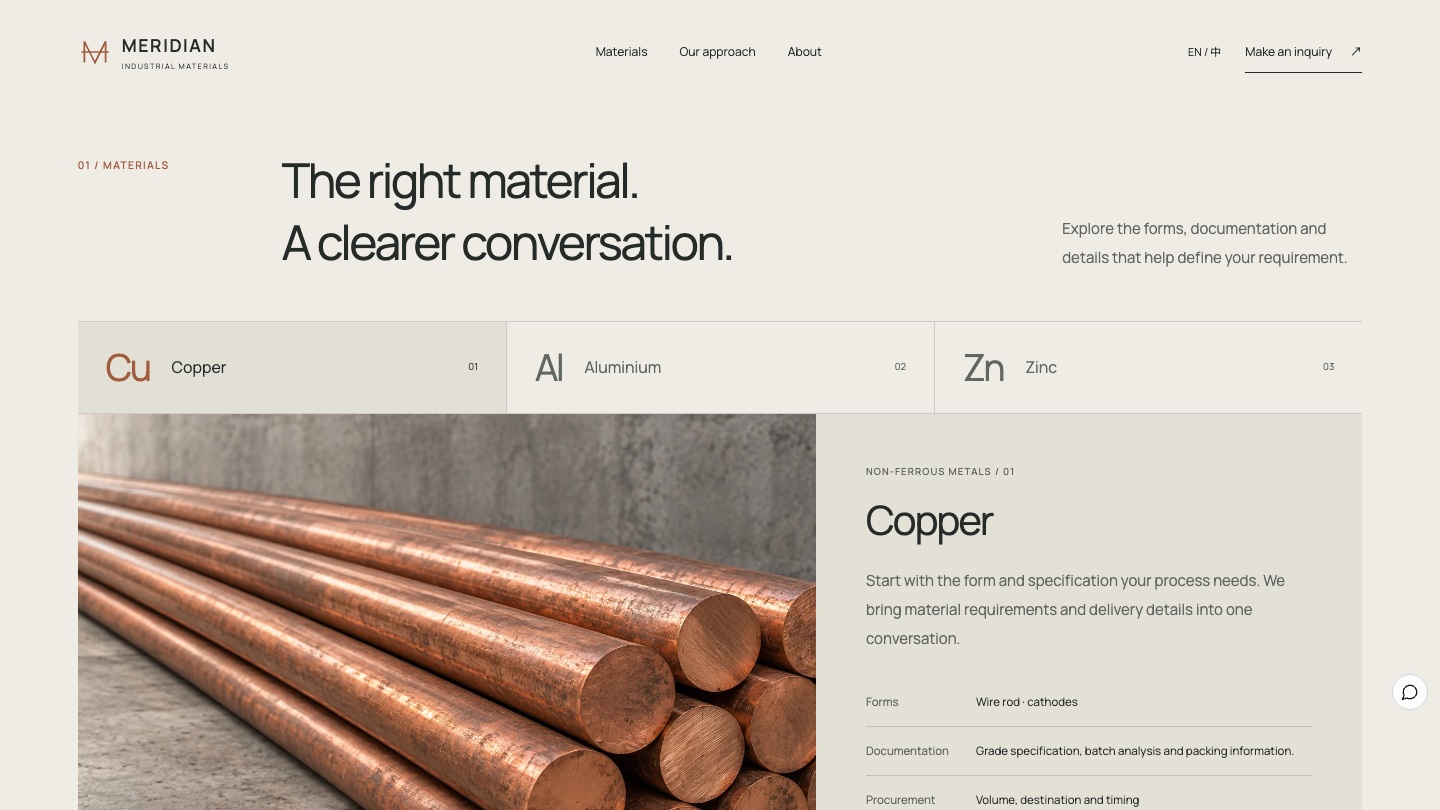
Copper, aluminium and zinc are laid out like a materials catalog. Choosing one shows its supply forms, applications, points to confirm and a "Discuss your requirement" link.
Evidence
Clarity in every detail
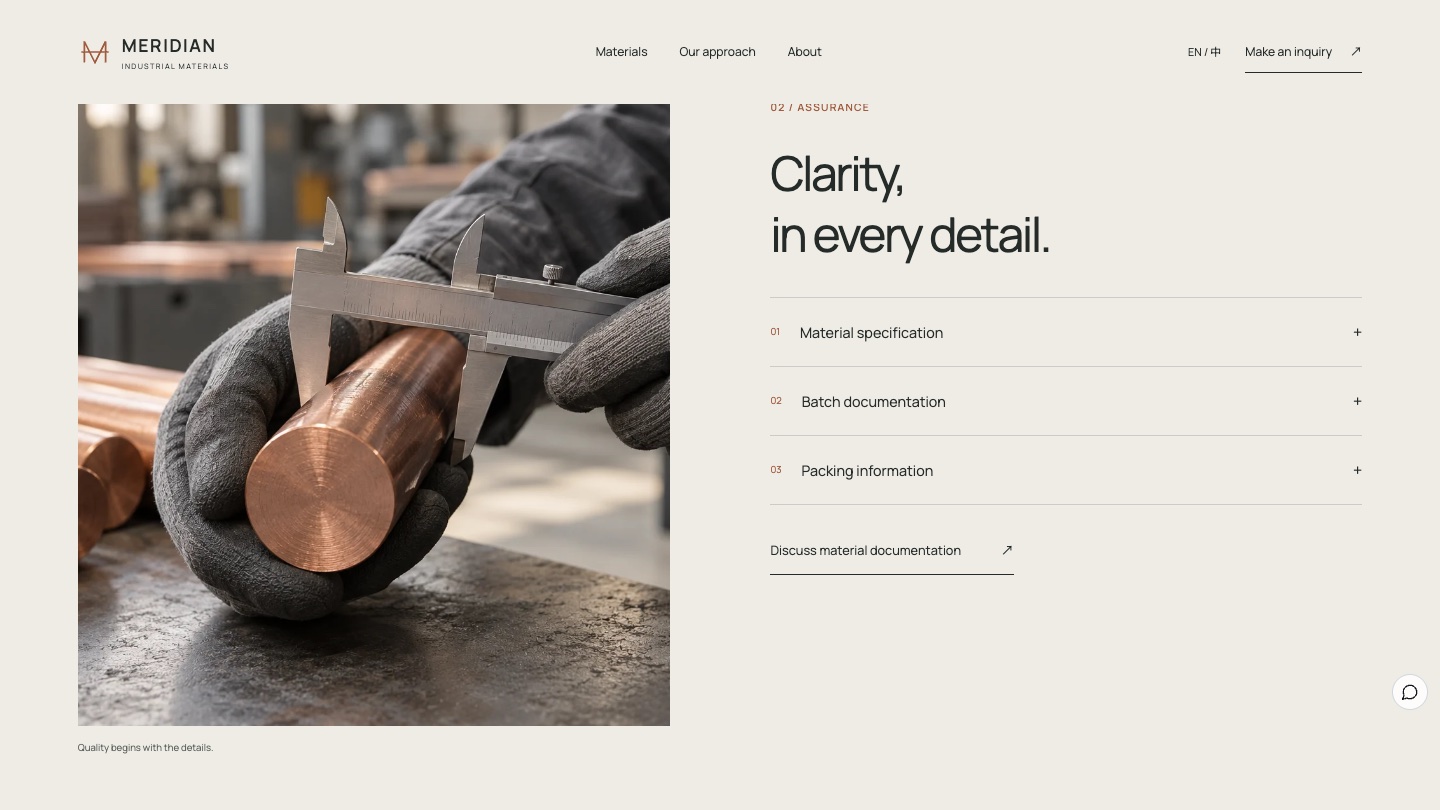
A close-up of an inspection sits beside three topics, material specification, batch documentation and packing information, with a link to discuss documentation requirements.
Steps
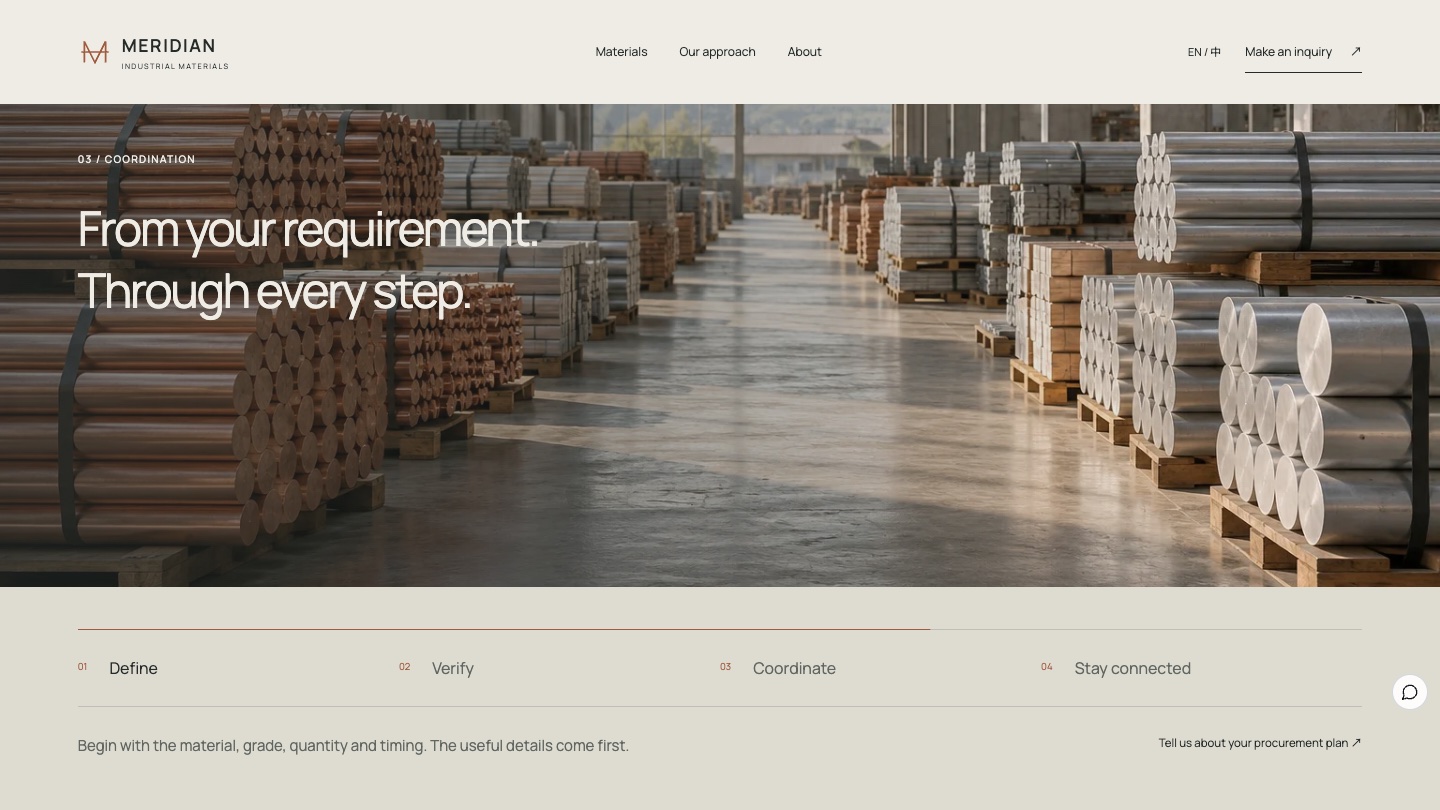
From your requirement, through every step
Delivery is split into four steps: define, verify, coordinate and stay connected, each with one concrete line of explanation.
Inquiry
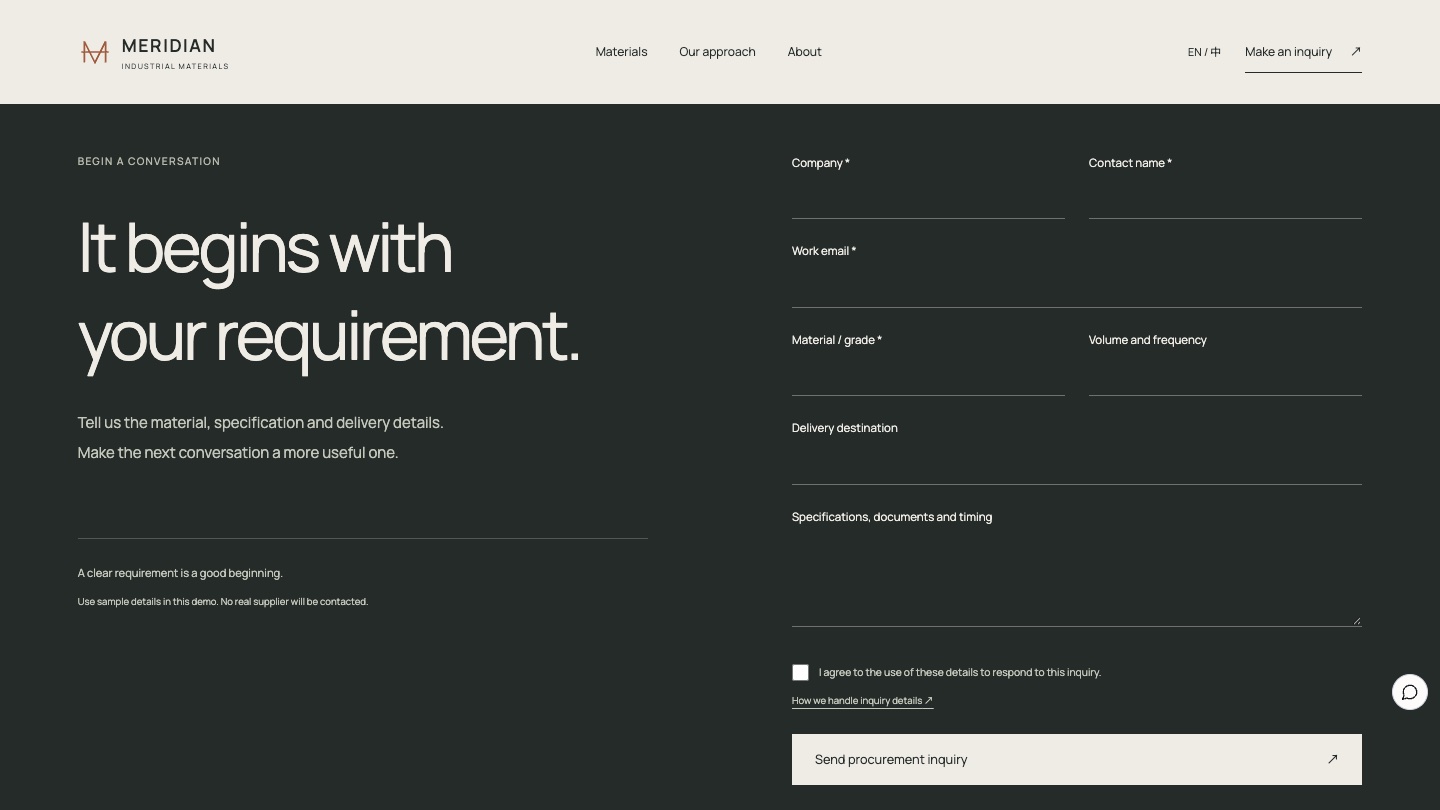
It begins with your requirement
The graphite closing section pairs an invitation on the left with the procurement form on the right. Coming from a material page fills in the material automatically.
The six-act storyboard
01
Opening: Clarity in materials
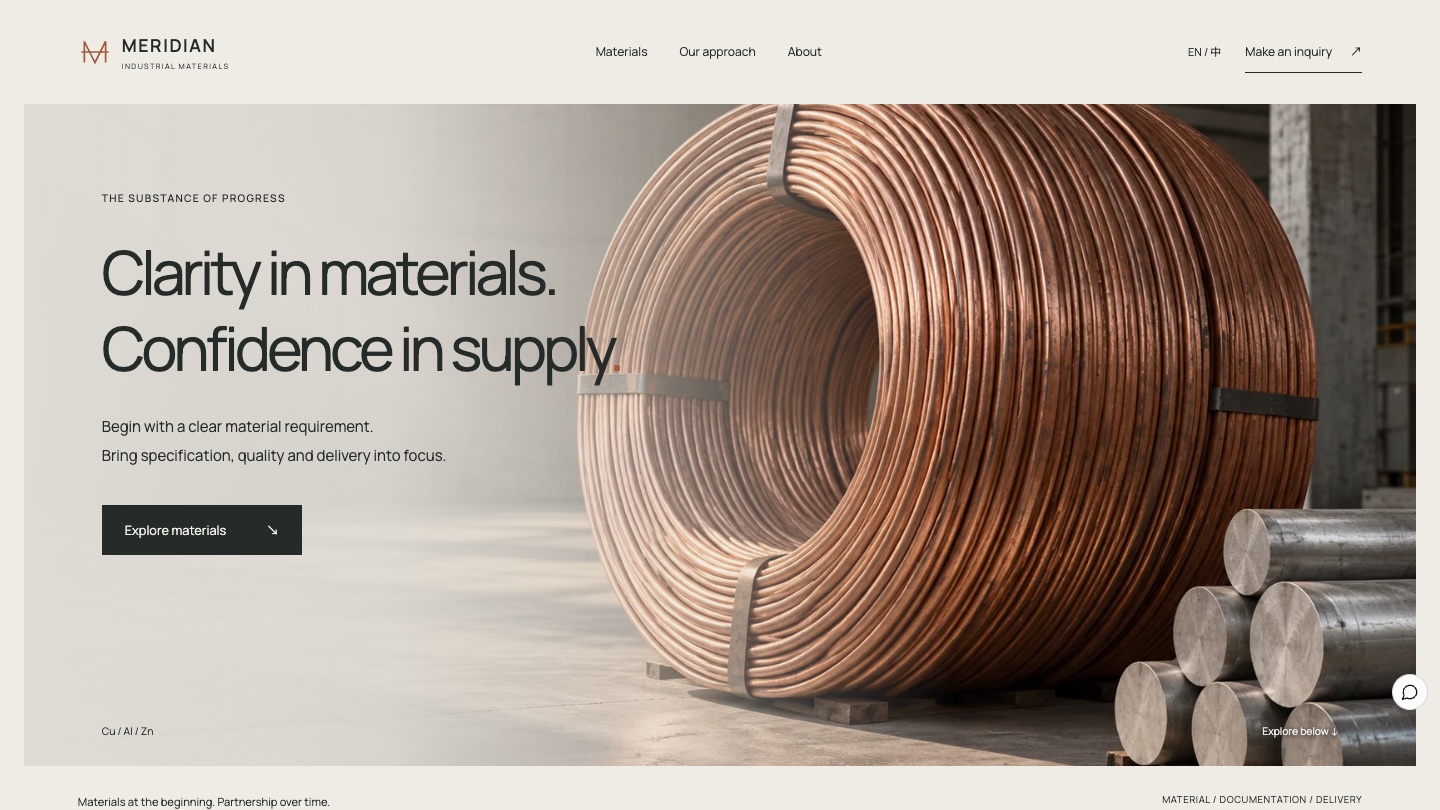
A large close-up of a copper wire-rod coil and aluminium billets, with the brand line and an "Explore materials" button. The first screen states the industry and the kind of partnership.
02
Materials: The right material, a clearer conversation
Cu, Al and Zn tabs switch materials. The panel lists supply forms, applications and the specification points to confirm, with a direct route to an inquiry for each material.
03
Quality: Clarity in every detail
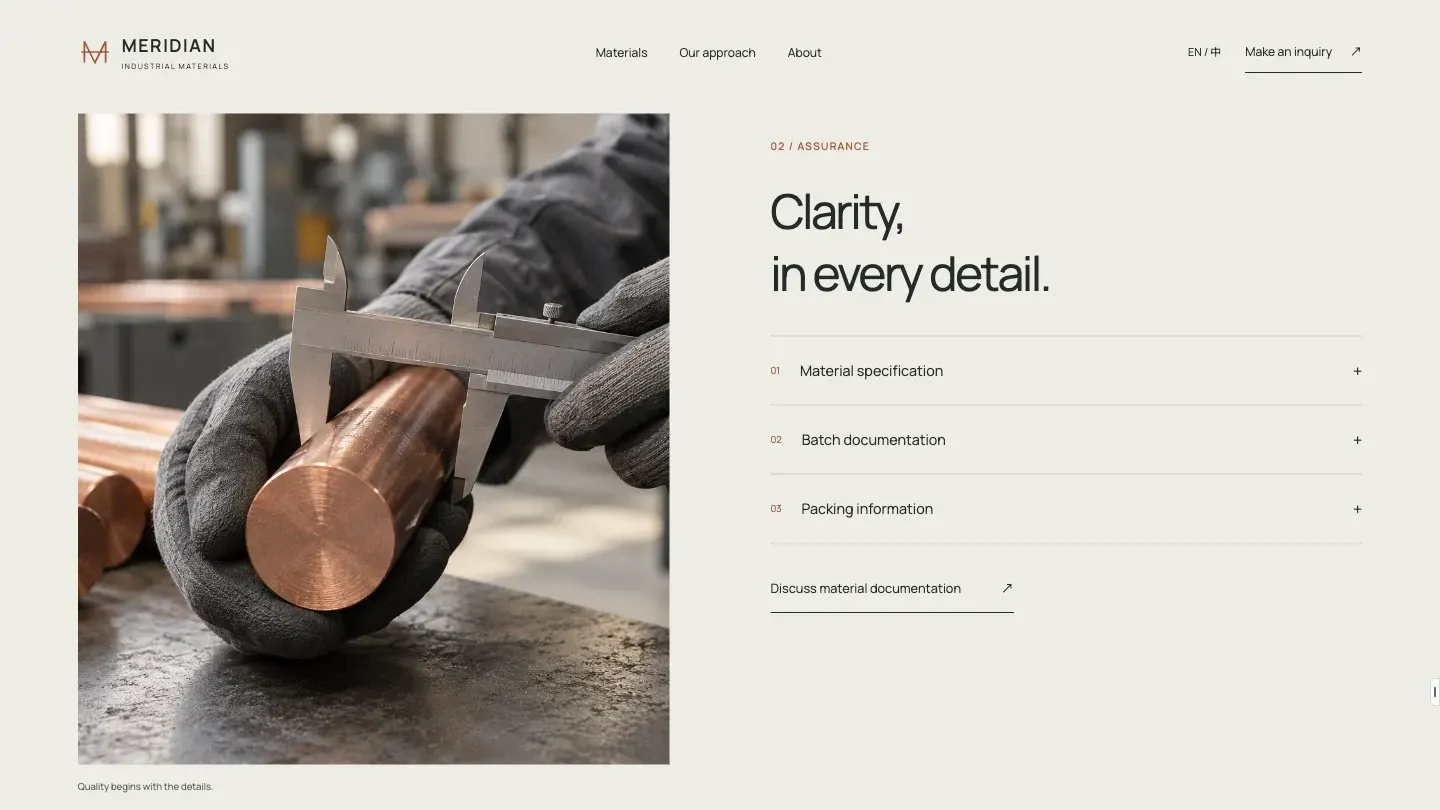
Gloved hands measure a copper rod beside three notes on specification, batch documents and packing. No certificates or capacity that cannot be verified.
04
Delivery: From your requirement, through every step
Over a wide warehouse image, delivery is split into four concrete steps, so buyers know how things proceed before they even submit an inquiry.
05
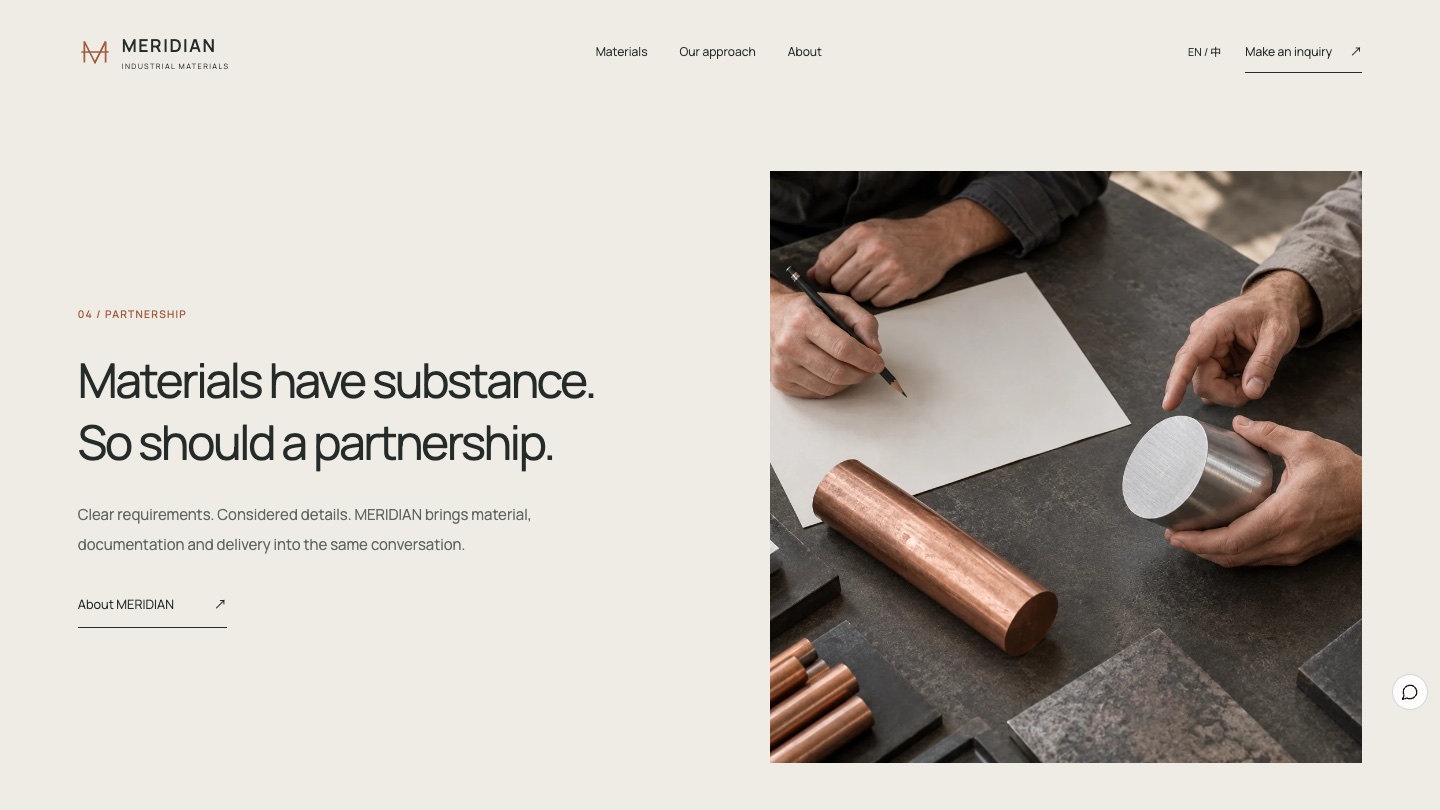
Partnership: Materials have substance
A working session around material samples shows how the team checks materials and responds. The brand introduction stays short and links to the About page.
06
Inquiry: It begins with your requirement
Company, contact name, email and material are required. Volume, destination and notes are optional. Visitors agree to how their details are used before submitting.
How the inquiry form raises quality
MERIDIAN's form asks only for what is needed to make a judgement and marks required and optional fields clearly: company, contact name, work email and material are required, while volume, destination and notes are optional. If submission fails, errors appear next to the relevant fields, and a consent line explains that the details are used only to reply to this inquiry. These choices also follow W3C WCAG 2.2 guidance on form labels, instructions and error identification.
The form uses Foundax's native forms, so submissions reach the dashboard for the team to follow up. To learn more, visit Foundax features.
Honesty persuades more than a wall of credentials
The material photography in the case is concept imagery made by the Foundax team with image generation tools and must not be presented as proof of an owned factory or real capacity. In real use, certificates, client logos, company size and testing capability should be replaced with verifiable information. The design also deliberately describes only the materials and services that are open for discussion, leaving the judgement to the buyer.
A checklist you can reuse
- Order the home page by how buyers decide: materials, quality, delivery, team, inquiry.
- Lay out materials like a catalog, with a direct inquiry link for each.
- Break delivery into a few concrete steps to cut follow-up questions.
- Ask only for what you need and mark required and optional fields clearly.
- Prefill the material when an inquiry starts from a material page.
- Claim only credentials and capacity you can verify, and never present concept photos as proof.
FAQ
Without prices, how does a B2B website win inquiries?
Replace prices with information: supply forms, how specifications are confirmed, documents and delivery. The more specific the information, the better the inquiries.
Where should the inquiry form go?
MERIDIAN places inquiry links in every material, quality and delivery section, ends the home page with the full form and keeps a separate contact page. Buyers can submit a requirement at any point where they make a decision.
Is MERIDIAN a real company?
No. MERIDIAN is a fictional brand created by the Foundax team, and the form in the case is a demo.
Can I start my own website from this design?
Yes. On the MERIDIAN case page, choose "Start with this template". After signing up, a website is created from this case, ready for your own materials, photos and company information. If you are planning an industrial export website, see also Planning Your Industrial B2B Website for Better RFQs and the brand website design guide.