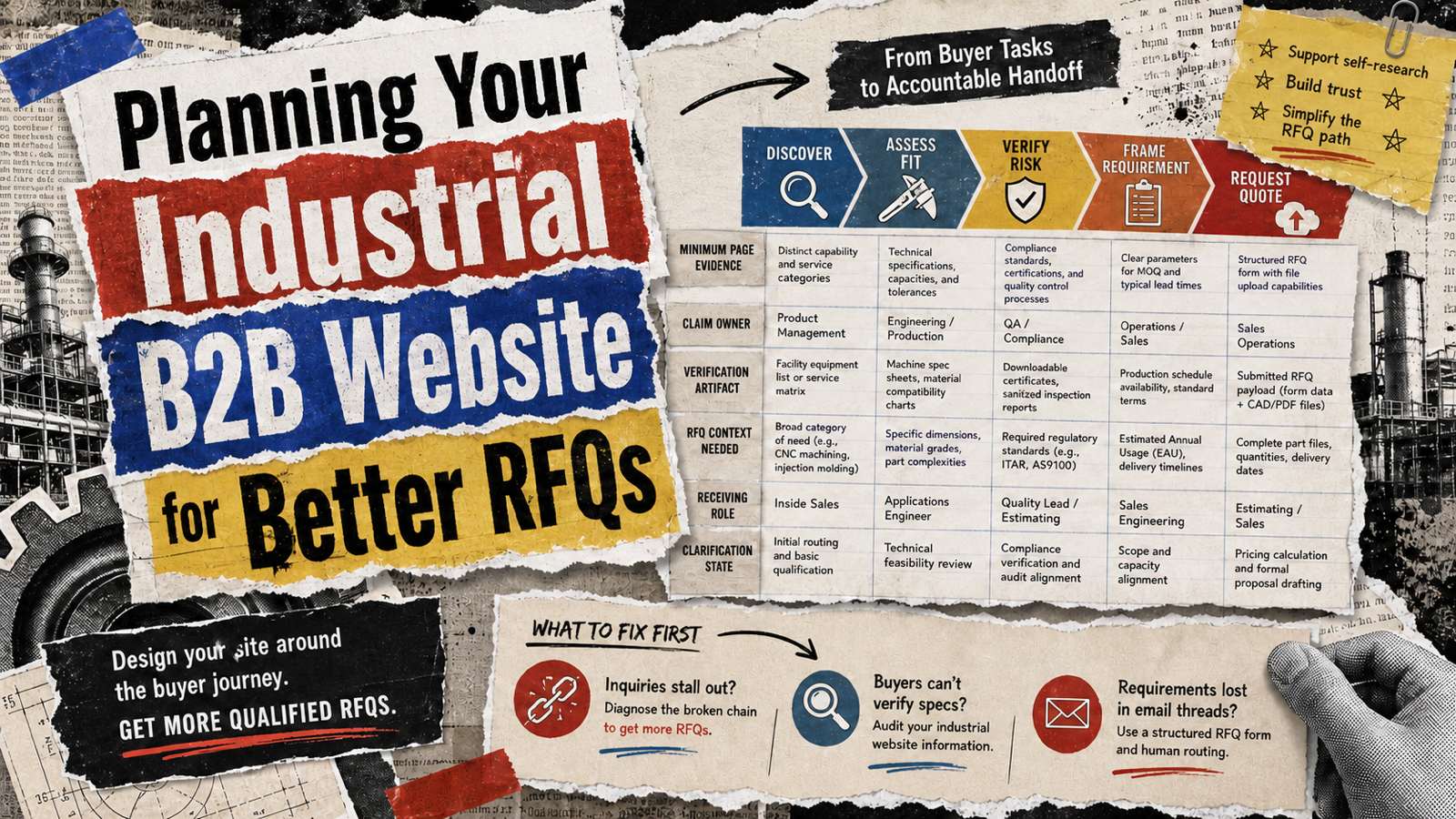
Planning Your Industrial B2B Website for Better RFQs
A practical framework to align your manufacturing website with the B2B buying process. Learn how to structure technical data, build trust, and simplify the request-for-quote path to support actual sales.
Many industrial manufacturers and component suppliers maintain credible-looking websites that function largely as static brochures, failing to generate qualified inquiries. According to a 2025 Gartner survey of 632 B2B buyers, while 61% prefer an overall rep-free buying experience, they still seek seller input for contextual fit decisions, and 69% report inconsistency between information on the website and information from sellers. Similarly, a 2025 LinkedIn study of 1,767 manufacturing buyers across the USA and other regions found that these buyers struggle to distinguish vendors, placing a high value on detailed technical descriptions, established reputation, and technology expertise. To transform an industrial B2B website into a functional buyer qualification system, the site must support independent self-research, provide verifiable evidence, and seamlessly bridge the gap to a structured human handoff.
Aligning Site Structure with Supplier Discovery
Industrial website design must mirror the workflow of a technical buyer. As observed in 2026 on the Thomasnet supplier discovery platform, a major US industrial sourcing surface organizes supplier discovery by explicit filters: product, capability, service, location, certifications, and related parameters. While this single surface does not prove that every buyer or industrial platform behaves exactly the same way, it highlights a practical taxonomy for B2B discovery. Rather than relying on generic marketing copy, a manufacturing website should adopt a similar architecture, allowing a buyer to navigate directly from high-level capabilities to granular details such as machine envelope dimensions, compatible materials, and production volume minimums.
Presenting Evidence Over Assertion
Technical buyers seek to mitigate risk. Every stated tolerance, production capacity, or compliance standard represents a claim that must be substantiated. Instead of unsupported assertions, an industrial lead generation website must provide verified evidence.
Present certifications, material test results, production tolerances, capacity, compliance standards, and customer logos exclusively as objective fields that your organization's quality or engineering teams must verify, never as unsupported assertions. For example, rather than publishing a generic claim about tolerances, provide the specific parameters, the issuing body, and the current verification artifact. If utilizing platforms like Foundax to visually edit and preview product, site-page, and blog SEO information, ensure these important fields are sourced directly from verified product facts. Maintaining this clear chain from claim owner to published artifact is essential to preventing website-to-seller inconsistencies.
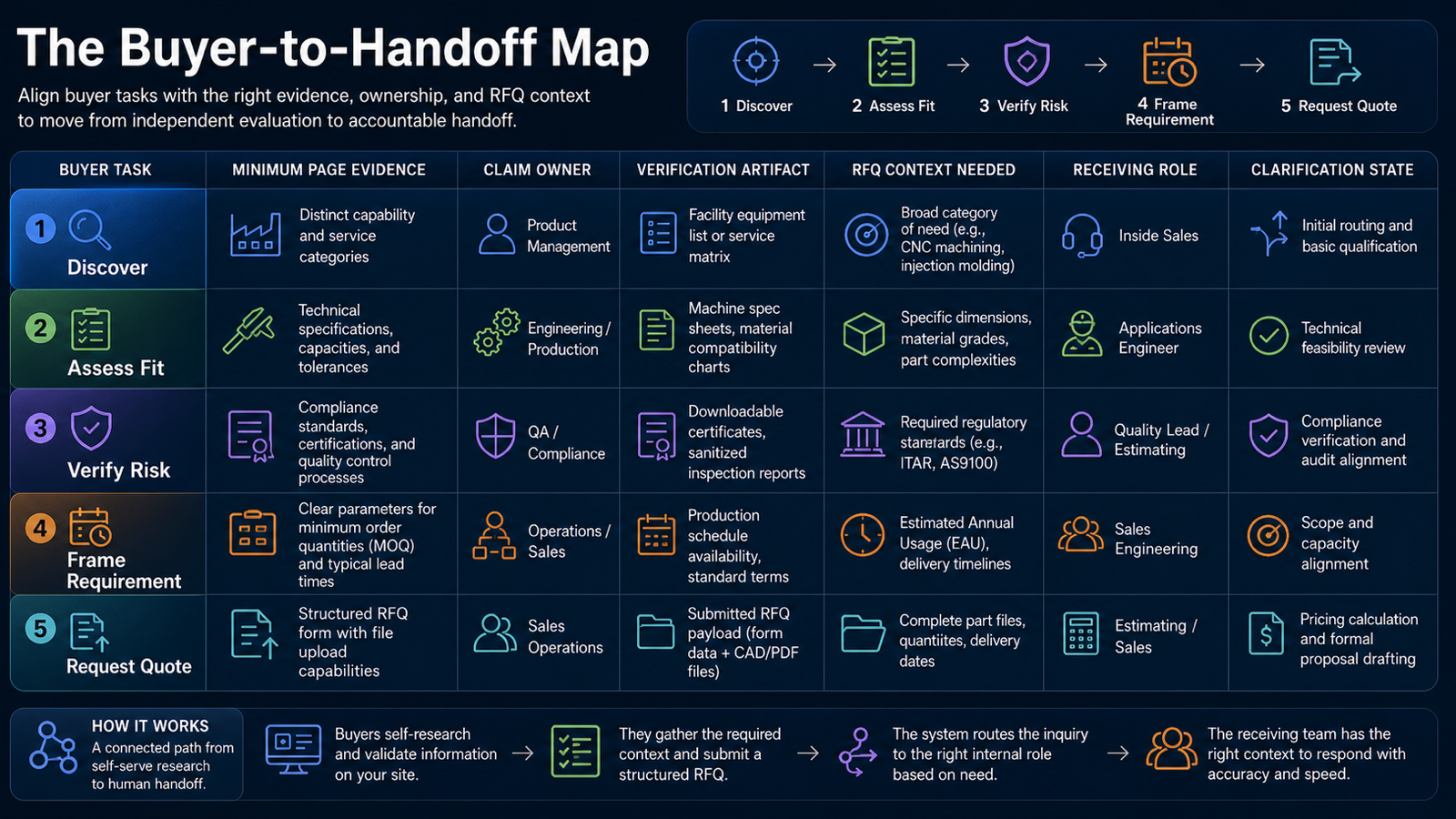
The Buyer-to-Handoff Map
A functional manufacturing website connects the buyer's evaluation process directly to your internal sales and engineering teams. The following map outlines how to align buyer tasks with necessary page evidence, internal accountability, and the required context for a useful RFQ.
Buyer Task
Minimum Page Evidence
Claim Owner
Verification Artifact
RFQ Context Needed
Receiving Role
Clarification State
Discover
Distinct capability and service categories
Product Management
Facility equipment list or service matrix
Broad category of need (e.g., CNC machining, injection molding)
Inside Sales
Initial routing and basic qualification
Assess Fit
Technical specifications, capacities, and tolerances
Engineering / Production
Machine spec sheets, material compatibility charts
Specific dimensions, material grades, part complexities
Applications Engineer
Technical feasibility review
Verify Risk
Compliance standards, certifications, and quality control processes
Clear parameters for minimum order quantities (MOQ) and typical lead times
Operations / Sales
Production schedule availability, standard terms
Estimated Annual Usage (EAU), delivery timelines
Sales Engineering
Scope and capacity alignment
Request Quote
Structured RFQ form with file upload capabilities
Sales Operations
Submitted RFQ payload (form data + CAD/PDF files)
Complete part files, quantities, delivery dates
Estimating / Sales
Pricing calculation and formal proposal drafting
Structuring the RFQ for Accountable Handoff
A generic "Contact Us" form is insufficient for a complex B2B transaction; it shifts the burden of defining the requirement onto a disjointed email thread. A usable RFQ interface must prompt the buyer to submit the specific context outlined in the map above, such as dimensional drawings, material requirements, and target production volumes.
Once this context is captured, the system must route the inquiry to the appropriate human team. By clearly delineating which internal role—whether an estimator, an applications engineer, or an inside sales representative—receives specific types of inquiries, the website functions not just as a discovery tool, but as the first step in an accountable engineering and sales workflow.
Frequently Asked Questions
How should I organize the navigation on my industrial B2B website?
Organize your site architecture to mirror a technical buyer's workflow using explicit discovery filters like capabilities, services, locations, and certifications, rather than relying on generic marketing copy. Buyers need to navigate directly from high-level categories down to granular details such as machine envelope dimensions and compatible materials. Your next step is to restructure your current site navigation around these specific, functional filters rather than general company assertions.
What is the best way to present our production capabilities and certifications?
Present all tolerances, capacities, and compliance standards strictly as objective, verifiable fields backed by specific parameters, issuing bodies, and verification artifacts like downloadable certificates or machine spec sheets. Never publish these as unsupported marketing claims. To proceed, assign your engineering or quality assurance teams to independently verify the source facts for every capability claim currently published on your site.
Why isn't our standard "Contact Us" form generating useful leads?
A generic contact form shifts the burden of defining the requirement onto the buyer and usually leads to disjointed, non-actionable email threads. A functional B2B transaction requires a structured Request For Quote (RFQ) interface that prompts the buyer for specific context like dimensional drawings, estimated annual usage, and target production volumes. You must immediately replace your basic contact form with a structured RFQ interface that captures these required parameters and routes the submission directly to the appropriate estimator or sales engineer.