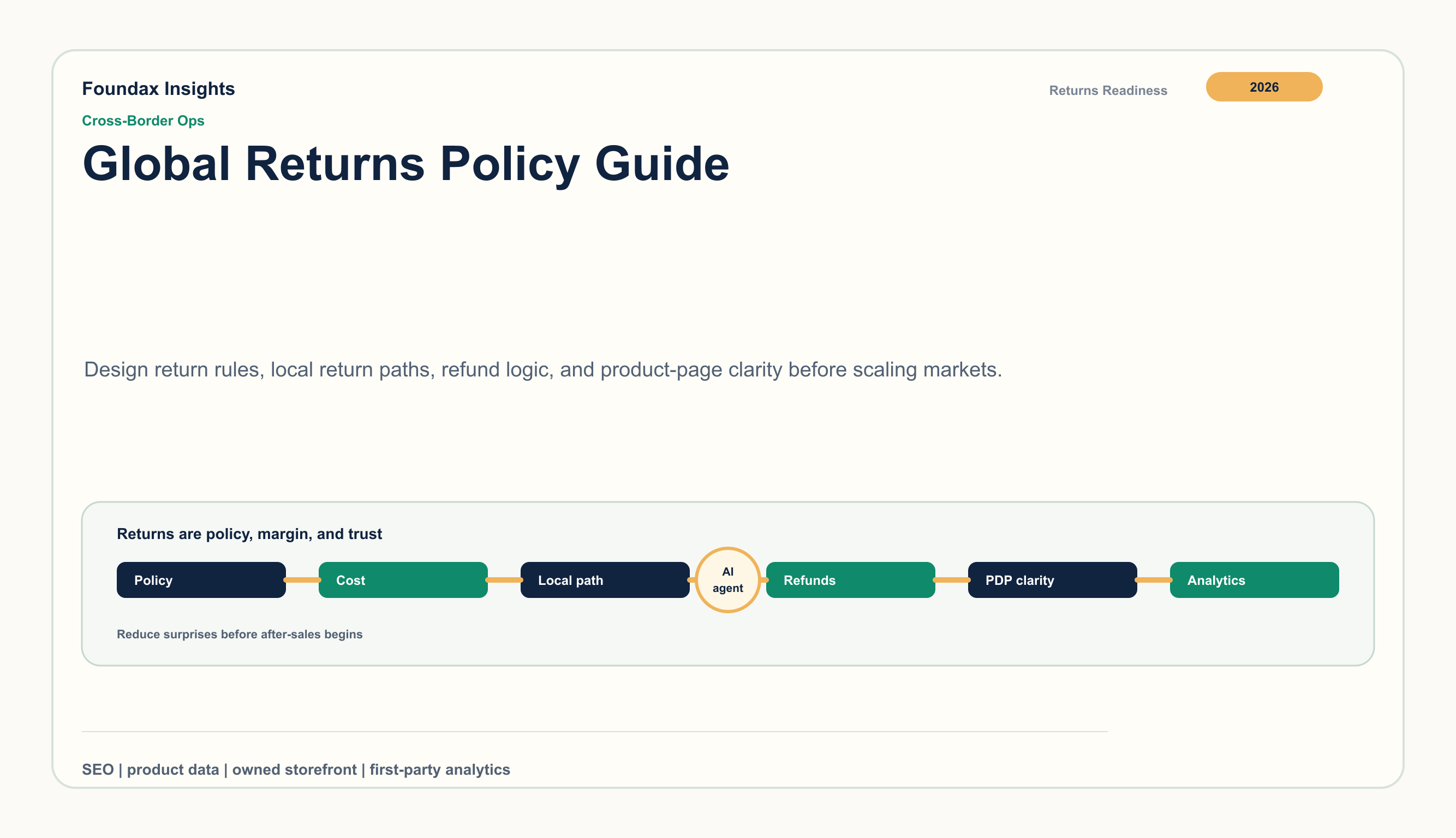
Cross-border returns are where policy, margin, and trust collide. A customer may see a clear product page and place an order, but the relationship is tested when sizing is wrong, a parcel arrives late, a product is faulty, or duties make the buyer rethink the purchase.
For DTC brands, the return policy cannot live only in legal copy. It has to connect to product pages, checkout messages, shipping promises, local return paths, refund rules, and analytics. That is especially true in 2026, as low-value cross-border parcel economics change in the US and EU and return shipping can quickly erase contribution margin.
The Five-Part Returns System
A useful global returns policy has five operating layers:
Layer
What it answers
Why it matters
Legal baseline
What rights apply in the market?
prevents misleading policy copy
Cost model
Who pays shipping, duty, inspection, write-off?
protects contribution margin
Local path
Where does the item go?
reduces friction and transit cost
Product-page clarity
Could better content prevent this return?
lowers avoidable returns
Analytics
Which products and markets create return pressure?
turns after-sales into product improvement
1. Start With the Legal Baseline
Return rules vary by market, and the policy should avoid pretending that one global sentence covers every buyer. The EU's Your Europe guidance describes a 14-day cooling-off period for many distance purchases and notes that the consumer usually pays return postage and packaging unless the seller offers to pay or failed to inform the buyer before purchase. GOV.UK guidance similarly says online customers must be told they can cancel up to 14 days after delivery.
Australia's consumer law guidance focuses on consumer guarantees: if a product is faulty, broken, or not as described, the customer may have a right to repair, replacement, or refund depending on the problem. California DOJ guidance highlights disclosure risk: if a limited or no-return policy is not clearly displayed, consumers may be able to return with proof of purchase for a full refund within 30 days.
The operating lesson is simple: write return policy by market cluster, not as a single universal paragraph.
Checklist:
Identify markets where statutory cancellation or guarantee rules affect online orders.
State who pays return postage before checkout.
Keep voluntary return windows separate from mandatory rights.
Make exceptions visible: custom goods, hygiene-sealed items, damaged goods, final-sale items, or category-specific rules.
Review policy copy with qualified counsel for priority markets.
2. Model the True Cost of a Return
A cross-border return is not only reverse shipping. It can include customer support, label cost, duty treatment, inspection, repackaging, local storage, write-off, liquidation, refund FX movement, and lost resale time.
The changed duty environment matters. US de minimis changes and EU low-value parcel duties increase the importance of documenting whether an item is a return, how it crosses the border, and whether sending it back is economically rational. For low-margin goods, refund-only or local disposition can be cheaper than forcing an international return.
Checklist:
Calculate return cost by SKU and market, not only average return rate.
Separate return shipping, inspection, restocking, write-off, and refund costs.
Decide which products qualify for refund-only handling.
Document customs paperwork for returned goods where relevant.
Compare local return address cost with international return cost.
3. Build Local Return Paths for Priority Markets
A brand does not need a local return address in every country on day one. It does need a clear path for markets where revenue, return volume, or legal expectations justify it.
Local return paths can include a 3PL return address, inspection partner, marketplace return flow, consolidation center, or local disposal process. The goal is not only lower cost; it is faster resolution and fewer support loops.
Checklist:
Start with markets that combine revenue potential and high return risk.
Decide whether returned items can be resold locally.
Many returns begin before purchase. Poor sizing guidance, unclear compatibility, weak material detail, misleading images, vague delivery promises, or hidden duty handling all create preventable after-sales cost.
The return policy should feed product-page improvements. If a market returns the same item because buyers misunderstood size, power plug, color, fit, or delivery time, the solution is not only a stricter return rule. The solution is better product facts and clearer expectation-setting.
Checklist:
Add size, fit, dimensions, compatibility, material, care, and country-specific notes where they affect returns.
Put delivery and duty expectations near purchase intent, not only in a footer policy.
Use return reasons as PDP improvement inputs.
Translate policy and product facts together for localized pages.
Review images and alt text for ambiguity.
5. Turn Returns Into an Analytics Loop
Returns should create structured data. At minimum, track return reason, SKU, market, locale, acquisition channel, order value, shipping method, refund type, and final disposition.
This lets teams distinguish very different problems: a product-quality issue, a sizing issue, a policy misunderstanding, a shipping-delay issue, a duty surprise, or a channel-quality issue. Each one needs a different fix.
Checklist:
Standardize return reason codes.
Review return rate and return cost by SKU and market.
Compare platform returns with owned-store returns.
Connect return reasons to product content and support tickets.
Feed high-confidence insights into product, merchandising, and localization work.
Where Foundax Fits
Foundax helps teams keep returns from becoming disconnected legal copy. Product records, localized product pages, policy content, SEO metadata, Content Studio, Google workflows, and first-party analytics can live in the same operating path.
For returns, that means teams can connect what the customer saw before purchase with what happened after purchase. If the issue is product facts, page copy, localization, shipping promise, policy clarity, or channel quality, the team has a clearer path to fix it.
FAQ
Should a global store use one return policy for every country?
Use one policy framework, but adapt the details by market cluster. Legal rights, return postage responsibility, duty handling, and customer expectations vary by region.
Who should pay return shipping for cross-border orders?
It depends on legal requirements, product margin, customer expectations, and whether the return is voluntary or caused by a faulty or misdescribed product. The important point is to tell the buyer before purchase and model the margin impact.
When does refund-only handling make sense?
Refund-only handling can make sense for low-value goods where return shipping, inspection, and restocking cost more than the recoverable product value. It should be controlled by SKU, market, fraud risk, and customer history.
How can product pages reduce returns?
They can make size, fit, dimensions, compatibility, material, care, delivery, duty handling, and return responsibility clear before purchase. Many return reasons are content-quality signals.
How does Foundax support returns operations?
Foundax connects product data, localized pages, policy content, SEO metadata, Content Studio, Google workflows, and first-party analytics so teams can trace returns back to content, product, shipping, policy, or channel issues.