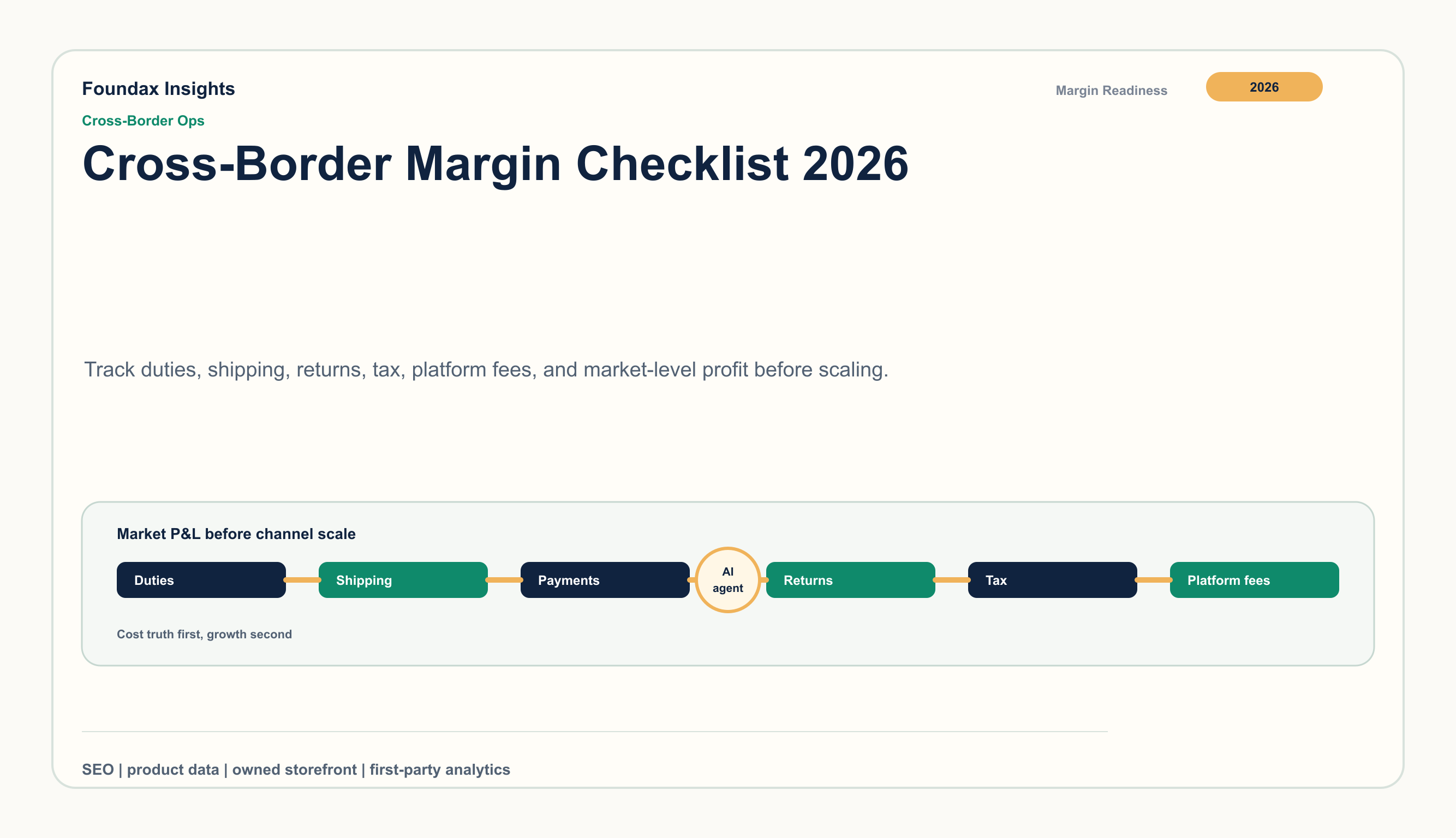
Cross-border margin work in 2026 starts with a different question. The issue is no longer whether a product can be shipped internationally. The issue is whether each market still works after duties, shipping, payment, returns, tax, localization, and platform rules are placed into the same SKU-level profit view.
The pressure is concrete. The US suspended de minimis treatment for goods from China and Hong Kong in 2025 and then expanded the suspension to low-value goods from all origins. Avalara notes that the temporary postal specific-duty option ended on February 28, 2026, leaving ad valorem duty as the ongoing method for international postal shipments. In the EU, the Council approved the removal of the duty relief threshold for goods under EUR 150 and introduced a temporary EUR 3 customs duty for low-value small-parcel items from July 1, 2026 to July 1, 2028. The Council cited 4.6 billion low-value packages entering the EU in 2024, with more than 91% originating from China.
That turns margin management into an operating discipline. A DTC team needs one view that connects product cost, landed cost, storefront price, policy, fulfillment path, platform fees, and actual contribution margin by market.
The 2026 Margin Model
A simple revenue-minus-product-cost spreadsheet is too thin for cross-border decisions. Use a market P&L that answers six questions before increasing spend:
Which sales should stay on platform and which should move to owned channels?
1. Duties Are Now a SKU-Level Cost
For US-bound orders, the old low-value parcel assumption is no longer a safe planning shortcut. A seller needs the HTS code, country of origin, declared value, and shipment method for each SKU. Operational guides may estimate additional entry, bond, classification, or brokerage costs, but those figures should be treated as scenarios. The publishable operating rule is simpler: every SKU needs a landed-cost model that can update when duty treatment or carrier handling changes.
For EU-bound low-value orders, the temporary EUR 3 customs duty is applied by item category or tariff subheading. That means the effect can depend on basket composition, not only order value. A multi-item order across several categories can carry more duty than a single-category order with the same subtotal.
Checklist:
Assign HTS/HS codes to top SKUs before scaling paid traffic.
Track origin by SKU, not only by supplier.
Model US and EU duty separately.
Review low-price bundles because category mix can change duty exposure.
Keep duty assumptions beside price, not buried in a finance spreadsheet.
2. Shipping Margin Depends on Packaging, Promise, and Return Path
Shipping cost is rarely one number. The same item can have different economics under postal, express, regional carrier, and local warehouse paths. Dimensional weight can make a low-cost item expensive to ship if packaging is bulky. A fast delivery promise can improve conversion while removing the margin that made the market attractive.
The useful comparison is not cheapest carrier versus fastest carrier. It is contribution margin after the delivery promise that shoppers actually see. If a market needs express delivery to convert, the product page price should already include that reality.
Checklist:
Compare at least two fulfillment paths for each priority market.
Record actual billed weight and dimensional weight after fulfillment, not only catalog weight.
Separate first-order shipping economics from repeat-order economics.
Add a return path to the model before launch.
Rewrite delivery copy when the margin model cannot support the promise.
3. Payments and Currency Can Quietly Move the Break-Even Point
Payment cost is part processor fee, part currency spread, part local method mix, and part dispute risk. A market can look profitable in USD and weaker after local currency settlement, refund handling, and chargebacks.
For DTC brands, this is also a conversion issue. A buyer who sees local currency, familiar payment options, clear tax treatment, and predictable delivery is more likely to complete checkout. The right question is whether local checkout improves conversion enough to pay for its operational complexity.
Checklist:
Calculate effective payment cost by market after FX spread.
Track refund cost in the currency where the customer paid.
Compare card, wallet, and bank-transfer options where they affect conversion.
Watch chargeback reasons for delivery confusion or policy gaps.
Keep payment method decisions tied to market-level margin, not only checkout preference.
4. Returns Turn Policy Into Margin
Returns are expensive in cross-border commerce because the cost is operational and trust-related at the same time. International return shipping can exceed product margin. Inspection and resale may require a local partner. Refund windows can be shaped by marketplace or consumer rules. TikTok Shop's US return and refund policy, updated May 13, 2026, documents seller review windows, auto-approval paths, and cases where refunds can be charged to the seller when the platform decides in favor of the customer.
The margin model should connect product content to returns. If sizing, compatibility, materials, delivery windows, or policy text are unclear, returns are not only an after-sales problem. They are a product-page quality problem.
Checklist:
Identify SKUs with high fit, sizing, compatibility, or damage risk.
Add size guides, specs, material details, care notes, and delivery expectations to PDPs.
Decide which returns go to local inspection, central warehouse, donation, or write-off.
Model marketplace refund rules separately from owned-store refunds.
Review return reasons monthly and turn them into product-page improvements.
5. Tax and Compliance Need a Launch Sequence
VAT, GST, sales tax, IOSS, customs classification, and platform collection rules can overwhelm a small team if every market is treated as equal. The better approach is sequencing: start with markets that justify compliance work through revenue potential, brand fit, and operational repeatability.
DTC websites make this more visible because the brand controls product pages, policy pages, checkout messaging, and first-party measurement. That control creates responsibility, but it also gives the team better data for deciding where compliance investment is worth it.
Checklist:
Rank markets by revenue potential and compliance complexity.
Decide whether tax display should be tax-inclusive or calculated at checkout.
Document who owns VAT/GST registration, filing, and invoice requirements.
Align checkout messages with policy pages.
Recheck assumptions before seasonal campaigns or new-market launches.
6. Platform Fees Belong in the Same Model as Owned-Store Costs
Marketplace sales can still be valuable. They provide demand, trust, search behavior, and conversion infrastructure. But fees, deposits, refund rules, advertising, and seller-policy changes belong in the same market P&L as owned-store costs.
Marketing4Ecommerce reported that TikTok Shop commission in Germany, Spain, France, Italy, and Ireland increased from 5% to 9% from January 8, 2026, with some category and new-seller variations. Whether a seller uses TikTok Shop, Amazon, Temu, or another platform, the lesson is the same: platform economics can change faster than product margin.
Checklist:
Calculate effective take rate by platform, category, and market.
Separate commission, ads, fulfillment, deposits, and refund losses.
Compare platform contribution margin with owned-store contribution margin.
Use marketplaces for discovery where they work, but build brand search and owned customer relationships in parallel.
Review platform economics monthly, not only when policy changes are announced.
Where Foundax Fits
Foundax is useful when margin work needs to connect public pages with operating data. Teams can manage product records, localized pages, SEO metadata, sitemap and hreflang, Product JSON-LD on PDPs, Content Studio articles, Google Search Console and Merchant Center checks workflows, and first-party analytics in one operating path.
The practical benefit is consistency. Product facts, policy notes, localized content, Google workflows, and performance signals are easier to compare when they live in the same workflow. That helps teams see whether a margin problem comes from border cost, shipping promise, weak product content, channel cost, or measurement gaps.
FAQ
What is the first cost to check before entering a new market?
Start with landed cost by SKU: product cost, duty, shipping, tax handling, payment cost, and expected return path. If this view is weak, traffic and localization decisions will be based on incomplete margin.
How often should cross-border margins be reviewed?
Review top SKUs monthly and before any major promotion, platform policy change, carrier change, or new-market launch. Duty, shipping, FX, and platform fees can move faster than annual planning cycles.
Should every market get a localized storefront?
Prioritize markets where search demand, conversion potential, compliance workload, and margin can justify the work. Localization is strongest when it includes product facts, policy clarity, currency, shipping expectations, and support paths, not only translated copy.
How should DTC brands use marketplaces in this model?
Use marketplaces where they create efficient discovery or conversion, then compare their effective take rate with owned-store economics. The goal is channel clarity: know which products belong on platform, which should move to DTC websites, and which need price or fulfillment changes.
How does Foundax help with margin visibility?
Foundax connects storefront pages, product data, SEO/GMC preflight, localized content, and first-party analytics. That makes it easier to see whether a margin issue is caused by product facts, public content, channel data alignment, fulfillment assumptions, or measurement gaps.