Cross-Border Ecommerce Shipping, Tax, and Payment Readiness Checklist
A practical launch checklist for DTC teams entering new markets: delivery promises, duties, tax ownership, payment trust, returns, and market-level analytics.
Read more
Map out your international payment processing strategy with this decision framework. Understand the structural requirements for accepting international payments online, from verifying business entities to selecting the right cross-border ecommerce payments stack for your target regions.
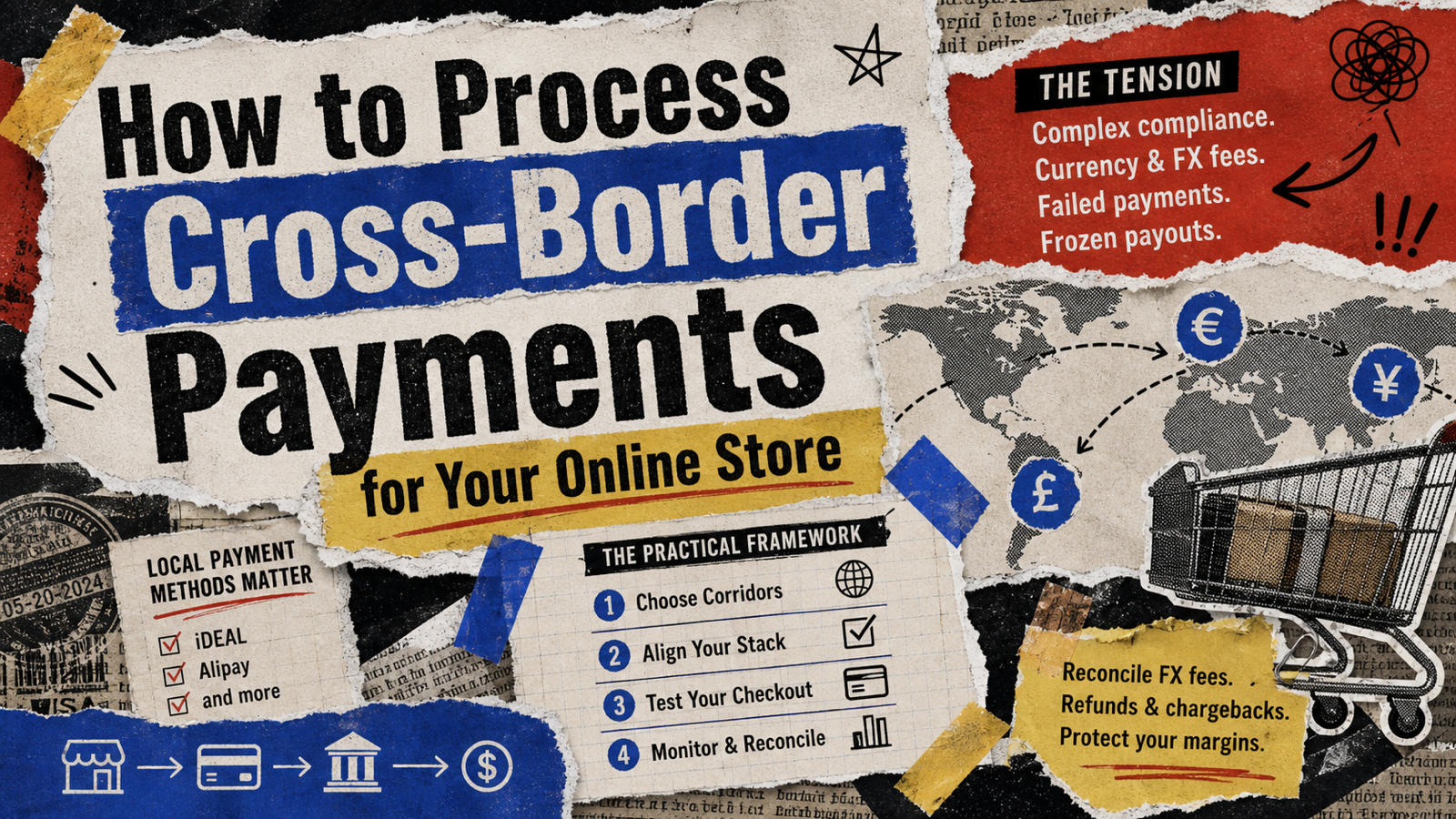
Selling internationally requires moving beyond a simple global shipping toggle. Cross-border payments involve currency conversion, intermediary routing, jurisdiction-specific compliance, and fluctuating foreign exchange (FX) fees. According to the Financial Stability Board's late-2025 progress report, global cross-border payment costs remain sticky and transparency is often uneven. Relying on default domestic settings for international checkouts will likely result in high cart abandonment, failed transactions, or frozen payouts.
To successfully process international payments, you must map a deliberate path from your target corridors to your final bank settlement, verifying that your legal identity, payment processor, and banking infrastructure are perfectly aligned.
A payment provider might excel at clearing domestic US credit cards but struggle with Southeast Asian digital wallets, or apply aggressive FX markups on specific currencies. Start by defining your target corridors (the buyer's country and currency) and verifying your provider's specific capabilities for those regions.
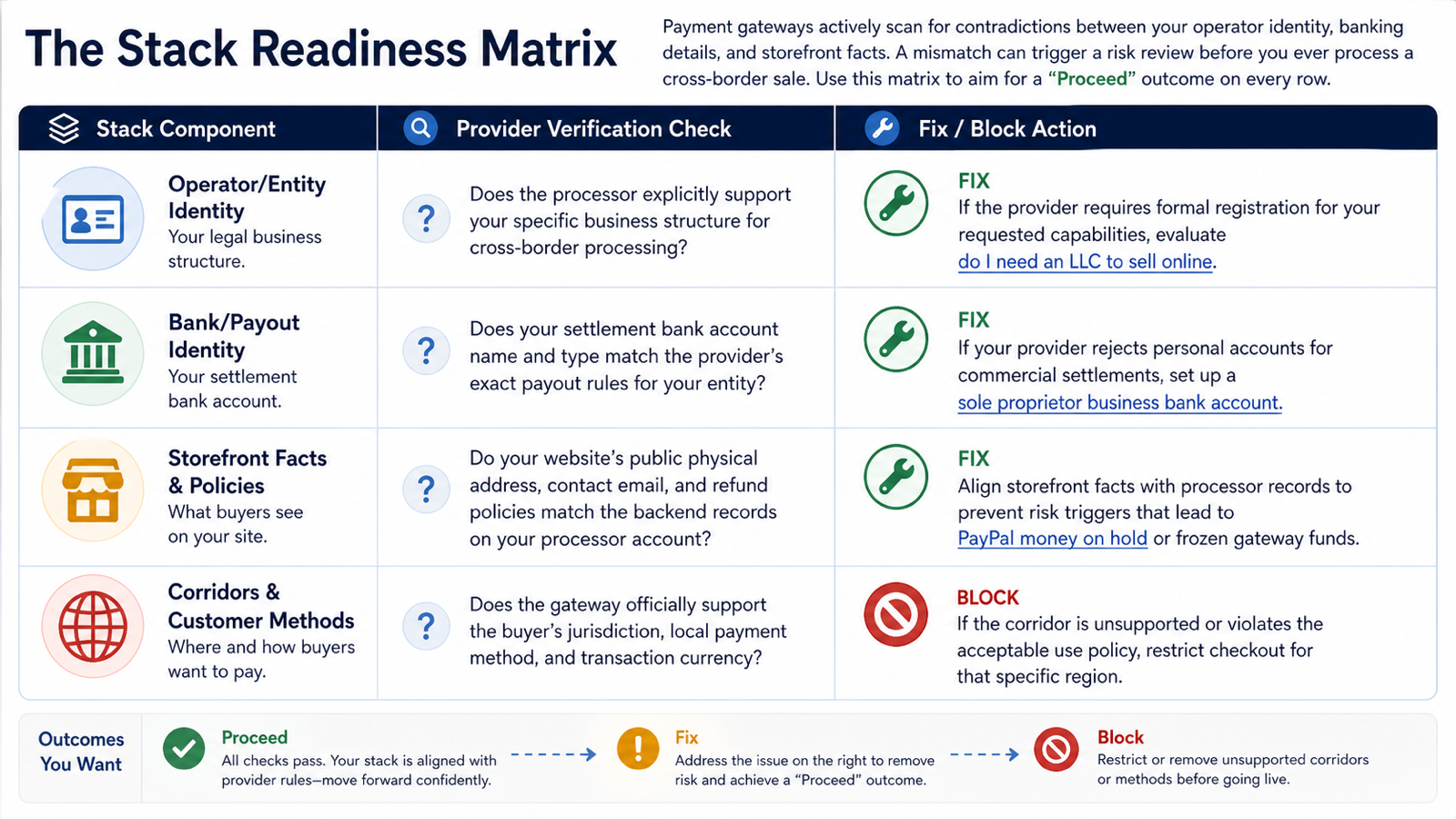
Payment gateways actively scan for contradictions between your operator identity, banking details, and storefront facts. A mismatch can trigger a risk review before you ever process a cross-border sale. Use this readiness matrix to evaluate your stack against your provider's current underwriting rules, aiming for a "Proceed" outcome on every row.
| Stack Component | Provider Verification Check | Fix / Block Action |
|---|---|---|
| Operator/Entity Identity | Does the processor explicitly support your specific business structure for cross-border processing? | Fix: If the provider requires formal registration for your requested capabilities, evaluate do I need an LLC to sell online. |
| Bank/Payout Identity | Does your settlement bank account name and type match the provider’s exact payout rules for your entity? | Fix: If your provider rejects personal accounts for commercial settlements, set up a sole proprietor business bank account. |
| Storefront Facts & Policies | Do your website's public physical address, contact email, and refund policies match the backend records on your processor account? | Fix: Align storefront facts with processor records to prevent risk triggers that lead to PayPal money on hold or frozen gateway funds. |
| Corridors & Customer Methods | Does the gateway officially support the buyer’s jurisdiction, local payment method, and transaction currency? | Block: If the corridor is unsupported or violates the acceptable use policy, restrict checkout for that specific region. |
Once your stack is aligned, configure your checkout environment. Enable local currency presentment and specific local payment methods only after verifying the associated foreign exchange markups and settlement fees.
Before launching, validate your setup through a strict, provider-approved testing sequence rather than simply toggling a checkout UI on. Do not use a VPN to spoof your location or attempt to bypass processor controls.
Cross-border operations require active monitoring of the post-transaction lifecycle.
Yes, relying solely on default domestic settings or standard US credit card processors will likely lead to high cart abandonment, as buyers expect familiar localized options like iDEAL in the Netherlands or Alipay in China. You must ensure your setup accommodates these preferences to prevent failed transactions. Evaluate your target buyer countries and verify that your payment gateway's directory explicitly supports presenting prices and accepting the localized payment methods expected in those specific regions.
Payment processors actively scan for mismatches between your business identity, bank details, and storefront facts, which can trigger a risk review before you process a single cross-border sale. To avoid this, your public physical address, contact email, refund policies, and payout bank account type must perfectly match the backend records and underwriting rules of your processor account. Audit your website's public policies and contact details against your payment gateway's backend records to confirm exact alignment today.
No, you should never use a VPN to spoof your location or attempt to bypass processor controls when testing cross-border transactions. Proper validation requires following your provider's approved protocols. Run a full sandbox testing sequence using your processor's documented test mode and approved test payment instruments to safely simulate transactions, intentional failures, and refunds.
Cross-Border Ecommerce Shipping, Tax, and Payment Readiness Checklist