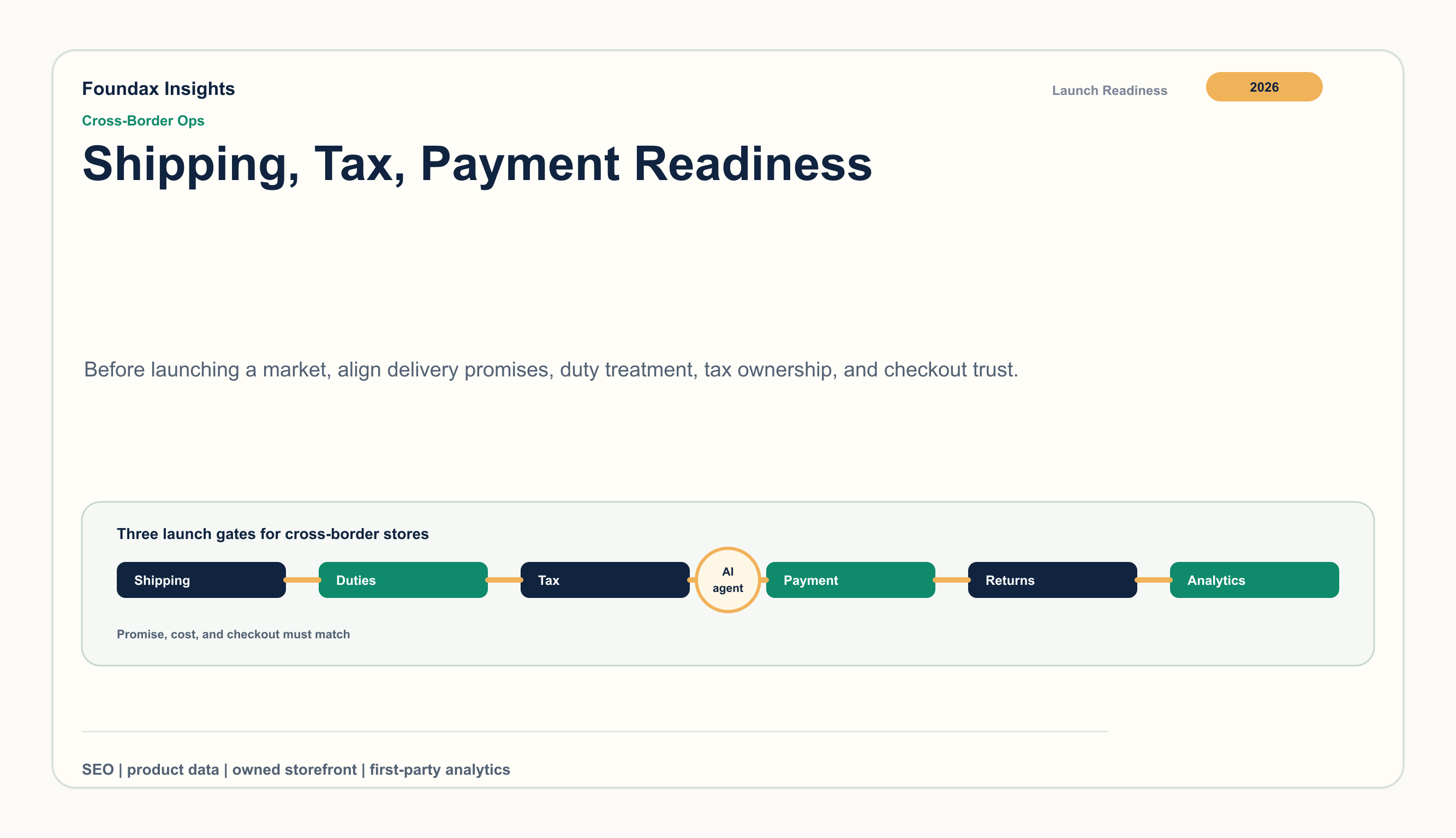
Cross-Border Ecommerce Shipping, Tax, and Payment Readiness Checklist
A practical launch checklist for DTC teams entering new markets: delivery promises, duties, tax ownership, payment trust, returns, and market-level analytics.
International launch risk usually appears at checkout and after purchase, not in the campaign plan. A product page may translate well, ads may find demand, and the first orders may arrive. Then the real questions start: Can the brand keep the delivery promise? Who pays duties? Is tax handled correctly? Does the customer recognize the payment method? What happens if the parcel is refused?
In 2026, those questions matter more because low-value parcel economics have changed. The US de minimis suspension now affects low-value goods from all origins, and Avalara notes that the temporary postal specific-duty option ended on February 28, 2026. In the EU, the Council and Commission describe a temporary EUR 3 customs duty on low-value small-parcel items from July 1, 2026 to July 1, 2028, alongside the removal of threshold-based duty relief for goods under EUR 150.
That makes shipping, tax, and payment setup a launch gate, not a back-office detail.
The Three Launch Gates
Before entering a new market, run three readiness gates in order:
Gate
Core question
What breaks if it is weak
Shipping promise
Can the brand deliver what the page says?
refusals, support tickets, refund pressure
Tax and duty ownership
Who calculates, pays, displays, and records border cost?
surprise charges, wrong prices, weak margin
Payment trust
Can the buyer pay in a familiar and low-friction way?
checkout abandonment, FX confusion, disputes
Gate 1: Shipping Promise
A cross-border shipping plan should start from the customer promise and work backward. The useful promise is not simply fast delivery. It is a promise the margin model can support.
Check five things before launch:
Delivery window by market. Separate economy, standard, and express timelines. Do not use one global shipping statement for every country.
Tracking coverage. Confirm whether the customer gets end-to-end tracking or only first-mile tracking. Support volume changes when tracking is incomplete.
DDP or DAP messaging. If duties are prepaid, say so. If the buyer may pay on delivery, explain it before checkout completion.
Return path. Decide whether returns go to a local address, central warehouse, inspection partner, write-off path, or refund-only policy for low-value goods.
Policy-page alignment. Product page, checkout, shipping policy, and post-purchase email should describe the same delivery reality.
Readiness signal: a customer should be able to understand delivery time, duty handling, and return responsibility before clicking the final payment button.
Gate 2: Tax and Duty Ownership
Tax and duty readiness is a decision about ownership. A team needs to know which costs are included in price, which are collected at checkout, which are paid at import, and which are only estimated.
For the US, low-value goods under the former de minimis threshold can now be subject to applicable duties. The exact cost depends on product classification, origin, value, and entry path. Scenario guides may estimate entry, classification, or brokerage costs, but those figures should stay inside planning models unless confirmed for the brand's lane and product type.
For the EU, the temporary EUR 3 duty applies to low-value consignments by item category or tariff subheading during the transitional period. That means a brand needs product classification at the SKU level, not only a broad category label.
Check five things before launch:
Product classification. Assign HTS/HS codes to priority SKUs.
Origin data. Store origin by SKU and supplier batch where relevant.
Duty display. Decide whether estimated duties appear in price, checkout, or delivery notice.
Tax workflow. Identify who owns VAT/GST, sales tax, IOSS, invoices, and filing support.
Readiness signal: the team can explain how a product's public price connects to landed cost and tax handling in each launch market.
Gate 3: Payment Trust
Payment readiness is not a long list of every local method. It is a trust and conversion decision. Buyers need to recognize the currency, understand the final amount, and complete payment without feeling that the store is foreign to them.
Check five things before launch:
Currency clarity. Show the buyer-facing currency consistently from PDP to checkout.
Payment method fit. Enable the methods that materially affect conversion in the target market, rather than every method available from the processor.
Refund currency. Make sure refund handling matches the currency and payment method used by the buyer.
Fraud review path. Decide which high-value or first-time orders need manual review.
Analytics events. Track payment abandonment, failed payment reasons, refund reasons, and chargeback themes by market.
Readiness signal: checkout data can tell whether buyers are abandoning because of shipping cost, tax surprise, payment method friction, or trust gaps.
A Practical Pre-Launch Checklist
Run these checks before opening a new market:
Top SKUs have HTS/HS classification and origin data.
Shipping policy, checkout, and post-purchase messages use the same delivery promise.
DDP/DAP handling is visible before payment.
Tax ownership is documented for VAT/GST, sales tax, IOSS, and invoices.
Local currency display is consistent.
Key payment methods are enabled only where they support conversion.
Refund and return paths are economically modeled.
Market-level analytics can separate shipping, tax, payment, and return friction.
Where Foundax Fits
Foundax helps when launch checklist needs to connect storefront content with operating signals. Teams can manage product records, localized pages, SEO metadata, sitemap and hreflang, PDP Product JSON-LD, Content Studio, Google workflows, and first-party analytics in one workflow.
For shipping, tax, and payment setup, the value is consistency: product pages, policy pages, checkout expectations, content, and measurement can be reviewed together instead of living in separate documents and tools.
FAQ
Should a DTC brand use DDP or DAP for cross-border orders?
DDP usually creates a clearer customer experience because duties are handled before delivery. DAP can be useful when duty exposure is too variable, but it needs clear pre-checkout messaging so the buyer is not surprised at delivery.
What should be checked before enabling a new market?
Check SKU classification, origin, delivery window, duty display, tax ownership, local currency, payment methods, return path, and market-level analytics. These are launch gates, not post-launch cleanup tasks.
How do tax changes affect storefront content?
Tax and duty changes affect price explanations, checkout copy, policy pages, shipping messages, and sometimes product-page FAQs. If content is not updated, customers may see one promise before purchase and a different cost after purchase.
How should teams choose local payment methods?
Start with the methods that remove real checkout friction in the target market. Avoid adding every possible method if the team cannot support refund, fraud, and reconciliation workflows for them.
How does Foundax support cross-border readiness?
Foundax connects product data, localized pages, SEO metadata, Google workflows, content, and first-party analytics. That makes it easier to identify whether launch friction comes from shipping promises, tax handling, payment methods, or content gaps.