AI Website Builder Maintenance: What Happens After Launch?
AI can generate a website quickly, but ecommerce teams still need ownership for content updates, product data, checkout, analytics, SEO, localization, and operational maintenance.
Read more
A practical framework for separating fast AI storefront generation from the operating layer that keeps product data, SEO, feeds, localization, content, and analytics aligned after launch.
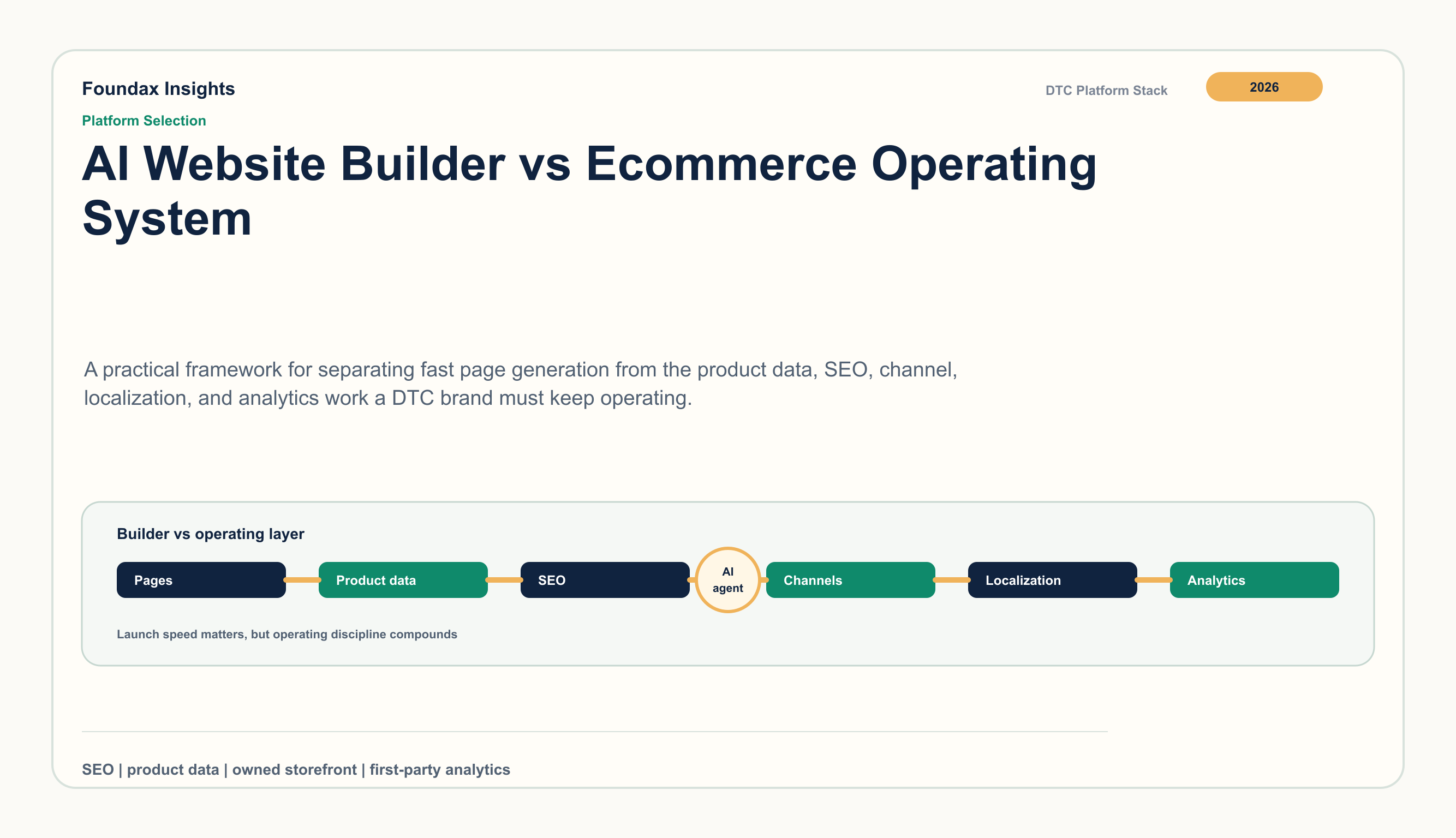
AI website builders changed the starting line for ecommerce teams. A founder can describe a product line, pick a visual direction, generate a first storefront, and show a working draft before the week is over. a16z described the same shift in its February 11, 2025 analysis of AI web app builders: tools such as Bolt, Lovable, and v0 have moved more of the work from code-first implementation into prompt-driven creation.
That speed is useful. The mistake is treating the first generated storefront as the whole ecommerce business. A DTC store becomes expensive after launch because product facts, pages, search metadata, merchant feeds, campaigns, localized copy, and reporting have to stay consistent while the business keeps changing.
The more useful question is no longer, "Can this tool make pages?" It is, "Can this system keep the store coherent after products, channels, markets, and acquisition loops start moving?"
A generated storefront solves presentation. It gives shoppers somewhere to land, learn, browse, and start checkout. For a test campaign, that may be enough. For a brand that expects organic discovery, paid traffic, repeat customers, international markets, and catalog growth, the storefront is only one surface of a larger operating model.
A normal month creates work that a page generator does not automatically own:
A builder can help with the visible page. An ecommerce operating system has to keep product facts, SEO metadata, structured data, merchant feeds, localized content, and measurement from drifting apart.
Most teams do not feel the limitation on launch day. They feel it when the second workflow begins.
Product data gets copied into too many places. The PDP has one description, the feed has another field set, ad campaigns use another naming convention, and analytics reports use a fourth label. Small catalog edits turn into reconciliation work.
SEO becomes a workflow, not a form. Title and description fields are only the entry point. The store also needs canonical paths, indexability rules, Product JSON-LD, image handling, sitemap updates, and Search Console diagnostics.
Content stops being launch copy. Buying guides, comparison pages, FAQs, category copy, return policies, and localized PDP sections need to change when inventory, positioning, markets, or customer objections change.
Localization becomes market operations. Translation alone does not answer sizing expectations, payment habits, shipping assumptions, address formats, policy language, or local search intent.
Measurement fragments. GA4, ad pixels, first-party events, Search Console, Merchant Center, and revenue reports can all describe different versions of the business if product and campaign identifiers are not preserved across the funnel.
| Decision area | Builder-first mindset | Operating-system mindset |
|---|---|---|
| Launch | How fast can we generate a storefront? | How quickly can we publish without creating future data debt? |
| Product data | Product copy appears on PDPs | Product facts feed PDPs, structured data, merchant feeds, localization, and analytics |
| SEO | Fill title and description once | Manage canonical paths, sitemap, Product JSON-LD, indexability, and search diagnostics |
| Content | Generate launch copy | Maintain buying guides, FAQs, comparison pages, policies, and localized updates |
| Channels | Add integrations when a channel asks | Check whether page data, feed data, and campaign measurement share the same source of truth |
| Markets | Translate the interface | Adapt product facts, policies, currency, shipping expectations, and search intent by market |
| Analytics | Install tracking scripts | Preserve a measurable funnel from landing page to product view, cart, checkout, and repeat purchase |
The useful test is not whether a product calls itself a builder, platform, CMS, or operating system. The useful test is what happens when the first page is no longer enough.
Google's Product structured data documentation explains that product pages can expose price, availability, reviews, shipping, and returns in richer Search experiences. Merchant Center's product data specification pushes the same requirement from the feed side: product information has to be accurate, correctly formatted, and consistent with the landing page.
The agentic commerce trend raises the stakes. Google introduced Universal Commerce Protocol work for agentic commerce in January 2026, and Shopify's agentic commerce materials also emphasize structured product data as the substrate agents use to understand products. Whether a brand sells through a platform, a DTC site, or both, product facts have to be current, specific, and machine-readable.
This does not make the visual storefront less important. It makes the storefront more dependent on the operating layer behind it. Beautiful pages with weak product data are difficult to scale. Plainer pages with disciplined product facts can keep improving.
Foundax is strongest for DTC teams that want fewer handoffs between the public store and the operating work behind it. The practical value is not that every workflow becomes effortless. The value is that product data, page publishing, SEO configuration, Product JSON-LD, Google Merchant Center preflight and sync, Search Console workflows, multilingual content, Content Studio, and first-party analytics can be managed as connected parts of the same store operation.
That matters because the real cost is often coordination. When product, content, SEO, localization, and measurement live in separate tools, the team spends too much time comparing states instead of improving the store. A connected operating layer gives the team a cleaner sequence: update the facts, publish the right surface, check the channel, measure the result, then improve the next version.
Choose a builder-first tool when you are validating a concept, have a small catalog, do not yet depend on organic search, and can tolerate manual cleanup after launch.
Choose an operating-system approach when the store already has multiple products, multiple acquisition channels, localized pages, Merchant Center requirements, content workflows, or a team that needs repeatable publishing and reporting.
The decision is not ideological. It is about where the work goes after the homepage exists. If the answer is spreadsheets, plugins, and one-off fixes, a cheap launch can become an expensive operating model.
It can support early validation. Once product data, SEO, Merchant Center, localization, content updates, and analytics affect revenue, the team needs a stronger operating layer.
It is the connected workflow that keeps product records, storefront pages, SEO metadata, structured data, merchant feeds, localized content, and analytics aligned after launch.
Search, shopping surfaces, merchant feeds, and AI-assisted discovery all rely on clear product facts. Prices, availability, identifiers, images, and policies have to stay consistent across public pages and channel data.
Foundax helps when a team wants storefront publishing, product data, SEO, Product JSON-LD, GMC checks, Search Console workflows, multilingual content, and analytics to live in one connected operating layer.
Early experiments can prioritize speed. Brands that rely on search, paid traffic, repeat purchase, multi-market pages, or catalog growth should evaluate operating depth before choosing a long-term platform.