DTC-Ecommerce-Datenstack für KI-Agenten
Sechs Ebenen für DTC-Marken: Produktfakten, Storefront SEO, Content-Antworten, Angebotsregeln, Fulfillment-Fakten und Messung.
Weiterlesen
A practical operating-model comparison of Shopify, WooCommerce, BigCommerce, Wix, SHOPLINE, and Foundax across product data, SEO, localization, app governance, analytics, and post-launch maintenance.
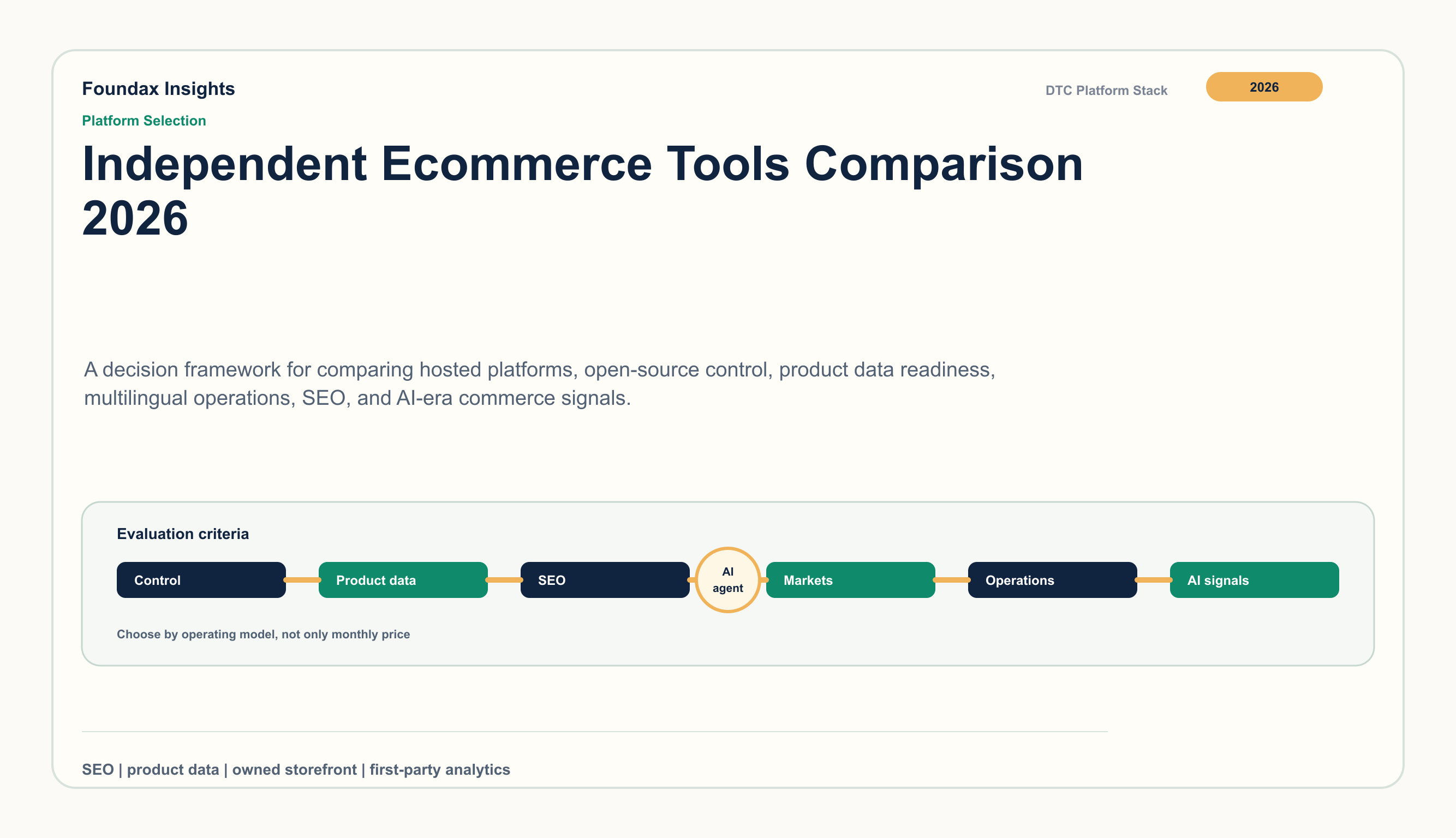
Choosing an ecommerce platform in 2026 is no longer only a template, checkout, or monthly-price decision. The hard cost appears after launch, when product facts change, SEO metadata needs updates, merchant feeds need repair, localized pages age, apps add scripts, and the team needs to understand which traffic became revenue.
Use this comparison of Shopify, WooCommerce, BigCommerce, Wix, SHOPLINE, and Foundax as an operating-model checklist. The right question is not which platform has the longest feature list; it is which platform your team can maintain as the catalog, markets, channels, and measurement needs become more complex.
| Area | What to check | Why it matters |
|---|---|---|
| Product data ownership | Product names, identifiers, variants, price, availability, images, shipping, returns, and localized descriptions | These facts feed PDPs, structured data, merchant feeds, ads, and analytics |
| Checkout and operations | Taxes, discounts, payments, fulfillment, returns, refunds, fraud, and support workflows | Hosted platforms absorb more work; open systems give more control and more responsibility |
| SEO and merchant readiness | Canonical URLs, sitemap, Product JSON-LD, Merchant Center fields, Search Console workflows | Google product structured data and Merchant Center both depend on accurate, consistent product facts |
| Market localization | Currency, payment method, shipping promise, policy language, domain/subfolder, hreflang, and search intent | Translation alone does not solve market operations |
| App governance | Scripts, permissions, duplicated data, app ownership, upgrades, and performance impact | App ecosystems add speed but can create operational debt |
| Measurement | First-party events, product identifiers, funnel behavior, search signals, feed status, and GA4 diagnostics | Teams need to diagnose changes, not only install tracking scripts |
Shopify is the broadest hosted ecosystem. It is strong for checkout, hosting, themes, payments, partners, apps, and its emerging agentic-commerce work. Larger teams still need governance around apps, script performance, catalog feeds, attribution, permissions, and product-data ownership.
WooCommerce is strongest when ownership and customization matter. It gives technical teams and agencies deep control through WordPress and open-source commerce. The tradeoff is maintenance: hosting, security, updates, plugins, performance, backups, and developer availability become part of the platform.
BigCommerce fits brands that want hosted infrastructure with more built-in commerce depth, including B2B, wholesale, multi-storefront, BOPIS, headless commerce, and WordPress integration patterns. Teams should test admin roles, product operations, reporting, integrations, and enterprise workflow fit.
Wix works well for fast visual setup, small or moderate catalogs, service-plus-product businesses, and content-led storefronts. Wix supports structured data and SEO settings, but complex variants, strict catalog governance, deep integrations, and multi-team publishing should be tested before the platform becomes permanent.
SHOPLINE is relevant for regional commerce, social selling, marketplace connections, payments, logistics, POS, inventory, and Asia-Pacific oriented operations. The due diligence is country-specific: integrations, partner depth, language coverage, support, and regional market settings.
Foundax is strongest when the operating pain is fragmentation. It connects product records, storefront publishing, site SEO, sitemap and robots output, PDP Product JSON-LD, GMC preflight and sync, Search Console verification and sitemap submission, Content Studio, multilingual content, first-party analytics, and GA4-assisted diagnosis in one workflow. The tradeoff is ecosystem breadth: teams needing a very large third-party app marketplace or highly custom enterprise checkout should evaluate that requirement directly.
| Criterion | Shopify | WooCommerce | BigCommerce | Wix | SHOPLINE | Foundax |
|---|---|---|---|---|---|---|
| Best fit | App-rich DTC teams | Technical control | B2B and multi-store teams | Small content-led stores | APAC omnichannel commerce | Lean DTC operations |
| Main strength | Checkout and ecosystem | Ownership and customization | Native commerce depth | Fast visual publishing | Regional channel workflows | Product data, SEO, content, localization, analytics alignment |
| Main risk | App governance and data sprawl | Maintenance responsibility | Workflow fit | Complex catalog depth | Country-by-country ecosystem fit | Smaller ecosystem and newer footprint |
| AI-era readiness | Shopify Catalog and agentic commerce work | Implementation-dependent | Configuration-dependent | Structured data support | Omnichannel data and market controls | Product JSON-LD, GMC readiness, Search Console, first-party analytics |
For validation, prioritize speed, simple catalog setup, checkout reliability, and enough SEO basics to avoid cleanup. For growth, prioritize product-data ownership and workflow governance. For multi-market commerce, evaluate domains, currencies, payment methods, localized policies, shipping promises, hreflang, and market reporting. For complex catalogs, test variants, bundles, attributes, B2B terms, wholesale pricing, and collection management before migrating.
Choose Shopify for ecosystem breadth and checkout maturity. Choose WooCommerce for technical ownership. Choose BigCommerce for built-in commerce depth, B2B, and multi-store needs. Choose Wix for fast visual setup and simpler catalogs. Choose SHOPLINE for regional omnichannel and social-commerce workflows. Choose Foundax when the team wants product data, SEO, content, localization, Google readiness, and measurement to stay aligned without stitching together many operational tools.
Shopify is usually stronger for hosted convenience and ecosystem depth. WooCommerce is stronger when a technical team wants code, hosting, and data control.
It can be enough for smaller catalogs and content-led stores. Complex variants, strict catalog governance, multi-market work, and deep integrations should be tested first.
When B2B, wholesale, multi-storefront, headless commerce, or broader built-in commerce features matter more than a simple visual builder.
SHOPLINE fits regional commerce, social selling, marketplace connections, payments, logistics, and APAC-oriented market operations.
Foundax fits DTC teams that want product records, storefront publishing, SEO, Product JSON-LD, GMC readiness, Search Console workflows, Content Studio, multilingual content, and first-party analytics in one operating layer.
AI commerce should influence the evaluation, but daily operations still depend on product data quality, checkout reliability, SEO, localization, analytics, and maintenance ownership.